

You've walked past it dozens of times. Metal machines standing in the park, someone doing what looks like a workout. You've wondered: "How do you use those? Will I look stupid if I try? Can you even get a real workout there?" The answer to all three: yes you can, no you won't, and this guide will teach you everything. An outdoor gym is one of the best places for a beginner to start training — free, low-pressure, and surprisingly versatile.
How I Got Started at an Outdoor Gym
I didn't begin my training journey at an indoor gym. I started at an outdoor gym — and it was the best decision I could have made.
In 2016, at 19 years old, I was too intimidated to walk into a gym. It felt like a scary place: big people, strange equipment, and the feeling that everyone was watching. But a new outdoor gym had just opened in the nearby park. I could go there at seven in the morning without anyone seeing.
The first session was chaotic. I sat in the chest press facing the wrong way (yes, it's possible). I pulled the lat pulldown with my whole body rather than my back. And on the leg press, I used such a light weight that it barely registered.
But you know what was great? Nobody cared. An outdoor gym has no mirrors, no crowds, no feeling of someone waiting for the machine. It was my own quiet place to learn.
After a month, I knew how to use every piece of equipment. After two months, I saw the first results. After six months, I was ready to move to an indoor gym — but I didn't want to. The outdoor gym had become my favorite place.
Now, ten years later, I still go to an outdoor gym every summer. And this guide is written for you — the person who's exactly where I was back then, curious but uncertain.
"The best gym is the one you actually go to. An outdoor gym is free, always open, and nobody stares. It's the perfect place to start." – Pietari Risku, Founder of Tsemppi
Table of Contents
- Why is an outdoor gym a great place to start?
- What does an outdoor gym have?
- Before your first session — preparation
- Every machine explained for beginners
- First training program (4 weeks)
- Second training program (weeks 5–8)
- Third training program (weeks 9–12)
- Bodyweight exercises when no machines are available
- Technique tips for beginners
- Most common mistakes and how to avoid them
- Warm-up and cool-down
- Nutrition and recovery for beginners
- When to move to an indoor gym?
- FAQ
- Summary
Why Is an Outdoor Gym a Great Place to Start?
Many beginners struggle with gym anxiety. An outdoor gym significantly lowers that barrier.
Benefits for Beginners
| Benefit | Why it matters for beginners |
|---|---|
| Free | No monthly fee, no commitment — try it risk-free |
| Open 24/7 | Train whenever you want — morning, evening, weekend |
| No queues | Especially in the early morning and evening, often empty |
| Relaxed atmosphere | No mirrors, no "stares," none of the indoor gym tension |
| Guided movement paths | Weight stack machines guide the movement safely |
| Fresh air | Proven to improve mood and training motivation (Thompson Coon et al., 2011) |
| Vitamin D | Natural sunlight — especially valuable in northern countries |
| Short commute | Most people have a park nearby — no need to drive |
Research-Backed: Outdoor Exercise Is Good for the Mind
Studies show that exercising outdoors improves mood, reduces stress, and increases enjoyment compared to indoor training (Thompson Coon et al., 2011). Many people find training more enjoyable outside — and enjoyment is the key to consistency, especially early on.
Who Is the Outdoor Gym Especially Suited For?
- People who have never trained — safe and calm starting point
- Those with gym anxiety — no social pressure
- Those on a tight budget — €0 per month
- Those who want to train in summer — best season from May through September
- Outdoor enthusiasts — combines exercise and nature
What Does an Outdoor Gym Have?
Outdoor gyms vary in what they offer, but in most cities and towns you'll find increasingly quality equipment.
Three Types of Outdoor Gyms
1. Well-equipped (weight stack machines + pull-up rig)
These have adjustable weight stack machines (5–95 kg), a pull-up rig (pull-ups, dips), and often a log rack. Practically an indoor gym outside.
Found in: Large cities, well-funded parks
2. Basic (a few machines + rig)
A basic chest press, lat pulldown, leg press, and pull-up rig. More than enough for a complete workout.
Found in: Most medium-sized towns
3. Minimal (light resistance machines or just a bar)
Light machines with fixed resistance or just a pull-up bar and benches. Requires more reliance on bodyweight exercises.
Found in: Smaller towns, older installations
How to Find Out What Your Local Gym Has
- Google Maps: Search "outdoor gym" + your city
- City website: Most municipalities list outdoor gym locations
- Visit in person: The best way — you can see and try the equipment
- Tsemppi app: You can log exercises regardless of where you train
Read the best outdoor gyms guide for a more detailed overview.
Before Your First Session — Preparation
What to Bring?
| Item | Essential? | Why |
|---|---|---|
| Athletic clothing | ✅ Yes | Comfortable, flexible clothes |
| Water bottle | ✅ Yes | Hydration |
| Training shoes | ✅ Yes | Supportive sole — not sandals |
| Towel | Recommended | For wiping benches and sweat |
| Hand sanitizer | Recommended | Clean hands after training |
| Resistance band | Optional | For assisted pull-ups and extra exercises |
| Training gloves | Optional | If bars feel rough or cold |
| Headphones | Optional | Music helps — but stay aware of your surroundings |
Best Time for Your First Visit
Weekday mornings (7–9) or weekday evenings (after 18:00) are the quietest times. Weekend mornings are often completely empty. Avoid the after-work rush (16–18) on a nice day if you want peace and quiet.
Mental Preparation
Fact: Nobody is watching you at an outdoor gym. People are too focused on their own training. And the rare few who do notice you are probably thinking "nice, a new person training" — nothing negative.
You don't need to know everything in advance. You just need to know a few basic movements (this guide teaches them) and show up. The first time is always the hardest — after that it gets easier every visit.
Every Machine Explained for Beginners
Let's cover the most common outdoor gym machines in the simplest possible terms, so anyone can go and use them immediately.
Chest Press — "Push Forward"
What it trains: Chest muscles, shoulders, back of the upper arm (triceps)
How to use it:
- Sit in the machine with your back against the backrest
- Select a weight — start with the lightest (usually 5–10 kg)
- Grip the handles at chest height
- Push your arms straight forward — breathe out
- Return slowly — breathe in
- Repeat 10 times
Remember: Don't let the weight "drop" back. Lower slowly and under control. Your back stays against the backrest the whole time.
Lat Pulldown — "Pull Down"
What it trains: Back muscles, biceps
How to use it:
- Sit in the machine, thigh pad over your thighs
- Select a weight — start with the lightest
- Grip the bar wide (palms facing away from you)
- Pull the bar toward your upper chest — think "pull with your elbows"
- Squeeze your shoulder blades together when the bar is down
- Return slowly upward
- Repeat 10 times
Remember: Don't lean far back. A slight lean is fine, but the movement comes from your back — not momentum.
Seated Row — "Pull Toward You"
What it trains: Back muscles, biceps, posture
How to use it:
- Sit in the machine with your chest against the pad (if there is one)
- Select a weight — start with the lightest
- Grip the handles
- Pull the handles toward you — elbows travel along the sides of your body
- Squeeze your shoulder blades together
- Return slowly forward
- Repeat 10 times
Remember: Shoulders stay down — they don't rise toward your ears. This exercise is particularly good for improving posture.
Leg Press — "Push with Your Legs"
What it trains: Quadriceps, glutes, hamstrings
How to use it:
- Sit in the machine with your back against the backrest
- Place your feet on the footplate at shoulder width
- Select a weight — legs are strong, you can start a little heavier here
- Release the safety lock if there is one
- Bend your knees and lower the weight toward you
- When your thighs reach roughly 90 degrees, push back up
- Don't lock the knees fully straight at the top
- Repeat 10–12 times
Remember: Keep your whole foot on the plate. Knees track in line with your toes — not caving inward.
Shoulder Press — "Push Up"
What it trains: Shoulders, triceps
How to use it:
- Sit in the machine with your back against the backrest
- Select a weight — start very light (shoulders are small muscles)
- Grip the handles at shoulder height
- Push your arms straight up
- Return under control to shoulder level
- Repeat 10 times
Remember: Your lower back shouldn't arch — brace your core. If the weight feels too heavy, your body starts compensating with your back. Reduce the weight.
Pull-Up Rig — "Pull-Ups and Dips"
What it trains: Back, biceps (pull-up) / chest, triceps (dip)
Beginner pull-up (negative):
- Jump up so that your chin is above the bar
- Lower yourself SLOWLY (count to five in your head)
- When your arms are fully extended, let go and jump back up
- Repeat 5 times
Beginner dip (bench dip):
- Sit on the edge of a bench with your hands on the edge, fingers pointing forward
- Slide your hips off the bench edge, legs extended in front (straight or bent)
- Lower yourself by bending your elbows
- When your elbows are at roughly 90 degrees, press back up
- Repeat 8–10 times
Tip: If you can't do even a negative pull-up, start with the Australian pull-up (hang under a low bar and pull your chest to it). That's the first step toward a pull-up.
Log Rack — "Free Weights"
What it trains: Full body — depending on the exercise
Beginner log exercises:
- Squat: Lift the lightest log (10–15 kg) onto your shoulders, squat down and stand back up
- Overhead press: Lift the log to your chest, press it overhead and lower back down
- Bent-over row: Lean forward, pull the log toward your abdomen and lower it back
Remember: ALWAYS start with the lightest log. Technique first, weight later.
Ab Bench
What it trains: Abdominals
How to use it:
- Sit on the bench with your feet hooked under the support
- Lower your torso back slowly — you don't need to go all the way down
- Rise back up by contracting your abs
- Add rotation: touch your right elbow toward your left knee, and vice versa
- Repeat 10–15 times
Remember: The movement comes from your abs — don't pull on your neck. If your neck hurts, cross your arms over your chest instead of placing hands behind your head.
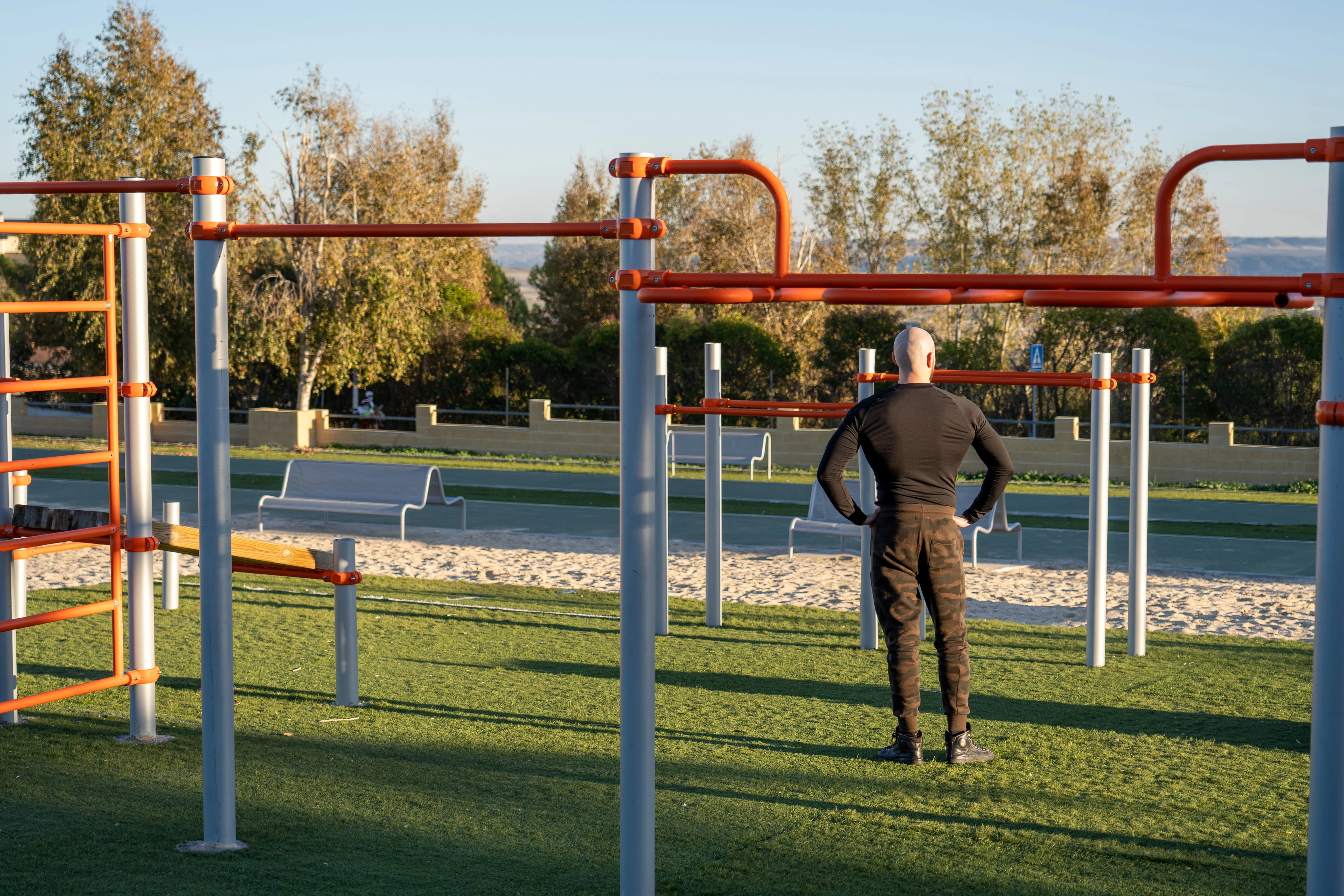 Training at an outdoor gym for beginners 2026
Outdoor gym machines are safe and easy to learn — start with the lightest weight and focus on technique.
Training at an outdoor gym for beginners 2026
Outdoor gym machines are safe and easy to learn — start with the lightest weight and focus on technique.
First Training Program (4 Weeks)
This is the simplest possible program for learning the fundamental movements and building a foundation. Train 2–3 times per week with at least one rest day between sessions.
Full Body Workout — Weeks 1–4
| # | Exercise | Sets × Reps | Rest | Notes |
|---|---|---|---|---|
| 1 | Leg press | 3×12 | 90 sec | Start light, focus on depth |
| 2 | Chest press | 3×10 | 90 sec | Controlled movement, no jerking |
| 3 | Lat pulldown | 3×10 | 90 sec | Pull with elbows, not hands |
| 4 | Shoulder press | 2×10 | 60 sec | Light weight, feel it in the shoulders |
| 5 | Seated row | 2×10 | 60 sec | Squeeze shoulder blades together |
| 6 | Ab bench crunch | 2×12 | 45 sec | With rotation or straight |
Total duration: ~30–40 minutes (plus warm-up and cool-down) Total volume: 15 sets
How Do I Choose the Right Weight?
The golden rule for beginners:
Choose a weight where you can complete all the reps with clean technique, but the last 2–3 reps feel genuinely challenging. If you can do 15 reps easily, increase the weight. If you can't do 8 reps with good form, reduce it.
On your first session: Always start with the lightest possible weight. Do one set, assess how it feels, and adjust. It's far better to start too light than too heavy.
Progression in Weeks 1–4
| Week | Goal |
|---|---|
| Week 1 | Learn the movements, find appropriate weights |
| Week 2 | Same program, add 1–2 reps per set where possible |
| Week 3 | Try increasing weight on one machine (e.g., leg press) |
| Week 4 | Increase weight on 1–2 machines, keep reps the same |
Second Training Program (Weeks 5–8)
After four weeks, your body has adapted to the basic movements. Now we add a little more volume and introduce bodyweight exercises.
Full Body Workout A — Weeks 5–8
| # | Exercise | Sets × Reps | Rest | Notes |
|---|---|---|---|---|
| 1 | Leg press | 3×10–12 | 90 sec | Increase weight from previous phase |
| 2 | Chest press | 3×10 | 90 sec | Focus on controlled lowering |
| 3 | Lat pulldown | 3×10 | 90 sec | Try different grip widths |
| 4 | Walking lunge (bodyweight) | 2×8/leg | 60 sec | New exercise! Long stride |
| 5 | Negative pull-up | 3×4–5 | 90 sec | New exercise! Lower slowly |
| 6 | Ab bench crunch (with rotation) | 3×12 | 45 sec | Add rotation |
Full Body Workout B — Weeks 5–8
| # | Exercise | Sets × Reps | Rest | Notes |
|---|---|---|---|---|
| 1 | Log squat (or bodyweight squat) | 3×10 | 90 sec | New exercise! Learn the hip hinge |
| 2 | Seated row | 3×10 | 90 sec | Increase weight from previous phase |
| 3 | Push-up (on ground or elevated) | 3×max | 60 sec | Do as many as you can with clean form |
| 4 | Shoulder press | 3×10 | 60 sec | Slight weight increase |
| 5 | Bench dip | 2×10–12 | 60 sec | New exercise! |
| 6 | Plank | 3×20–30 sec | 45 sec | Keep body in a straight line |
Weekly Structure, Weeks 5–8
| Day | Session |
|---|---|
| Monday | Workout A |
| Wednesday | Workout B |
| Friday | Workout A |
| (Next week start with B) |
Total duration: ~35–45 minutes Total volume: 17–18 sets
Third Training Program (Weeks 9–12)
Three months of training behind you — now you're ready for a more challenging program. This phase introduces new exercises and raises intensity.
Full Body Workout A — Weeks 9–12
| # | Exercise | Sets × Reps | Rest | RPE |
|---|---|---|---|---|
| 1 | Leg press | 3×10–12 | 90 sec | 7–8 |
| 2 | Chest press | 3×8–10 | 90 sec | 7–8 |
| 3 | Lat pulldown (wide grip) | 3×8–10 | 90 sec | 7–8 |
| 4 | Bulgarian split squat (bench) | 3×8/leg | 60 sec | 8 |
| 5 | Pull-up (assisted or bodyweight) | 3×max | 90 sec | 8–9 |
| 6 | Hanging knee raise | 3×10 | 45 sec | 7–8 |
Full Body Workout B — Weeks 9–12
| # | Exercise | Sets × Reps | Rest | RPE |
|---|---|---|---|---|
| 1 | Log squat | 3×8–10 | 90 sec | 7–8 |
| 2 | Seated row | 3×8–10 | 90 sec | 7–8 |
| 3 | Dip (rig, assisted or full) | 3×6–10 | 90 sec | 8 |
| 4 | Log Romanian deadlift | 3×10–12 | 90 sec | 7–8 |
| 5 | Shoulder press | 3×10 | 60 sec | 7–8 |
| 6 | Ab bench crunch (with rotation) | 3×15 | 45 sec | 7–8 |
| 7 | Calf raises (on a step) | 3×15–20 | 45 sec | 7–8 |
Weekly Structure, Weeks 9–12
| Day | Session |
|---|---|
| Monday | Workout A |
| Wednesday | Workout B |
| Friday | Workout A |
| (Next week start with B) |
Total duration: ~40–50 minutes Total volume: 18–21 sets
RPE Scale for Beginners
RPE (Rate of Perceived Exertion) describes how hard a set felt:
| RPE | How it feels | What it means |
|---|---|---|
| 6 | Easy | Could do 4+ more reps |
| 7 | Moderate | Could do 3 more reps |
| 8 | Challenging | Could do 2 more reps |
| 9 | Very challenging | Could do 1 more rep |
| 10 | Maximum | Can't do another rep |
As a beginner, stay at RPE 7–8. This means you still have 2–3 reps "in the tank" after each set. It's safe, productive, and leaves room for progression.
Bodyweight Exercises When No Machines Are Available
If your outdoor gym only has a pull-up rig and some benches — or you can't find the machine you want — bodyweight exercises save the session.
Full Body Bodyweight Workout (no machines needed)
| # | Exercise | Sets × Reps | Rest | Replaces |
|---|---|---|---|---|
| 1 | Bodyweight squat | 3×15–20 | 60 sec | Leg press |
| 2 | Push-up (on ground or elevated) | 3×max | 60 sec | Chest press |
| 3 | Australian pull-up (low bar) | 3×10–15 | 60 sec | Seated row, lat pulldown |
| 4 | Bulgarian split squat (bench) | 3×10/leg | 60 sec | Leg press |
| 5 | Negative pull-up | 3×4–5 | 90 sec | Lat pulldown |
| 6 | Bench dip | 3×10–12 | 60 sec | Chest press |
| 7 | Step-up onto bench | 2×10/leg | 60 sec | Leg press |
| 8 | Plank | 3×30 sec | 45 sec | Ab bench |
Tip: Bodyweight training isn't "worse" than machines. Pull-ups, dips, and push-ups are proven to be highly effective builders of muscle mass and strength (Kotarsky et al., 2018).
How to Make Bodyweight Movements Harder Without Weights
| Method | Example |
|---|---|
| Slow the tempo | Push-up: 3 sec down, 1 sec pause, 2 sec up |
| Add a hold | 2 sec pause at the bottom of each rep |
| Harder variation | Push-up → feet elevated → dip |
| Single-limb version | Squat → single-leg squat progression |
| Add external load | Backpack with stones or water bottles (5–15 kg easily) |
Technique Tips for Beginners
5 Universal Rules for Every Exercise
1. Breathe correctly
Inhale on the lowering phase (when resistance comes toward you), exhale on the effort phase (when pushing or pulling). Don't hold your breath — it unnecessarily raises blood pressure.
2. Control the lowering phase
The lowering phase (eccentric) is just as important as the lifting phase. Lower SLOWLY and under control — don't let the weight drop. A good target: 2–3 seconds down, 1–2 seconds up.
3. Full range of motion
Take every rep from start to finish. Half-reps produce half-results. Better to do 8 perfect reps than 12 partial ones with heavier weight.
4. Brace your core
Engage your core in every exercise — as if someone is about to poke you in the stomach. This protects your spine and transfers force more efficiently.
5. Weight isn't the main thing — technique is
The first 4 weeks are for learning technique. Use light weights and focus on how the movement feels. The weights will come naturally later.
Mind-Muscle Connection
This sounds mystical but it's a concrete skill: feel the muscle you're training.
- Chest press: feel the chest squeeze as you push
- Lat pulldown: feel the back muscles contract as you pull
- Leg press: feel the quads and glutes doing the work
If you don't feel the target muscle, the weight is probably too heavy and other muscles are compensating. Reduce the weight and focus on the feeling.
Most Common Mistakes and How to Avoid Them
1. Weight Too Heavy
Mistake: "I want to look strong" → too heavy → technique breaks down → no results or injury.
Fix: Leave the ego at home. Start light, learn the technique. Nobody is watching your weights — and those who do respect good technique over heavy weight done badly.
2. Skipping the Warm-Up
Mistake: Going straight to the first machine with cold muscles.
Fix: 5–10 minutes of warm-up EVERY single session. See the warm-up guidelines below.
3. Same Workout at the Same Weight Every Session
Mistake: 3×10 with the same weights week after week, month after month.
Fix: Progressive overload is the key. Add reps, weight, or sets every week or every other week. Small improvements compound into major development.
4. Only Upper Body, Ignoring Legs
Mistake: Chest press, shoulder press, bicep curl — then go home. Legs forgotten.
Fix: Legs are the body's largest muscle group. The leg press or a squat belongs in EVERY session. Read the leg workout program.
5. No Plan
Mistake: "I'll go there and see what I feel like doing." → random exercises with no structure.
Fix: Follow one of the programs in this guide or save your program in the Tsemppi app. Know what you're doing before you arrive.
6. Too Infrequent
Mistake: Once a week "whenever I remember."
Fix: At least 2 times per week, ideally 3. Put sessions in your calendar like any other appointment. Consistency beats intensity every time.
7. Comparing Yourself to Others
Mistake: "That person lifts so much more, I'm terrible."
Fix: That person has been training for years. Compare yourself only to who you were last week. If you lifted even one kilogram more or did one extra rep today — you've improved.
Warm-Up and Cool-Down
Warm-Up (do this EVERY session)
Duration: 5–10 minutes
| # | Exercise | Duration/Reps | Why |
|---|---|---|---|
| 1 | Brisk walk or easy jog | 3–5 min | Raises heart rate and body temperature |
| 2 | Arm circles | 10/direction | Shoulder preparation |
| 3 | Leg swings (front-back) | 8/leg | Hip preparation |
| 4 | Bodyweight squat | 10 | Leg activation |
| 5 | Light push-ups (on knees is fine) | 8 | Upper body activation |
In cooler weather (below +15°C): Extend walking/jogging to 5–8 minutes and add an extra round of light movements. Cold muscles are more prone to injury.
On machines: Do the first set of each exercise with very light weight (about 50% of your working weight). This is the movement's own "warm-up set."
Cool-Down (do this EVERY session)
Duration: 5–8 minutes
| # | Exercise | Duration | Target area |
|---|---|---|---|
| 1 | Easy walk | 2–3 min | Lower heart rate |
| 2 | Chest stretch (hold the rig, rotate away) | 20–30 sec/side | Chest |
| 3 | Back stretch (hang from the bar) | 20–30 sec | Back, shoulders |
| 4 | Quad stretch (hold ankle, pull heel to glute) | 20–30 sec/side | Quads |
| 5 | Hamstring stretch (foot on bench, lean forward) | 20–30 sec/side | Hamstrings |
Read more in the stretching and mobility guide.
Nutrition and Recovery for Beginners
Training is the stimulus — growth happens during rest and with the right nutrition. Here are the essential guidelines for beginners.
Nutrition Basics
Three most important things:
1. Eat enough protein
Protein is the building block of muscle. Target: 1.6 g of protein per kilogram of bodyweight per day.
Example: 70 kg person → 112 g protein per day
Good sources: chicken, fish, eggs, cottage cheese, Greek yogurt, legumes, protein powder.
Read the full protein intake guide.
2. Eat enough total calories
To build muscle, you need a slight calorie surplus. To lose fat, a slight deficit. As a beginner, you can do both simultaneously (a "recomp") by eating at maintenance and focusing on protein.
Read the calorie counting for muscle growth guide.
3. Drink enough water
Especially when training outdoors in summer. Target: 2–3 liters of water per day, more on training days.
Recovery Basics
| Factor | Target | Why it matters |
|---|---|---|
| Sleep | 7–9 hours | Growth hormone is released during sleep |
| Rest between sessions | 1–2 rest days | Muscles grow during recovery |
| Protein | 1.6 g/kg/day | Building blocks for muscle |
| Water | 2–3 liters | Dehydration impairs performance |
Most important recovery tip for beginners: Don't train every day. 3 sessions per week with rest days is optimal. Muscles need 48–72 hours to recover.
Read the full recovery from training guide.
When to Move to an Indoor Gym?
An outdoor gym serves many people well for a long time — but at some point, you might feel ready to move on.
Signs You're Ready for an Indoor Gym
| Sign | Explanation |
|---|---|
| Weights max out | The weight stack limit no longer challenges you |
| You want free weights | A barbell + plates opens up more training options |
| You want more machines | Cable stacks, hack squat, various cable attachments |
| Winter arrives | Outdoor gym season has natural limits |
| Goals scale up | Competitive bodybuilding or powerlifting requires an indoor facility |
You Never Have to Move
If the outdoor gym serves you — it serves you. Bodyweight + outdoor gym + a good program takes you a long way. Many people train at outdoor gyms for decades with excellent results.
The Combination Is Best
Many experienced athletes do indoor gym training in winter and outdoor gym training from spring through autumn — or combine both within the same week. You don't have to choose just one.
FAQ
Can I start at an outdoor gym if I've never trained before?
Absolutely yes — and it may actually be a better starting point than an indoor gym. Weight stack machines guide the movement safely, the atmosphere is relaxed, and you don't need to know everything in advance. Follow the weekly programs in this guide and start with the lightest weights.
Is training at an outdoor gym as effective as an indoor gym?
Yes — especially for beginners. Your body doesn't care where the stimulus comes from — muscle growth requires mechanical tension, and you get that just as effectively outdoors. A well-equipped outdoor gym with weight stack machines is nearly identical to indoor machines. Read the outdoor gym exercises guide for a complete equipment and exercise breakdown.
How often should I train?
For beginners, 2–3 times per week is optimal. Train every other day or on a Monday-Wednesday-Friday schedule. At least one rest day between sessions. Research shows that 2–3 full-body sessions per week is the best frequency for beginners to build muscle (Schoenfeld et al., 2016).
How long should a session be?
30–50 minutes is plenty (plus warm-up and cool-down). Quality beats quantity. A focused 35-minute session is more effective than a 90-minute wandering one.
Should I eat before training outdoors?
Recommended but not essential. A light meal 1–2 hours before training (e.g., banana + toast or yogurt + fruit) provides energy. Training on an empty stomach in the morning also works — but performance may suffer slightly.
What if I can't do a pull-up?
That's completely normal — most beginners can't. Start with negative pull-ups (jump to the top, lower slowly) and Australian pull-ups. Read the pull-up program for beginners for a step-by-step guide.
Do I need supplements?
Not initially. Focus on your diet: sufficient protein, balanced meals, enough calories. If you want to add a supplement, creatine is the most researched and effective option — but it's not necessary at the start.
Can you lose weight at an outdoor gym?
Yes. Strength training (including at an outdoor gym) builds muscle, raises metabolism, and burns calories. Combined with a controlled diet, it's an excellent way to reduce body fat. Read the bulk and cut guide.
How do I keep myself motivated?
Three most effective motivators: 1) track your progress — log weights and reps (the Tsemppi app makes this easy), 2) train with a friend — the relaxed outdoor vibe makes it especially enjoyable together, 3) set small goals — "my first pull-up" or "50 kg on the leg press."
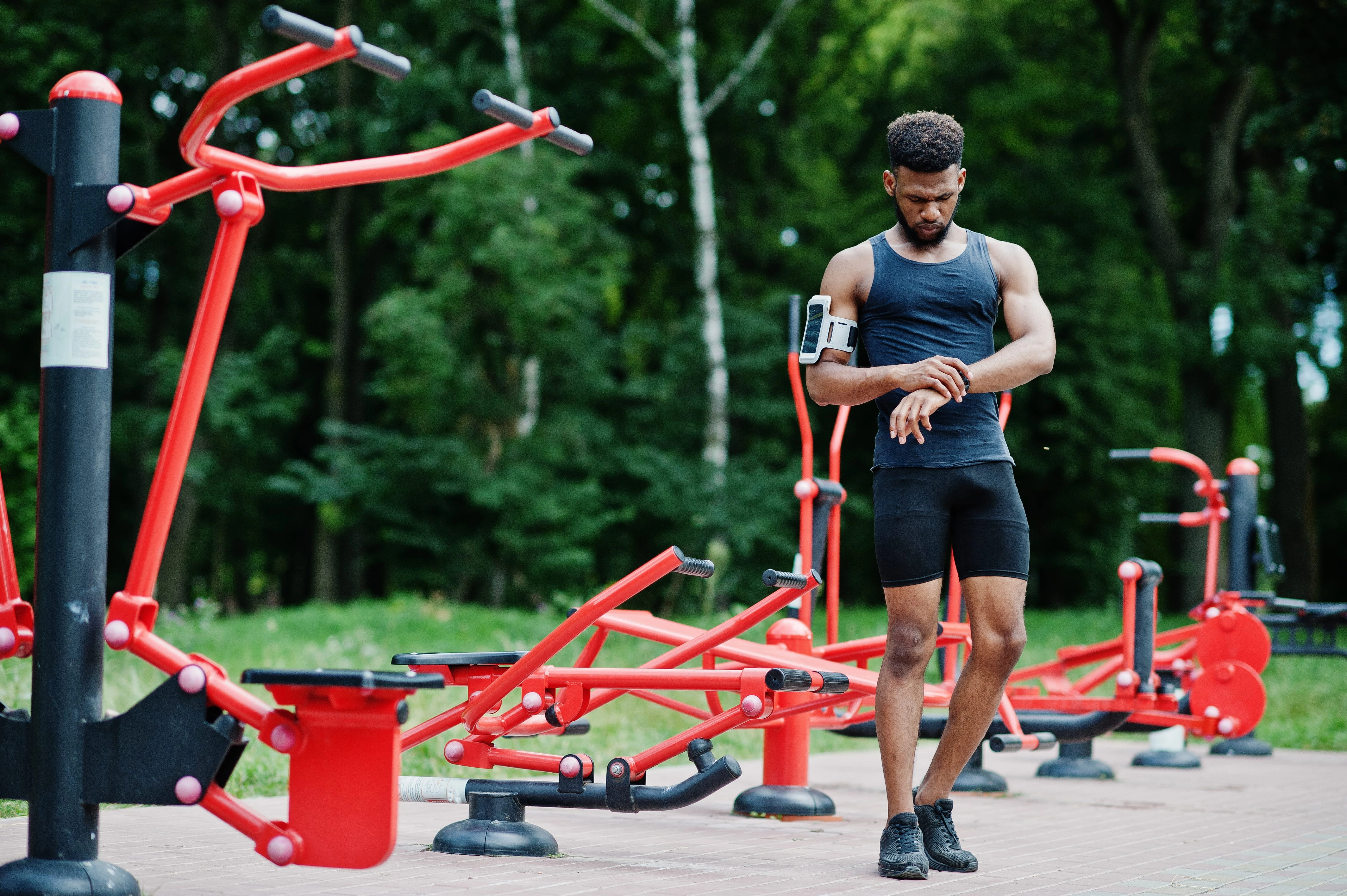 Outdoor gym atmosphere 2026
Outdoor training combines movement, nature, and fresh air — many people find it more motivating than training indoors.
Outdoor gym atmosphere 2026
Outdoor training combines movement, nature, and fresh air — many people find it more motivating than training indoors.
Summary
An outdoor gym is a beginner's dream: free, calm, safe, and surprisingly versatile. You don't need to know everything — you just need to start. Here are the key takeaways:
The cornerstones of outdoor gym training for beginners:
- Start light — technique first, weights come later
- Train 2–3 times per week — consistency beats everything else
- Follow a program — don't wander randomly from machine to machine
- Train your whole body — legs, back, chest, shoulders, core
- Always warm up — 5–10 min before every session, especially outdoors
- Progress — add reps or weight every week or every other week
- Eat protein — 1.6 g/kg/day, otherwise muscle won't grow
- Enjoy it — fresh air, nature, and freedom are bonuses no indoor gym can offer
The 12-week beginner journey:
| Weeks | What happens |
|---|---|
| 1–4 | Learn the machines, find appropriate weights, body adapts to training |
| 5–8 | Add bodyweight exercises, strength increases noticeably |
| 9–12 | More challenging program, first visible results, maybe your first pull-up! |
The first step is always the hardest. Go to your nearest outdoor gym tomorrow, do week 1's workout from this guide, and see how it feels. I promise: in three months, you'll thank yourself.
Also read these guides:
- Outdoor Gym Exercises 2026: Guide to Every Machine
- Best Outdoor Gyms
- Beginner Gym Workout Program
- Workout Program 2026: Complete Guide
- Pull-Up Program for Beginners
- Progressive Overload Training
- Protein Intake for Muscle Growth
References
-
Schoenfeld, B.J., et al. (2016). Effects of Resistance Training Frequency on Measures of Muscle Hypertrophy: A Systematic Review and Meta-Analysis. Sports Medicine, 46(11), 1689-1697. PubMed
-
Thompson Coon, J., et al. (2011). Does Participating in Physical Activity in Outdoor Natural Environments Have a Greater Effect on Physical and Mental Well-Being than Physical Activity Indoors? Environmental Science & Technology, 45(5), 1761-1772. PubMed
-
Kotarsky, C.J., et al. (2018). Effect of Progressive Calisthenic Push-up Training on Muscle Strength and Thickness. Journal of Strength and Conditioning Research, 32(3), 651-659. PubMed
-
Kikuchi, N., & Nakazato, K. (2017). Low-load bench press and push-up induce similar muscle hypertrophy and strength gain. Journal of Exercise Science & Fitness, 15(1), 37-42. PubMed
-
Ratamess, N.A., et al. (2009). Progression Models in Resistance Training for Healthy Adults. Medicine & Science in Sports & Exercise, 41(3), 687-708. PubMed
-
Schoenfeld, B.J., et al. (2017). Dose-response relationship between weekly resistance training volume and increases in muscle mass. Journal of Sports Sciences, 35(11), 1073-1082. PubMed
-
Calatayud, J., et al. (2015). Importance of mind-muscle connection during progressive resistance training. European Journal of Applied Physiology, 116(3), 527-533. PubMed
Want a personalized outdoor gym training program? Join Tsemppi — the AI builds you a complete beginner program, tracks your progression, and tells you when it's time to increase the weight — whether you're training indoors or out. Start your 7-day free trial today, no credit card required.


