

Outdoor gyms are one of fitness's best-kept secrets. Free, open 24/7, no queues for equipment — and fresh air thrown in for good measure. Yet many people walk right past an outdoor gym wondering: "What do you even do with those machines?" This guide solves that problem. We'll cover every piece of equipment you'll find at an outdoor gym, the exercises, technique, and ready-made training programs — regardless of your experience level.
How Outdoor Gyms Changed My Relationship with Training
I'll admit it: I was skeptical about outdoor gyms for a long time. "Toy equipment," I thought, walking past one in the park. Real training happens in a real gym, with free weights and a serious face. That was my attitude.
Then came the summer of 2023. My gym closed for two months of renovations and the only option was the outdoor gym in a nearby park. The first session was humbling — I couldn't figure out half the equipment, the weight stacks felt different from indoor machines, and doing pull-ups in direct sunlight was a completely different experience.
But after a week, something changed. The sessions felt different — better. Fresh air, sunshine, birdsong in the background. I found myself staying longer because I didn't want to leave. And the equipment? Surprisingly versatile. Modern outdoor gyms are on a completely different level than they were ten years ago.
After two months of outdoor training, I hadn't lost any strength — I had actually improved my pull-ups and dips significantly. And I had discovered an entirely new way to enjoy training.
Now the outdoor gym is a regular part of my training year from May through September. And this guide will help you do the same.
"An outdoor gym isn't a substitute for an indoor gym — it's its own experience entirely. Fresh air, natural light, and the freedom to train whenever you want without a monthly fee. Once you learn to use the equipment properly, the results come just as well as indoors." – Pietari Risku, Founder of Tsemppi
Table of Contents
- What does an outdoor gym have?
- Weight stack machines and their exercises
- The pull-up rig and its exercises
- Log rack and its exercises
- Bodyweight exercises at the outdoor gym
- Senior / light resistance machines
- Exercises by muscle group
- Outdoor gym training program: Full body
- Outdoor gym training program: 3-day split
- Progression at the outdoor gym
- Outdoor gym challenges and solutions
- Warm-up and cool-down outdoors
- FAQ
- Summary
What Does an Outdoor Gym Have?
Outdoor gyms vary in how well-equipped they are, but most will have at least some of the following. The two most common equipment manufacturers are Omnigym (formerly David) with adjustable weight stacks and Waffa with lighter senior-friendly machines.
Typical Well-Equipped Outdoor Gym
| Equipment | What it trains | Found at most sites? |
|---|---|---|
| Chest press | Chest, shoulders, triceps | ✅ Yes |
| Lat pulldown | Back, biceps | ✅ Yes |
| Seated row | Back, biceps | ✅ Yes |
| Leg press | Quads, glutes | ✅ Yes |
| Shoulder press | Shoulders, triceps | ✅ Most |
| Bicep curl | Biceps | Varies |
| Tricep pushdown | Triceps | Varies |
| Pull-up rig (Big Rig) | Pull-ups, dips, hanging | ✅ Most |
| Log rack | Squat, press, row, lunge | Varies |
| Ab bench | Abs | ✅ Most |
| Hyperextension bench | Back extensors, glutes | Varies |
| Senior/light machines | Light full-body work | Varies |
Weight Stack Machines
Weight stack machines are the flagship of outdoor gyms. They work with an adjustable weight stack — typically from 5 to 95 kg depending on the machine. These are essentially the same as indoor gym cable machines but designed to withstand outdoor conditions.
Key features:
- Stainless steel and weather-protected construction
- Weight stack operates on the same pin-select principle as indoor machines
- Seat height often adjustable
- Always ensure the pin is fully seated before starting!
The Pull-Up Rig
The most versatile single structure at an outdoor gym. Typically includes pull-up bars (often multiple grip widths), dip bars, a dead hang position, and sometimes a climbing rope or rings.
The Log Rack
The outdoor gym's version of free weights. Logs come in various sizes (typically 10–40 kg) and can be used for many of the same movements as a barbell or dumbbells at an indoor gym.
Weight Stack Machines and Their Exercises
Let's cover each common weight stack machine and how to use it correctly.
1. Chest Press
Target muscles: Pectorals, front deltoid, triceps
Technique:
- Adjust the seat so the handles are at approximately lower chest height (nipple line or slightly below)
- Sit with your back firmly against the backrest, feet flat on the ground
- Grip the handles at shoulder width
- Brace your core and pull your shoulder blades together
- Press the handles forward by extending your arms — don't lock the elbows out fully
- Return under control, elbows at roughly 45–75 degrees from the body
- Feel a light stretch in the chest at the bottom before the next rep
Most common mistakes:
- Shoulders rising toward the ears → reduce weight, keep shoulders down
- Back lifting off the backrest → brace your core
- Elbows flaring too wide → keep elbows at roughly 45–60 degrees
Variations:
- Wide grip — targets the outer chest more
- Narrow grip — shifts emphasis to triceps and inner chest
- Single arm — reveals imbalances, requires more core stability
Indoor equivalent: Machine chest press, bench press. Read the chest workout program.
2. Lat Pulldown
Target muscles: Latissimus dorsi, biceps, teres major
Technique:
- Adjust the thigh pad to hold firmly over your thighs (prevents body from rising)
- Take a wide overhand grip (~1.5× shoulder width), thumb over or around the bar
- Sit with chest up, a slight backward lean
- Initiate the pull by drawing shoulder blades down — think "pull with your elbows, not your hands"
- Pull the bar to your upper chest
- Squeeze shoulder blades together and hold for 1 second
- Return under control to full extension, feel the lats stretch at the top
Most common mistakes:
- Pulling with biceps only → initiate from the shoulder blades
- Excessive backward lean → maximum 15–20 degrees
- Bar pulled to the stomach instead of upper chest → aim for upper chest
Variations:
- Wide grip — emphasizes lat width
- Close underhand grip — activates biceps more, targets lower lats
- Neutral grip (if available) — a good middle-ground option
Indoor equivalent: Lat pulldown, pull-up. Read the back workout program.
3. Seated Row
Target muscles: Latissimus dorsi, middle trapezius, rhomboids, biceps
Technique:
- Sit in the machine with your chest against the pad (if there is one)
- Grip the handles — grip can be narrow or wide depending on the machine
- Initiate the movement by retracting the shoulder blades
- Pull the handles toward your lower abdomen/lower ribs
- Elbows travel close to the sides of the body
- Squeeze shoulder blades hard together at the end position
- Return under control, feel the stretch in the back at the forward position
Most common mistakes:
- Shoulders shrugging up → keep shoulders down and back
- Torso rocking back and forth → keep chest against the pad
- Pulling with arms only → initiate with scapular retraction
Indoor equivalent: Seated cable row, bent-over row. Read the back workout program.
4. Leg Press
Target muscles: Quadriceps, glutes, hamstrings
Technique:
- Sit in the machine with your back firmly against the backrest
- Place feet on the footplate at shoulder width
- Release the safety (if the machine has one)
- Lower the weight in a controlled manner by bending your knees
- Go until thighs are at least at 90 degrees — deeper if your mobility allows
- Drive back up through the whole foot — press the entire sole against the plate
- Don't lock the knees fully at the top
Most common mistakes:
- Partial reps → go deep enough
- Hips rising off the seat at the bottom → don't exceed your mobility range
- Knees caving inward → push knees in line with toes
Foot placement affects targeting:
- Wide stance, toes out — emphasizes inner thighs and glutes
- Narrow stance — emphasizes quads
- Feet high on the plate — emphasizes glutes and hamstrings
- Feet low on the plate — emphasizes quads
Indoor equivalent: Leg press, squat. Read the leg workout program.
5. Shoulder Press
Target muscles: Front and lateral deltoids, triceps
Technique:
- Adjust the seat so the handles are at shoulder height in the starting position
- Sit with your back straight against the backrest
- Grip the handles at shoulder width
- Brace your core and press the handles straight up
- Extend arms to near-full extension — keep a slight bend in the elbows
- Return under control to shoulder height
Most common mistakes:
- Lower back arching excessively → brace your core, use a lighter weight
- Elbows too far forward or backward → keep elbows slightly in front of the body
- Lowering too quickly → a controlled descent is important for shoulder health
Indoor equivalent: Machine shoulder press, overhead press.
6. Bicep Curl
Target muscles: Biceps brachii, elbow flexors
Technique:
- Sit or stand in the machine (depending on design)
- Rest elbows on the pad (preacher-style) or keep them at your sides
- Grip with a supinated grip (palms facing up)
- Curl the handles toward your shoulders by bending the elbows
- Squeeze the bicep at the top for 1 second
- Lower under control — don't let the weight drop
Most common mistakes:
- Whole body swings → elbows stay fixed
- Lowering too fast → take 2–3 seconds on the way down
- Too heavy → the bicep does the work, not momentum
7. Tricep Pushdown
Target muscles: Triceps brachii
Technique:
- Stand (or sit) in front of the machine
- Grip with a pronated grip (palms down) or neutral grip
- Keep elbows tight to your sides — they must not move
- Extend the elbows and push the handles down
- Squeeze the triceps at full extension for 1 second
- Return under control to roughly 90 degrees
Most common mistakes:
- Elbows swinging forward and back → lock them in place
- Leaning forward over the weight → stand upright
Machine Summary
| Machine | Primary target | Recommended sets × reps |
|---|---|---|
| Chest press | Chest, shoulders, triceps | 3–4 × 8–12 |
| Lat pulldown | Back, biceps | 3–4 × 8–12 |
| Seated row | Back, biceps | 3–4 × 8–12 |
| Leg press | Quads, glutes | 3–4 × 10–15 |
| Shoulder press | Shoulders, triceps | 3–4 × 8–12 |
| Bicep curl | Biceps | 2–3 × 10–15 |
| Tricep pushdown | Triceps | 2–3 × 10–15 |
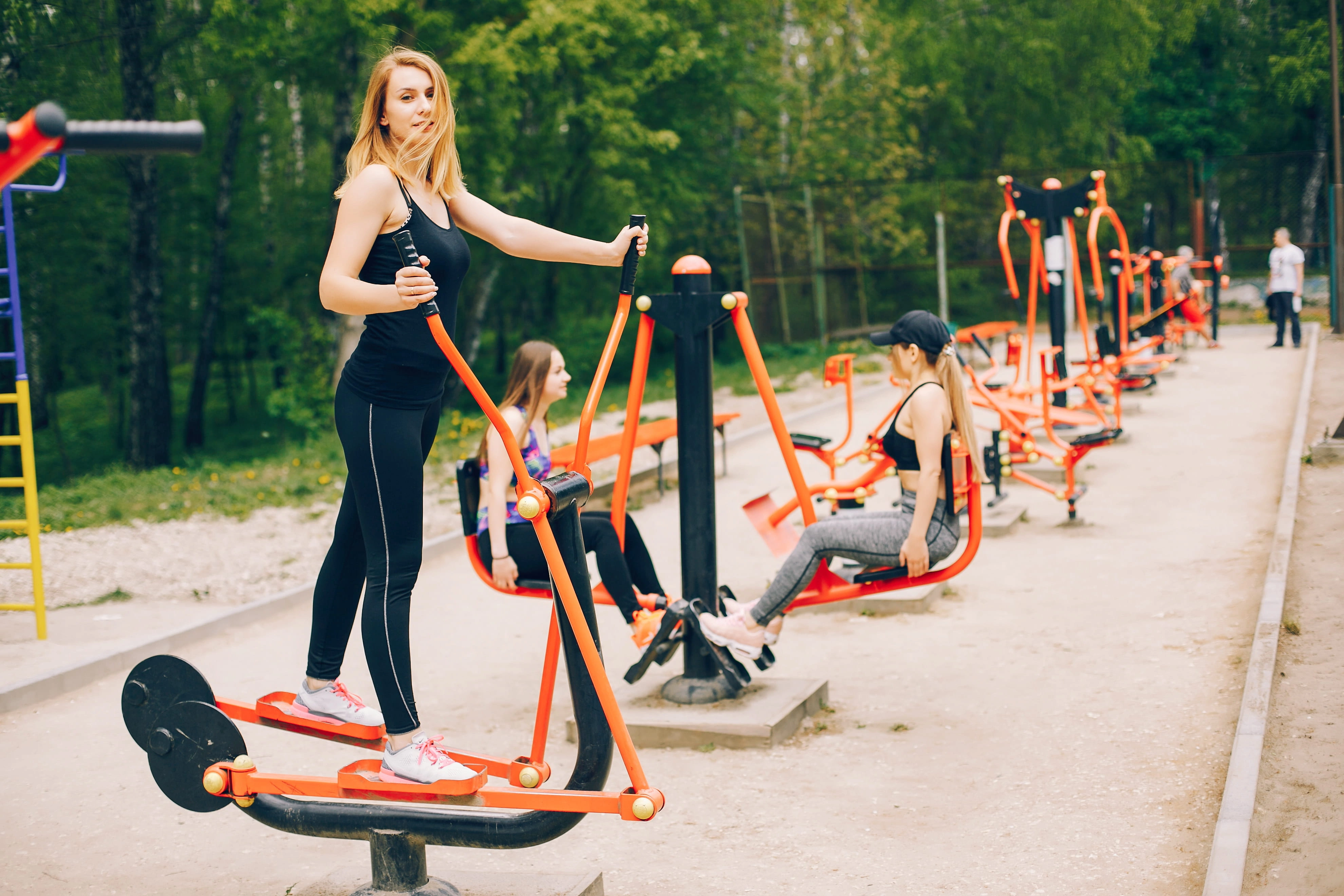 Outdoor gym equipment 2026
Modern outdoor gyms offer weight stack machines that allow just as varied a workout as an indoor gym.
Outdoor gym equipment 2026
Modern outdoor gyms offer weight stack machines that allow just as varied a workout as an indoor gym.
The Pull-Up Rig and Its Exercises
The pull-up rig is the most versatile structure at any outdoor gym. The movements you do on it are often more effective than machines.
1. Pull-Up / Chin-Up
The king of back training. If you can do pull-ups, you have a strong back — full stop.
Technique:
- Grip the bar — wide overhand grip (pull-up) or close underhand grip (chin-up)
- Hang with straight arms (dead hang), shoulders actively packed in place
- Activate the shoulder blades by pulling them down (scapular depression)
- Pull yourself up until your chin is above the bar
- Lower under control to full extension
- Repeat
Variations by difficulty:
| Level | Variation | Description |
|---|---|---|
| Beginner | Negative pull-up | Jump to the top, lower slowly (5 sec) |
| Beginner | Assisted pull-up (resistance band) | Band under foot provides assistance |
| Intermediate | Bodyweight pull-up | Standard pull-up or chin-up |
| Advanced | Weighted pull-up | Backpack with weight or dip belt |
| Advanced | L-sit pull-up | Legs extended straight in front |
Read the full pull-up program for beginners.
2. Dip
An excellent chest and tricep movement using bodyweight.
Technique:
- Grip the dip bars and press yourself up — arms straight
- Cross your ankles behind you or keep legs straight below
- Lower under control by bending the elbows — at least 90 degrees at the bottom
- Chest dip: Lean torso slightly forward, elbows slightly out
- Tricep dip: Keep torso more upright, elbows close to the body
- Press back up to the start
Progression:
| Level | Variation |
|---|---|
| Beginner | Negative dip (jump up, lower slowly) |
| Beginner | Assisted dip (band or feet on a bench) |
| Intermediate | Bodyweight dip |
| Advanced | Weighted dip (backpack or dip belt) |
3. Dead Hang
Simple but effective — improves grip strength, decompresses the spine, and opens the shoulders.
Technique:
- Grip the bar at shoulder width
- Hang with straight arms, feet off the ground
- Keep shoulders actively packed (don't let them rise toward the ears)
- Hold for 20–60 seconds
Variations:
- Passive hang — relaxed, focused on decompression
- Active hang — pull shoulder blades down without bending the elbows (scapular pulls)
- Single-arm hang — advanced grip strength development
4. Hanging Leg Raise
The most effective bodyweight ab movement.
Technique:
- Hang from the bar with straight arms
- Raise your legs while keeping them straight (or knees bent for the easier version)
- Raise to at least horizontal — ideally toward the bar
- Lower under control without swinging
Progression:
- Knees to chest (easiest)
- Straight legs to horizontal
- Straight legs to bar (harder)
- Toes to bar (hardest)
5. Australian Pull-Up (Inverted Row)
A horizontal pulling movement using bodyweight — an excellent alternative to the bent-over row.
Technique:
- Position yourself under a low bar (or use the lower part of the rig)
- Hang under the bar, feet on the ground, body in a straight line
- Pull your chest toward the bar by squeezing the shoulder blades together
- Lower under control
Adjusting difficulty:
- Easier: Knees bent, feet closer to the bar
- Harder: Legs straight, feet farther from the bar (body more horizontal)
- Hardest: Feet elevated on a bench
The Log Rack and Its Exercises
The log rack is the outdoor gym's free weights section. Logs are typically wooden or metal beams of varying sizes (usually 10–40 kg), and you can perform many of the same movements as with a barbell or dumbbells.
1. Log Squat
Technique:
- Lift the log onto your upper back (like a back squat)
- Find a stable shelf with the upper traps — pull shoulder blades together and grip the log
- Feet at shoulder width, toes turned slightly out
- Squat down — thighs at least parallel, deeper if mobility allows
- Keep chest up and spine neutral throughout
- Drive back up powerfully
Read the full squat program.
2. Log Overhead Press
Technique:
- Lift the log to your front rack position (palms forward, elbows up)
- Brace your core and squeeze your glutes
- Press the log straight overhead
- Extend arms to full lockout
- Lower under control back to the front rack
3. Log Walking Lunge
Technique:
- Place the log on your shoulders (like a squat) or hold it at your chest
- Take a long step forward
- Lower the rear knee toward the ground — front thigh parallel to the floor
- Drive back up through the front foot and bring feet together
- Alternate legs — or continue as walking lunges
4. Log Bent-Over Row
Technique:
- Hold the log with a shoulder-width grip
- Hinge at the hip — torso at roughly 45–60 degrees
- Keep your back straight and knees slightly bent
- Row the log toward your lower abdomen
- Squeeze shoulder blades together at the top
- Lower under control
5. Romanian Deadlift with Log
Technique:
- Hold the log in front of your body with straight arms
- Push your hips back (hip hinge)
- Lower the log along your legs — knees stay nearly straight
- Feel the stretch in your hamstrings
- Squeeze glutes and return to standing
Read the full deadlift program.
6. Hip Thrust on a Bench (log across hips)
Technique:
- Sit on the ground with upper back against the edge of a bench
- Place the log across your hips (use a folded towel as padding)
- Feet flat on the ground, knees at ~90 degrees at the top
- Drive hips up by squeezing your glutes
- Keep chin slightly tucked
- Lower under control
Bodyweight Exercises at the Outdoor Gym
Beyond the machines and logs, outdoor gyms allow excellent bodyweight exercises using benches, bars, and open ground.
Upper Body Bodyweight Exercises
| Exercise | Target | Description |
|---|---|---|
| Push-up | Chest, shoulders, triceps | Classic — on the ground or elevated |
| Incline push-up (feet elevated) | Upper chest, shoulders | Feet on bench, hands on ground |
| Diamond push-up | Triceps, inner chest | Hands in triangle under chest |
| Dip | Chest or triceps | On the rig or bench edge |
| Pull-up | Back, biceps | On the rig bar |
| Australian pull-up | Back | Under a low bar |
| Pike push-up | Shoulders | V-position, mimics the overhead press |
Lower Body Bodyweight Exercises
| Exercise | Target | Description |
|---|---|---|
| Bulgarian split squat | Quads, glutes | Rear foot on bench |
| Pistol squat | Full leg | Single-leg squat — advanced |
| Step-up | Quads, glutes | Step onto a bench |
| Glute bridge | Glutes | On the ground or feet on bench |
| Wall sit | Quads | Isometric hold |
| Calf raises | Calves | On a step edge or flat ground |
Core Bodyweight Exercises
| Exercise | Target | Description |
|---|---|---|
| Hanging leg raise | Abs | From the hang position |
| Plank | Full core | Static hold |
| Ab bench crunch | Abs | With rotation or straight |
| Mountain climbers | Core, cardio | "Running" in a push-up position |
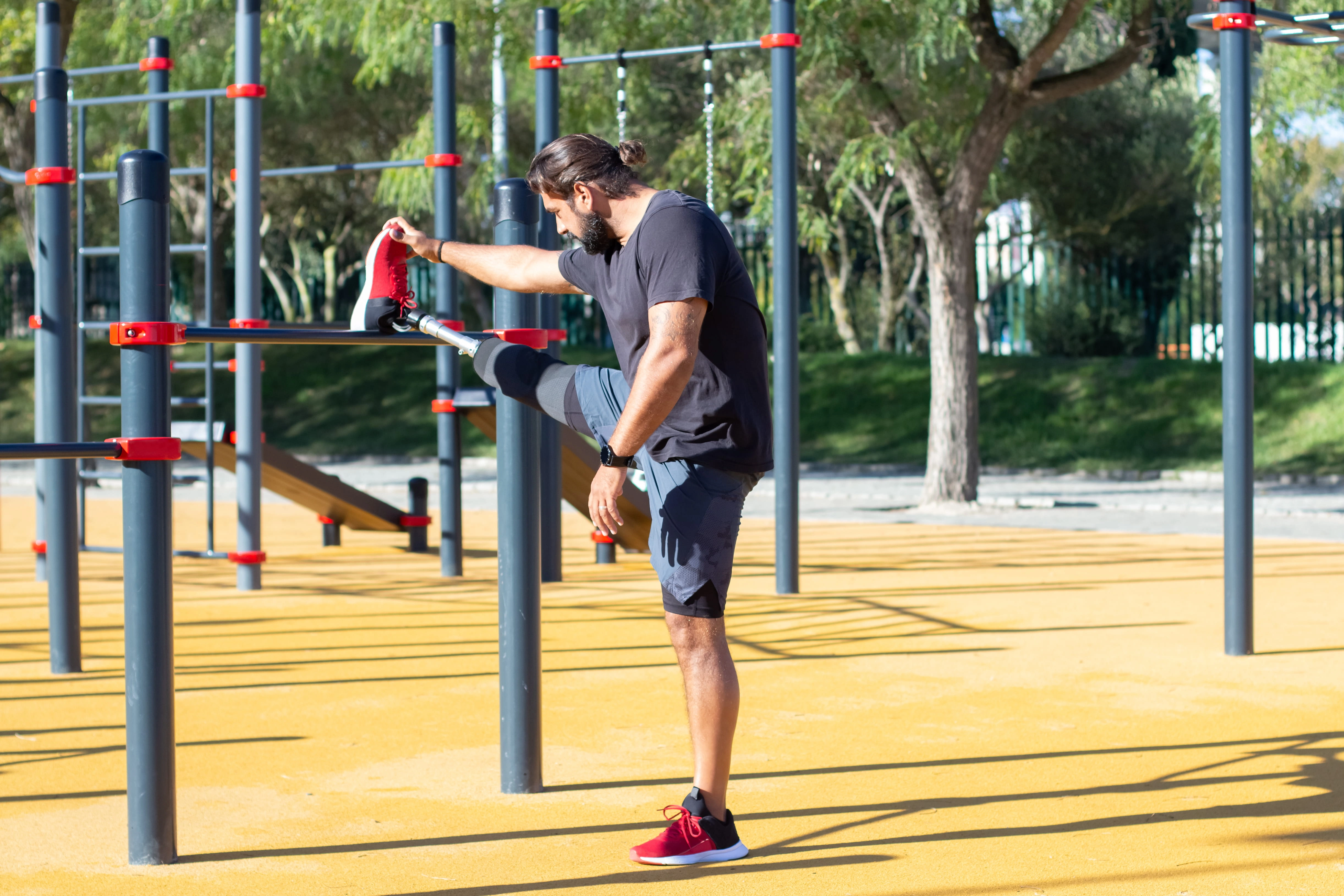 Bodyweight exercises at the outdoor gym 2026
Bodyweight movements — pull-ups, dips, and push-ups — are the outdoor gym's most effective exercises.
Bodyweight exercises at the outdoor gym 2026
Bodyweight movements — pull-ups, dips, and push-ups — are the outdoor gym's most effective exercises.
Senior / Light Resistance Machines
Some outdoor gyms feature lighter machines with fixed resistance, particularly in locations frequented by older adults and beginners. They won't replace weight stack machines for serious training, but they provide a solid supplementary workout or entry point.
Who Are These Machines For?
- Beginners learning fundamental movement patterns
- Older adults
- Active recovery (as a light session)
- Warm-up before heavier work on the logs or rig
Exercises by Muscle Group
If your outdoor gym has limited equipment, here are alternatives for every muscle group:
Chest
| Priority | Equipment/exercise | Alternative if not available |
|---|---|---|
| 1 | Chest press (weight stack) | Push-up |
| 2 | Dip (rig, chest focus) | Feet-elevated push-up |
| 3 | Push-up variations | — |
Back
| Priority | Equipment/exercise | Alternative if not available |
|---|---|---|
| 1 | Lat pulldown | Pull-up (rig) |
| 2 | Seated row | Australian pull-up |
| 3 | Pull-up (rig) | Log bent-over row |
| 4 | Log row | Band row |
Legs
| Priority | Equipment/exercise | Alternative if not available |
|---|---|---|
| 1 | Leg press | Log squat |
| 2 | Log squat | Bulgarian split squat (bench) |
| 3 | Log walking lunge | Step-up onto bench |
| 4 | Hip thrust (log + bench) | Glute bridge on ground |
Shoulders
| Priority | Equipment/exercise | Alternative if not available |
|---|---|---|
| 1 | Shoulder press (weight stack) | Log overhead press |
| 2 | Pike push-up | — |
| 3 | Log lateral raise (light) | Band lateral raise |
Arms
| Priority | Equipment/exercise | Alternative if not available |
|---|---|---|
| 1 | Bicep curl (weight stack) | Chin-up (supinated grip pull-up) |
| 2 | Tricep pushdown | Dip (tricep focus) |
| 3 | — | Diamond push-up |
Core
| Priority | Equipment/exercise | Alternative if not available |
|---|---|---|
| 1 | Hanging leg raise | Ab bench crunch |
| 2 | Ab bench crunch | Plank |
| 3 | Plank variations | Mountain climbers |
Outdoor Gym Training Program: Full Body
This program is ideal for beginners and those training at the outdoor gym 2–3 times per week.
Full Body Workout A
| # | Exercise | Sets × Reps | Rest | Target |
|---|---|---|---|---|
| 1 | Leg press (or log squat) | 3×10–12 | 90 sec | Legs |
| 2 | Chest press | 3×8–12 | 90 sec | Chest |
| 3 | Lat pulldown | 3×8–12 | 90 sec | Back |
| 4 | Shoulder press | 3×10–12 | 60 sec | Shoulders |
| 5 | Log walking lunge | 2×10/leg | 60 sec | Legs |
| 6 | Hanging leg raise | 3×10–15 | 45 sec | Core |
Full Body Workout B
| # | Exercise | Sets × Reps | Rest | Target |
|---|---|---|---|---|
| 1 | Log squat | 3×8–10 | 90 sec | Legs |
| 2 | Seated row | 3×8–12 | 90 sec | Back |
| 3 | Dip (or chest press) | 3×8–12 | 90 sec | Chest, triceps |
| 4 | Log RDL | 3×10–12 | 90 sec | Hamstrings, glutes |
| 5 | Pull-up (or assisted) | 3×max | 90 sec | Back |
| 6 | Ab bench crunch | 3×12–15 | 45 sec | Core |
Weekly Structure
| Day | Session |
|---|---|
| Monday | Full Body A |
| Tuesday | Rest or light activity |
| Wednesday | Full Body B |
| Thursday | Rest |
| Friday | Full Body A |
| Saturday | Rest or outdoor activity |
| Sunday | Rest |
Start the following week with Workout B. Alternate A and B sessions. This suits beginners and ensures adequate recovery.
Duration: ~40–55 minutes Total volume: 18 sets per session
Outdoor Gym Training Program: 3-Day Split
For more experienced athletes who want more volume and train 3–6 times per week.
Day 1: Push (Chest, shoulders, triceps)
| # | Exercise | Sets × Reps | Rest | RPE |
|---|---|---|---|---|
| 1 | Chest press | 4×8–10 | 90 sec | 8 |
| 2 | Dip (chest focus) | 3×8–12 | 90 sec | 8 |
| 3 | Shoulder press | 3×10–12 | 90 sec | 7–8 |
| 4 | Feet-elevated push-up | 3×max (or 12–15) | 60 sec | 8–9 |
| 5 | Diamond push-up | 2×max | 60 sec | 9 |
Day 2: Pull (Back, biceps, core)
| # | Exercise | Sets × Reps | Rest | RPE |
|---|---|---|---|---|
| 1 | Pull-up (or assisted) | 4×6–10 | 2 min | 8 |
| 2 | Seated row | 4×8–12 | 90 sec | 8 |
| 3 | Lat pulldown (close grip) | 3×10–12 | 90 sec | 7–8 |
| 4 | Australian pull-up | 3×10–15 | 60 sec | 8 |
| 5 | Bicep curl (machine or log) | 3×10–12 | 60 sec | 8 |
| 6 | Hanging leg raise | 3×10–15 | 45 sec | 8 |
Day 3: Legs + Core
| # | Exercise | Sets × Reps | Rest | RPE |
|---|---|---|---|---|
| 1 | Leg press | 4×10–12 | 90 sec | 8 |
| 2 | Log squat | 3×8–10 | 90 sec | 8 |
| 3 | Log RDL | 3×10–12 | 90 sec | 8 |
| 4 | Bulgarian split squat (bench) | 3×10/leg | 60 sec | 8 |
| 5 | Hip thrust (log + bench) | 3×12–15 | 60 sec | 8 |
| 6 | Calf raises (on a step) | 4×15–20 | 45 sec | 8 |
| 7 | Ab bench crunch (with rotation) | 3×15–20 | 45 sec | 7–8 |
Weekly Structure
| Day | Session |
|---|---|
| Monday | Push |
| Tuesday | Pull |
| Wednesday | Rest |
| Thursday | Legs + Core |
| Friday | Rest |
| Saturday | Start next round or rest |
| Sunday | Rest |
This is essentially a Push/Pull/Legs program adapted for the outdoor gym. If you train 6 days per week, run two full rounds.
Duration: ~45–65 minutes per session
Progression at the Outdoor Gym
Progression works slightly differently at an outdoor gym than indoors, since weight adjustments are more limited and some movements use bodyweight.
Progression on Weight Stack Machines
Works on the same principle as indoor gym machines:
- Add weight — move the pin to the next position
- Add reps — when you hit all target reps, increase the weight (double progression)
- Add sets — more volume at the same weight
Progression on Bodyweight Exercises
Bodyweight progression requires creativity:
| Method | Example |
|---|---|
| Add reps | Push-up 10 → 15 → 20 |
| Slow the tempo | 3 sec down, 1 sec pause, 2 sec up |
| Harder variation | Push-up → feet elevated → dip |
| Add external load | Backpack with stones/water bottles, weight vest |
| Reduce rest | 90 sec → 60 sec between sets |
| Add isometric hold | 2 sec squeeze at contraction point |
| 1.5-rep method | Go down, rise halfway, go back down, stand up |
Concrete Pull-Up Progression Model
| Week | Performance | Next step |
|---|---|---|
| 1 | Negative pull-ups 3×5 (5 sec descent) | Continue until easy |
| 3 | Assisted pull-up (band) 3×6 | Lighter band |
| 6 | Bodyweight pull-up 3×3 | Add reps |
| 9 | Bodyweight pull-up 3×6 | Add reps |
| 12 | Bodyweight pull-up 3×10 | Add load (backpack) |
| 15 | Weighted pull-up (+5 kg) 3×6 | Add reps/weight |
Read more about progressive overload.
Outdoor Gym Challenges and Solutions
1. Weather
Challenge: Rain, cold, heat, wind.
Solutions:
- Rain: Light rain is fine — dress in layers and bring a towel. In heavy rain, move inside or do a home workout.
- Cold (spring/autumn): Extended warm-up (10 min), wear a hat and gloves, remove layers as you heat up. Below +5°C, consider training indoors.
- Heat (summer): Train in the morning or evening, drink plenty of water, use sunscreen.
- Wind: Doesn't affect machines, but bodyweight movements (especially pull-ups) may feel different.
2. Equipment Availability
Challenge: Not all outdoor gyms have every piece of equipment.
Solution: Learn substitute exercises (see the muscle group table above). A good rule of thumb: if you have a pull-up rig (for pull-ups and dips) and one log, you can train the whole body effectively.
3. Limited Weight Range
Challenge: Weight stack runs out or the logs are too light.
Solutions:
- Slow the tempo (3-0-3: 3 sec down, 0 sec pause, 3 sec up)
- Add 1.5-reps or pause reps
- Use drop sets: heavy set → immediately lighter
- Add more sets or reps
- Use single-arm/single-leg variations (effectively doubles the challenge)
4. Hygiene
Challenge: Outdoor equipment isn't as clean as indoor gym machines.
Solution: Bring a small towel for seat surfaces and use hand sanitizer after training. Rain naturally cleans outdoor equipment, but watch out for birds and their droppings.
5. Other Users
Challenge: Outdoor gyms are public — sometimes children play on the equipment or you may have to wait.
Solution: Train in the morning or late evening during quieter hours. Plan sessions so you can flexibly change the order of exercises.
Warm-Up and Cool-Down Outdoors
Warming up is even more important when training outdoors than indoors — especially in spring and autumn when the air is cool.
Outdoor Gym Warm-Up (8–10 min)
| # | Exercise | Duration/Reps | Purpose |
|---|---|---|---|
| 1 | Brisk walk/easy jog to the gym | 3–5 min | Raises core temperature |
| 2 | Leg swings (front-back) | 10/leg | Hip joint mobilization |
| 3 | Arm circles | 10/direction | Shoulder mobilization |
| 4 | World's greatest stretch | 5/side | Hips, thoracic spine, hamstrings |
| 5 | Light push-ups | 10 | Upper body activation |
| 6 | Bodyweight squat | 10 | Lower body activation |
In cool weather (+5–15°C): Extend warm-up to 12–15 minutes. Start your first working sets with lighter weight than usual.
Cool-Down (5–10 min)
| # | Exercise | Duration | Target area |
|---|---|---|---|
| 1 | Easy walk | 3–5 min | Heart rate recovery |
| 2 | Hip flexor stretch | 30 sec/side | Hip flexors |
| 3 | Chest stretch (using the rig) | 30 sec/side | Pectorals |
| 4 | Hamstring stretch | 30 sec/side | Hamstrings |
| 5 | Dead hang | 20–30 sec | Spinal decompression |
Read more in the stretching and mobility guide.
FAQ
Can you actually build muscle at an outdoor gym?
Yes. Muscle growth requires adequate mechanical tension, metabolic stress, and progressive overload — all of which are achievable at an outdoor gym. Weight stack machines provide the same benefits as indoor machines, and bodyweight movements like pull-ups and dips are proven muscle builders. The key is progressive overload — systematically increase weight, reps, or movement difficulty over time.
How often should I train at an outdoor gym per week?
For beginners: 2–3 times per week with a full-body program. For intermediate athletes: 3–4 times with a 2- or 3-day split. For advanced: 4–6 times per week. The same frequency principles apply as indoors — the location doesn't change the fundamentals.
Is an outdoor gym as effective as an indoor gym?
Depends on the equipment and the trainee. A well-equipped outdoor gym with weight stack machines, a pull-up rig, and a log rack is nearly as versatile as an indoor gym. The main limitations are the absence of a free barbell setup and a more limited cable machine selection. Bodyweight training (pull-ups, dips, push-ups) is in some ways even more effective at an outdoor gym than on machines.
What equipment do I need for an outdoor gym?
Minimum: athletic clothing and a water bottle. Recommended extras: training gloves (bars can be cold or rough), resistance bands (for assisted pull-ups and added resistance), a small towel, hand sanitizer, and a backpack (as added weight for bodyweight movements or for storing gear). For winter training: beanie, gloves, and layered clothing.
Is an outdoor gym suitable for beginners?
Absolutely. Weight stack machines are safe (guided movement paths, no drop risk) and bodyweight movements are natural. For many people an outdoor gym is actually a better starting point than an indoor gym — fewer people, no crowds, and a more relaxed atmosphere. Read the outdoor gym for beginners guide for a complete starter's walkthrough.
Can I train at an outdoor gym in winter?
You can, but it's challenging. Below 0°C, metal bars are icy, weight stack mechanisms can freeze, and warming up takes significantly longer. Realistically, the outdoor gym season is May through September. In winter, replace outdoor sessions with a home workout or indoor gym.
What equipment should I bring?
Essentials: water, a towel. Useful extras: resistance bands, training gloves, and a backpack if you want to add load to bodyweight exercises.
Do I need straps at an outdoor gym?
Usually not. Weight levels at outdoor gyms tend to be more moderate than indoors, so grip strength rarely becomes the limiting factor. Exception: if you're doing heavy rows or weighted pull-ups and grip fails before your back does, straps can help.
Summary
The outdoor gym is an underused training venue that offers a free, versatile, and refreshing alternative to the indoor gym. Once you learn to use the equipment correctly and track progression, results come just as reliably. Here are the key takeaways:
The cornerstones of outdoor gym training:
- Learn the machines — chest press, lat pulldown, seated row, and leg press cover the whole body
- Use the pull-up rig — pull-ups and dips are the best individual movements available
- Use the logs — squat, RDL, and row with a log replace free weights
- Bodyweight movements are underrated — push-ups, Bulgarian split squats, and planks are highly effective
- Progression is possible — weight, reps, tempo, variations, and added load all work
- Warm up properly — especially in cooler weather
Realistic outdoor gym goals:
| Experience level | What you can achieve outdoors |
|---|---|
| Beginner | Learning technique, first pull-ups and dips, building strength |
| Intermediate | Weighted pull-ups, full-body strength development, muscle growth |
| Advanced | Maintenance and supplement to indoor training, peak bodyweight strength |
An outdoor gym isn't a substitute for an indoor gym — it's its own experience entirely. Try it this spring and you may be surprised how effective and motivating training in the fresh air can be.
Also read these guides:
- Outdoor Gym for Beginners
- Best Outdoor Gyms
- Workout Program 2026: Complete Guide
- Pull-Up Program for Beginners
- Progressive Overload Training
- Home Workout Program
References
-
Schoenfeld, B.J., et al. (2016). Effects of Resistance Training Frequency on Measures of Muscle Hypertrophy: A Systematic Review and Meta-Analysis. Sports Medicine, 46(11), 1689-1697. PubMed
-
Schoenfeld, B.J., et al. (2017). Dose-response relationship between weekly resistance training volume and increases in muscle mass. Journal of Sports Sciences, 35(11), 1073-1082. PubMed
-
Calatayud, J., et al. (2015). Importance of mind-muscle connection during progressive resistance training. European Journal of Applied Physiology, 116(3), 527-533. PubMed
-
Ratamess, N.A., et al. (2009). Progression Models in Resistance Training for Healthy Adults. Medicine & Science in Sports & Exercise, 41(3), 687-708. PubMed
-
Thompson Coon, J., et al. (2011). Does Participating in Physical Activity in Outdoor Natural Environments Have a Greater Effect on Physical and Mental Well-Being than Physical Activity Indoors? Environmental Science & Technology, 45(5), 1761-1772. PubMed
-
Kikuchi, N., & Nakazato, K. (2017). Low-load bench press and push-up induce similar muscle hypertrophy and strength gain. Journal of Exercise Science & Fitness, 15(1), 37-42. PubMed
-
Kotarsky, C.J., et al. (2018). Effect of Progressive Calisthenic Push-up Training on Muscle Strength and Thickness. Journal of Strength and Conditioning Research, 32(3), 651-659. PubMed
Want a personalized outdoor gym training program? Join Tsemppi — the AI builds you a complete program based on the equipment available at your gym, tracks your progression, and tells you when it's time to step up the challenge. Start your 7-day free trial today, no credit card required.


