

The pull-up is one of the best bodyweight exercises for building back and arm strength. Many people assume they'll never be able to do one — they're wrong. With the right program, anyone can learn the pull-up.
This guide gives you a step-by-step program that takes you from zero to your first rep and beyond.
My Pull-Up Journey
I remember the first time I tried a pull-up — I couldn't even get halfway up. It felt like an impossible movement. I thought "maybe this just isn't for me."
But then I started training systematically: negatives first, then assisted reps, then isometric holds. A month later I got my first rep. That feeling was incredible.
Now pull-ups are one of my favorite movements — and I've seen the same progression in dozens of Tsemppi users. Anyone can learn this.
"The pull-up feels impossible at first, but with consistent training it becomes routine. It teaches something important: our ability isn't fixed — it grows with practice." – Pietari Risku, Founder of Tsemppi
Table of Contents
- Why learn the pull-up?
- Pull-up technique
- Program: Zero to your first rep
- Program: 1 to 10 reps
- Most common mistakes
- Variations
- FAQ
Why Learn the Pull-Up?
The pull-up is the king of bodyweight exercises. It activates:
- Latissimus dorsi — gives the upper body its V-shape
- Biceps — an effective bicep movement at the same time
- Trapezius and rhomboids — improves posture
- Core — stabilizes throughout the entire movement
Research shows the pull-up activates the latissimus dorsi more effectively than the lat pulldown machine — and you can do it anywhere (Youdas et al., 2010).
Benefits of Pull-Ups
| Benefit | Explanation |
|---|---|
| Functional strength | Develops pulling strength you use in everyday life |
| No equipment | All you need is a bar |
| Measurable progress | Rep count directly shows your development |
| Grip strength | Strengthens forearms at the same time |
Pull-Up Technique
The Right Grip
- Chin-up: Palms facing toward you, shoulder-width apart — easier, more bicep involvement
- Pull-up: Palms facing away, slightly wider grip — harder, more back emphasis
For beginners, we recommend the chin-up grip — it's easier and gets you to your first rep faster.
Execution
- Hang with straight arms — always start from a dead hang
- Activate your shoulders — pull shoulder blades down and back
- Pull yourself up — lead with your elbows, not your hands
- Chin over the bar — this is a full rep
- Lower under control — don't drop down
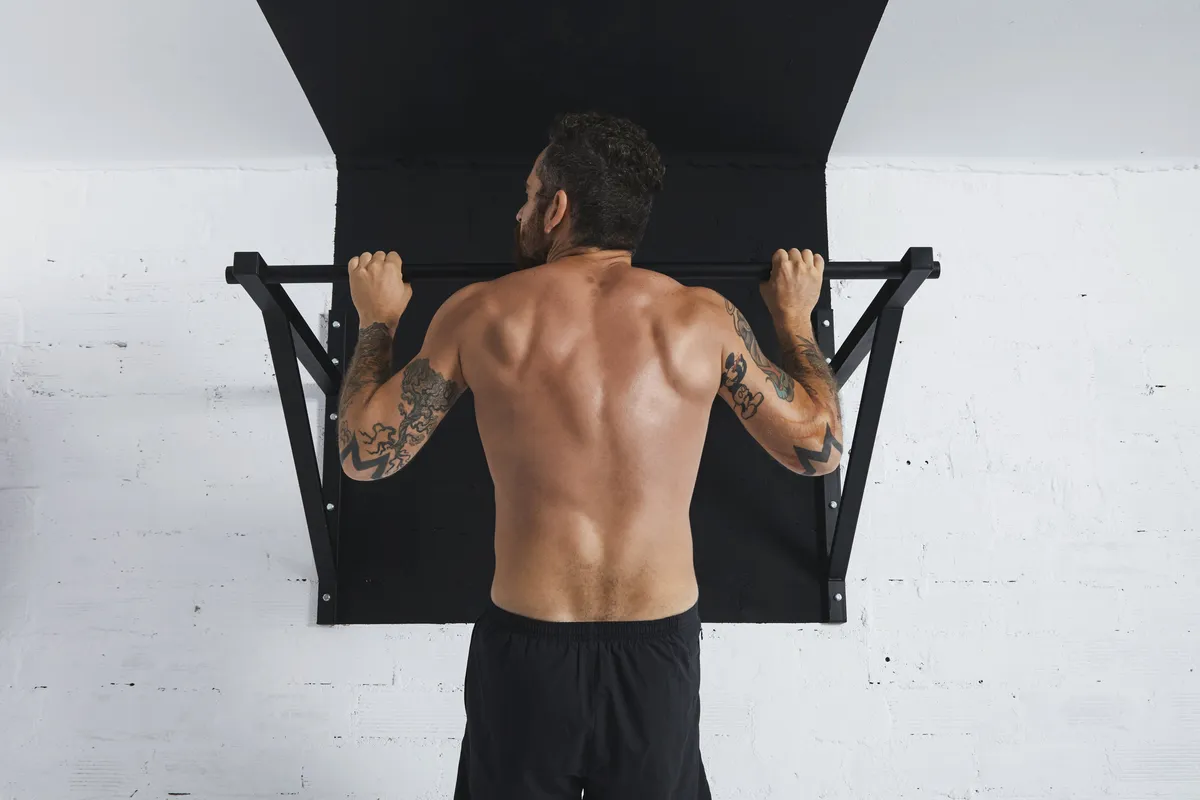 Pull-up correct technique
Key points for the pull-up: full hang at the bottom, chin above the bar at the top.
Pull-up correct technique
Key points for the pull-up: full hang at the bottom, chin above the bar at the top.
Program: Zero to Your First Rep
If you can't do a single rep yet, this 4–6 week program will get you there.
Weeks 1–2: Building Base Strength
Do 3× per week:
| Exercise | Sets | Reps/Time |
|---|---|---|
| Dead hang | 3 | 20–30 sec |
| Assisted pull-up (resistance band) | 3 | 5–8 |
| Lat pulldown | 3 | 10–12 |
| Negatives (descent only) | 3 | 3–5 |
Weeks 3–4: Negative Focus
Do 3× per week:
| Exercise | Sets | Reps/Time |
|---|---|---|
| Dead hang | 3 | 30–45 sec |
| Negatives (5 sec descent) | 5 | 3 |
| Assisted pull-up | 3 | 6–8 |
| Bent-over row | 3 | 10 |
Weeks 5–6: Toward Your First Rep
Do 3× per week:
| Exercise | Sets | Reps |
|---|---|---|
| Attempt a pull-up | 1 | Max effort |
| Negatives (6–8 sec descent) | 5 | 2–3 |
| Assisted (lighter band) | 4 | 4–6 |
| Isometric hold at top | 3 | 10–15 sec |
💡 Tip: When you get your first rep, celebrate! Then move on to the next program.
Program: 1 to 10 Reps
You got your first rep — now let's build the numbers.
Greasing the Groove Method
Do several small sets throughout the day, every day:
| Your max | Reps per set | Sets per day |
|---|---|---|
| 1 rep | 1 | 5–6 |
| 2–3 reps | 1–2 | 5–6 |
| 4–5 reps | 2–3 | 4–5 |
| 6–7 reps | 3–4 | 4–5 |
| 8–10 reps | 4–5 | 3–4 |
Alternative Weekly Program
Do 3× per week:
| Day | Program |
|---|---|
| Mon | 5 sets of max reps (2 min rest) |
| Wed | 3 × 50% of max + 3 × negatives |
| Fri | Pyramid: 1-2-3-2-1 (or as far as you can get) |
 Pull-up progression
Consistent training produces results — track your progression.
Pull-up progression
Consistent training produces results — track your progression.
Most Common Mistakes
1. Kipping (Swinging)
Problem: Using momentum to get yourself up.
Fix: Perform every rep under control. Engage your core to prevent swinging.
2. Partial Reps
Problem: Not going all the way down or all the way up.
Fix: Always start from a dead hang. Chin over the bar on every rep.
3. Shoulders by the Ears
Problem: Not activating the shoulder blades — shoulders rise toward the ears.
Fix: Before pulling, draw shoulder blades down and back. Keep them active throughout the movement.
4. Progressing Too Fast
Problem: Attempting harder variations before mastering the current stage.
Fix: Master each phase before moving on. Read more about progressive overload.
Variations
Easier (for beginners)
| Variation | Description |
|---|---|
| Assisted (resistance band) | Band looped under foot reduces the load |
| Assisted machine | Knees on pad provides assistance |
| Negatives | Only the lowering phase — jump up, lower slowly |
| Australian pull-up | Lower bar, feet on ground, angled position |
Harder (for advanced athletes)
| Variation | Description |
|---|---|
| Wide-grip pull-up | Wider grip — more back emphasis |
| Archer pull-up | Shift weight from side to side |
| L-sit pull-up | Legs extended in front — brutal for core |
| Weighted | Dip belt + plates |
FAQ
How long does it take to learn a pull-up?
Depends on your starting point. Most people get their first rep in 4–8 weeks with consistent training. If you're overweight or have no strength training background, it may take longer — and that's completely fine.
Do you need to know how to do pull-ups before going to a gym?
No! The pull-up is an advanced movement. At the gym you can use the lat pulldown machine and assisted pull-up machine until you can do them with your own bodyweight. Read more in the beginner gym workout program.
Chin-up or pull-up — which one first?
Chin-up (palms facing you) is easier because the biceps contribute more. Start there and progress to pull-ups once you can do chin-ups comfortably.
How often should I train pull-ups?
3–5 times per week works best. Pull-ups are a bodyweight movement so recovery is faster than heavy strength training. The Greasing the Groove method (small sets throughout the day) works excellently. Read more about recovery from training.
Can I do pull-ups every day?
Yes, as long as you don't go to failure every set. In Greasing the Groove you do 50–70% of your max multiple times per day. If you're doing max-effort sets, take 1–2 rest days between sessions.
How do I get to 20 reps?
Once you reach 10 reps, add resistance: use a dip belt and add 2.5–5 kg, train 5×5 with added weight, and develop strength — the bodyweight reps will follow.
Summary
The pull-up is a skill anyone can learn. Remember:
- Start where you are — negatives and assisted reps are effective training
- Technique first — full reps, no swinging
- Train frequently — 3–5× per week, small sets
- Be patient — the first rep can take weeks
- Celebrate progress — every rep is a win
References
-
Youdas, J.W., et al. (2010). Surface electromyographic activation patterns and elbow joint motion during a pull-up, chin-up, or perfect-pullup rotational exercise. Journal of Strength and Conditioning Research, 24(12), 3404-3414. PubMed
-
Snarr, R.L., & Esco, M.R. (2013). Electromyographic comparison of traditional and suspension push-ups. Journal of Human Kinetics, 39, 75-83.
-
Hewit, J.K., et al. (2018). Understanding the pull-up and chin-up: a biomechanical analysis. Strength and Conditioning Journal, 40(4), 52-58.
-
McGill, S.M., et al. (2014). Analysis of pushing exercises: muscle activity and spine load while contrasting techniques on stable surfaces with a labile suspension strap training system. Journal of Strength and Conditioning Research, 28(1), 105-116.
Want to track your pull-up progress? Join Tsemppi — the app tracks your progression and keeps you motivated. Start your 7-day free trial today, no credit card required.


