

"I didn't skip leg day" — a phrase every gym-goer knows. Yet leg day remains by far the most skipped training session. In 2026, that ends. This guide gives you everything you need: ready-made programs, the right exercises, technique tips, and a progression model to build genuinely strong legs.
Why Leg Training Is Personal to Me
I'll admit it: I skipped leg day for years. I did bench press and bicep curls like a religion, but squats were always "tomorrow." Then came the day I caught the truth in the mirror — my upper body had grown, but my legs looked exactly the same as before I ever set foot in a gym.
But the appearance wasn't the biggest problem. I realized that without strong legs, my entire progress had plateaued. My deadlift wasn't going up. My leg drive on the bench was non-existent. I had literally built a house without a foundation.
The turning point came when I started squatting systematically. In three months my squat went from 60 kg to 100 kg — and at the same time, every other lift improved. Legs are the body's largest muscle group, and when they get stronger, the whole body benefits.
Now I'm going to help you do the same — without the mistakes I made.
"Legs are your body's foundation. Without strong legs, you're building on sand — it looks great until it doesn't hold." – Pietari Risku, Founder of Tsemppi
Table of Contents
- Why is leg training so important?
- Leg anatomy for lifters
- Best leg workout exercises
- Leg workout program for beginners
- Leg workout program for intermediate lifters
- Leg workout program for advanced lifters
- Leg training within different programs
- Leg training progression model
- Technique tips for key exercises
- Most common mistakes in leg training
- Leg training and recovery
- Leg training without a gym
- FAQ
- Summary
Why Is Leg Training So Important?
Leg training isn't an optional add-on — it's the foundation of all training. Here's why:
The Science
Leg muscles make up over 50% of total body muscle mass. Research shows that lower body training:
- Significantly raises testosterone and growth hormone levels — more so than upper body training (Shaner et al., 2014)
- Boosts metabolism — large muscle groups burn more energy even at rest
- Improves athletic performance in nearly every sport (Suchomel et al., 2016)
- Prevents injuries by strengthening the structures that support the knees, hips, and ankles
Practical Benefits
| Benefit | Explanation |
|---|---|
| Overall strength | Legs are the source of power in almost every lift |
| Body proportions | Prevents the "wide on top, narrow on bottom" look |
| Everyday function | Stairs, lifting, carrying — everything gets easier |
| Fat burning | Large muscle groups consume the most calories |
| Hormonal response | Heavy leg sessions raise anabolic hormone levels |
| Injury prevention | Strong legs protect the knees and lower back |
What Happens When You Skip Leg Day?
The upper/lower body imbalance isn't just an aesthetic problem. It leads to:
- Lower back pain (weak hamstrings and glutes fail to support the spine)
- Knee problems (quads dominate, hamstrings fall behind)
- Declining athletic performance
- A performance ceiling on all other lifts
Leg Anatomy for Lifters
Effective leg training requires understanding which muscles you're training. Legs aren't one muscle — they're a complex system that demands varied training.
Quadriceps (Quadriceps femoris)
The quadriceps is the body's largest single muscle group, made up of four heads:
- Rectus femoris — the only head that crosses the hip joint
- Vastus lateralis — outer side of the thigh
- Vastus medialis — inner side of the thigh ("teardrop" above the knee)
- Vastus intermedius — deep in the center of the thigh
Primary function: Knee extension (squats, leg press, leg extensions)
Hamstrings
Three muscles along the back of the thigh:
- Biceps femoris — long and short head
- Semitendinosus
- Semimembranosus
Primary function: Knee flexion and hip extension (Romanian deadlift, leg curl)
Glutes (Gluteus)
The body's most powerful muscle group:
- Gluteus maximus — the largest single muscle in the entire body
- Gluteus medius — side of the hip
- Gluteus minimus — deepest glute muscle
Primary function: Hip extension, external rotation, and abduction (squats, hip thrust, lunges)
Calves (Triceps surae)
- Gastrocnemius — superficial, two heads, the most visible part of the calf
- Soleus — deeper, endurance-oriented muscle
Primary function: Ankle plantarflexion (calf raises)
Hip Adductors and Abductors
Often overlooked but important stabilizing muscles:
- Adductors (inner thigh)
- Abductors (outer thigh, gluteus medius)
Why this matters: When you understand the anatomy, you can build a program that truly trains every part — not just the quads with squats and then head home.
Best Leg Workout Exercises
Compound Movements (prioritize these)
Compound movements activate multiple muscle groups simultaneously and allow the heaviest loads. These are the cornerstone of leg training.
1. Squat (Back Squat)
The king of all exercises. Activates quads, glutes, hamstrings, and core.
| Attribute | Details |
|---|---|
| Target muscles | Quads, glutes, hamstrings |
| Type | Compound |
| Equipment | Barbell + rack |
| Difficulty | Intermediate–Advanced |
Read the full squat guide.
2. Romanian Deadlift (RDL)
The single best movement for hamstrings and glutes. Differs from the conventional deadlift through its hip-hinge-dominant pattern.
| Attribute | Details |
|---|---|
| Target muscles | Hamstrings, glutes, lower back |
| Type | Compound |
| Equipment | Barbell or dumbbells |
| Difficulty | Intermediate |
3. Leg Press
A safe way to load the legs heavily without stressing the back. A solid option for those for whom squatting isn't possible.
| Attribute | Details |
|---|---|
| Target muscles | Quads, glutes (depending on foot placement) |
| Type | Compound (machine) |
| Equipment | Leg press machine |
| Difficulty | Beginner–Advanced |
4. Lunges
An excellent unilateral (single-leg) movement that reveals and corrects strength imbalances between sides.
| Attribute | Details |
|---|---|
| Target muscles | Quads, glutes, balance |
| Type | Compound |
| Equipment | Dumbbells, barbell, or bodyweight |
| Difficulty | Beginner–Advanced |
5. Bulgarian Split Squat
A favorite of many coaches for leg development. Combines strength, mobility, and balance in one movement.
| Attribute | Details |
|---|---|
| Target muscles | Quads, glutes, hip flexors (stretch) |
| Type | Compound, unilateral |
| Equipment | Dumbbells + bench |
| Difficulty | Intermediate–Advanced |
6. Hip Thrust
The king of glute activation. Scientifically proven to be the best exercise for isolating the gluteus maximus (Contreras et al., 2015).
| Attribute | Details |
|---|---|
| Target muscles | Glutes (primary), hamstrings |
| Type | Compound |
| Equipment | Barbell + bench |
| Difficulty | Beginner–Advanced |
7. Deadlift
A full-body strength movement that loads the posterior chain especially hard: hamstrings, glutes, and back.
| Attribute | Details |
|---|---|
| Target muscles | Hamstrings, glutes, back, core |
| Type | Compound |
| Equipment | Barbell |
| Difficulty | Intermediate–Advanced |
Read the full deadlift guide.
Isolation Movements (finish with these)
Isolation movements target a single muscle group at a time. Use these after compound work to round out the session.
8. Leg Extension
Perfectly isolates the quads. Great for warming up or finishing the session.
9. Leg Curl
Isolates the hamstrings. Important for full hamstring development — RDL alone isn't enough.
10. Calf Raises
Calves need their own isolated work. Squats and leg press aren't sufficient for calf development.
- Standing: Emphasizes the gastrocnemius
- Seated: Emphasizes the soleus
11. Hip Adduction/Abduction
Often forgotten but important for hip stability and knee health.
Exercise Summary
| Exercise | Primary target | Priority |
|---|---|---|
| Squat | Quads, glutes | ⭐⭐⭐ Highest |
| Romanian deadlift | Hamstrings, glutes | ⭐⭐⭐ Highest |
| Leg press | Quads | ⭐⭐ High |
| Lunge | Quads, glutes | ⭐⭐ High |
| Hip thrust | Glutes | ⭐⭐ High |
| Bulgarian split squat | Quads, glutes | ⭐⭐ High |
| Deadlift | Posterior chain | ⭐⭐ High |
| Leg extension | Quads | ⭐ Moderate |
| Leg curl | Hamstrings | ⭐ Moderate |
| Calf raises | Calves | ⭐ Moderate |
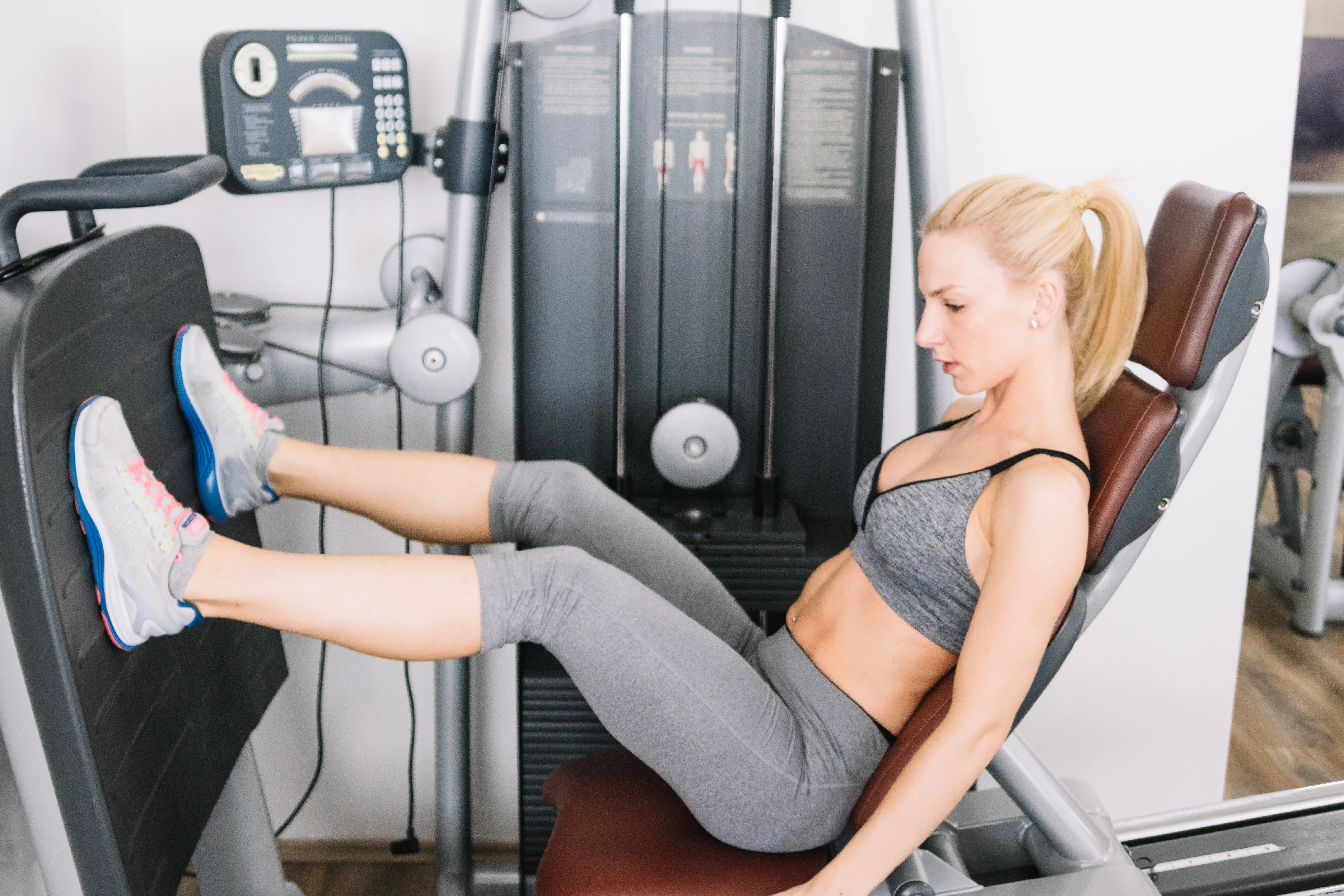 Leg workout exercises 2026
A well-rounded leg workout combines compound movements and isolation exercises into a balanced whole.
Leg workout exercises 2026
A well-rounded leg workout combines compound movements and isolation exercises into a balanced whole.
Leg Workout Program for Beginners
If you've been training for less than a year, start here. Focus on technique and consistency — not maximum weights.
Beginner Leg Workout (1× per week)
| Exercise | Sets × Reps | Rest | Notes |
|---|---|---|---|
| Leg press | 3×10–12 | 90 sec | Safe to learn on; start here |
| Goblet squat | 3×10–12 | 90 sec | Dumbbell held at chest |
| Romanian deadlift (dumbbells) | 3×10–12 | 90 sec | Learn the hip hinge with light weight first |
| Walking lunge | 2×10/leg | 60 sec | Bodyweight or light dumbbells |
| Leg curl | 2×12–15 | 60 sec | Machine, controlled movement |
| Standing calf raise | 3×15–20 | 45 sec | Full range of motion, stretch at the bottom |
Total volume: 16 sets Duration: ~45–55 minutes Goal: Learning technique and building muscle memory
Beginner Leg Work (as part of a full-body program)
If you train with a full-body program 3× per week, your leg work per session can be simpler:
| Exercise | Sets × Reps | Rest |
|---|---|---|
| Squat (goblet or barbell) | 3×8–10 | 2 min |
| Romanian deadlift | 3×10–12 | 90 sec |
| Leg press | 2×10–12 | 90 sec |
This way legs get trained 3× per week, which research shows is optimal for beginners (Schoenfeld et al., 2016).
Tips for Beginners
Technique first, weight second. Learn the squat with an empty bar or goblet variation before adding load.
Start with machines. The leg press is a safe way to load the legs without the balance demands of free weights.
Don't fear muscle soreness. The DOMS (delayed onset muscle soreness) in the first few weeks is normal — it fades as your body adapts.
Log everything. Record every session in a training app or notebook. Progression starts with tracking.
Leg Workout Program for Intermediate Lifters
After 1–3 years of training with solid technique on the fundamentals, it's time to add volume and intensity.
Intermediate Leg Workout A (Quad Focus)
| Exercise | Sets × Reps | Rest | RPE |
|---|---|---|---|
| Back squat | 4×6–8 | 2–3 min | 8 |
| Leg press | 3×10–12 | 90 sec | 7–8 |
| Bulgarian split squat | 3×8–10/leg | 90 sec | 7–8 |
| Leg extension | 3×12–15 | 60 sec | 8–9 |
| Standing calf raise | 4×10–12 | 60 sec | 8 |
Intermediate Leg Workout B (Hamstring & Glute Focus)
| Exercise | Sets × Reps | Rest | RPE |
|---|---|---|---|
| Romanian deadlift | 4×6–8 | 2–3 min | 8 |
| Hip thrust | 4×8–10 | 90 sec | 8 |
| Walking lunge | 3×10/leg | 90 sec | 7–8 |
| Leg curl | 3×10–12 | 60 sec | 8–9 |
| Seated calf raise | 4×12–15 | 60 sec | 8 |
Weekly Structure (as part of an Upper/Lower program)
This program works best within a 2-day Upper/Lower split:
| Day | Session |
|---|---|
| Monday | Upper A |
| Tuesday | Lower A (quad focus) |
| Wednesday | Rest |
| Thursday | Upper B |
| Friday | Lower B (hamstring/glute focus) |
| Saturday | Rest |
| Sunday | Rest |
Total weekly volume: 17–18 sets per leg session, 34–36 sets per week Duration: ~55–70 minutes per session
Leg Workout Program for Advanced Lifters
With 3+ years of training experience, you need more volume, variation, and strategic periodization.
Advanced Leg Workout A (Strength + Hypertrophy)
| Exercise | Sets × Reps | Rest | RPE |
|---|---|---|---|
| Back squat | 5×3–5 | 3–4 min | 8–9 |
| Hack squat | 4×8–10 | 2 min | 8 |
| Leg press (narrow stance) | 3×12–15 | 90 sec | 8–9 |
| Leg extension (drop set) | 3×10–12 + drop | 60 sec | 9–10 |
| Standing calf raise | 5×8–10 | 60 sec | 8–9 |
Advanced Leg Workout B (Hypertrophy + Posterior Chain)
| Exercise | Sets × Reps | Rest | RPE |
|---|---|---|---|
| Romanian deadlift | 4×5–7 | 3 min | 8–9 |
| Hip thrust | 4×8–10 | 2 min | 8–9 |
| Bulgarian split squat | 3×8–10/leg | 90 sec | 8 |
| Leg curl (Nordic curl) | 3×6–8 | 90 sec | 9 |
| Hip adduction | 3×12–15 | 60 sec | 8 |
| Seated calf raise | 4×12–15 | 60 sec | 8–9 |
Advanced Techniques
Drop sets: Complete a set, reduce weight by 20–30%, and continue immediately without rest. Excellent for metabolic overload on leg extensions and leg press.
Pause squats: Pause for 2–3 seconds at the bottom of the squat. Eliminates the stretch reflex and forces the muscles to work through the full range under load.
1.5-rep method: Go down, rise halfway, go back down, then stand up fully. One 1.5-rep = one rep. Doubles the time under tension in the bottom position.
Myo-reps: Perform an activation set (12–15 reps at RPE 8–9), rest 5 seconds, do 3–5 reps. Repeat 3–4 times. An efficient way to accumulate volume quickly.
Leg Training Within Different Programs
Leg training doesn't exist in isolation — it's part of a bigger picture. Here's how it fits into common program structures:
Full Body (1 split) — 3× per week
Include 2–3 leg exercises per session. Best for beginners.
| Session | Leg exercises |
|---|---|
| Session 1 | Squat 3×8, RDL 3×10 |
| Session 2 | Leg press 3×10, lunge 2×10 |
| Session 3 | Squat 3×6, hip thrust 3×10 |
Weekly leg volume: 14–17 sets
Upper/Lower (2 split) — 4× per week
Two dedicated leg sessions per week. The best option for most lifters. Read the Upper/Lower program guide.
Weekly leg volume: 28–36 sets
Push/Pull/Legs (3 split) — 3–6× per week
A dedicated leg day 1–2 times per week. Read the PPL guide.
| PPL frequency | Leg sessions |
|---|---|
| 1× through (3 days/week) | 1 leg session/week (14–18 sets) |
| 2× through (6 days/week) | 2 leg sessions/week (28–36 sets) |
Recommendation: If you run PPL only once through per week, make your leg day comprehensive since it's your only leg session of the week.
How Much Leg Volume Per Week?
| Experience level | Sets per muscle group/week | Recommended split |
|---|---|---|
| Beginner | 10–12 | Full body 3× |
| Intermediate | 14–18 | Upper/Lower 4× |
| Advanced | 18–24+ | PPL 6× or Upper/Lower 4× |
(Schoenfeld et al., 2017)
Leg Training Progression Model
Without progression there is no development. Here is a concrete model for advancing your leg training:
Double Progression for Leg Training
The best method for most lifters. Works equally well for squats and isolation exercises.
For primary lifts (squat, RDL, leg press):
| Week | Squat | Reps |
|---|---|---|
| 1 | 80 kg | 6, 6, 6, 6 |
| 2 | 80 kg | 7, 6, 6, 6 |
| 3 | 80 kg | 7, 7, 7, 6 |
| 4 | 80 kg | 8, 8, 7, 7 |
| 5 | 80 kg | 8, 8, 8, 8 → INCREASE WEIGHT |
| 6 | 82.5 kg | 6, 6, 6, 6 |
For isolation exercises (leg extension, leg curl, calf raises):
Same principle, but with a higher rep range (10–15) and smaller weight increments.
Linear Progression for Beginners
In the first few months, you can add weight every single week:
- Squat: +2.5 kg per week
- Leg press: +5 kg per week
- RDL: +2.5 kg per week
This typically works for 3–6 months before progression slows.
Periodization for Advanced Lifters
Rotate the training emphasis in 4–6 week blocks:
| Phase | Weeks | Focus | Reps | Intensity |
|---|---|---|---|---|
| Volume | 1–4 | High sets, moderate weight | 8–12 | RPE 7 |
| Intensity | 5–8 | Fewer sets, heavier weight | 4–6 | RPE 8–9 |
| Peak | 9–10 | Testing / new PRs | 1–3 | RPE 9–10 |
| Deload | 11 | Light week | 8–10 | RPE 5–6 |
Read more about progressive overload.
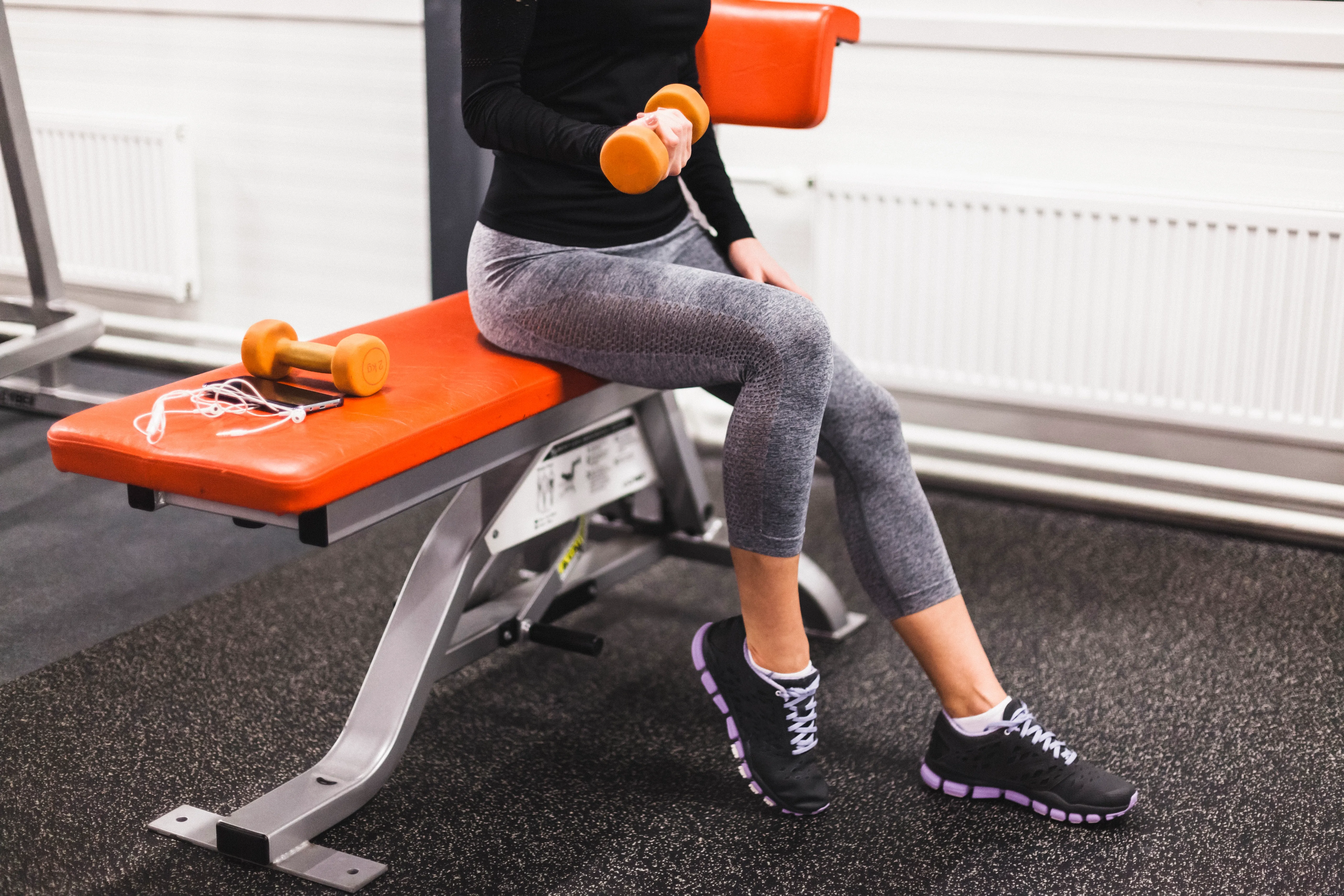 Leg training progression 2026
Systematic progression is the only way to build genuinely stronger legs over the long term.
Leg training progression 2026
Systematic progression is the only way to build genuinely stronger legs over the long term.
Technique Tips for Key Exercises
Squat Technique in Brief
- Bar position: On the upper traps (high bar) or across the rear delts (low bar)
- Foot width: Slightly wider than shoulder-width
- Toe angle: Turned slightly out (~30 degrees)
- Descent: Push knees out in line with toes, keep chest up
- Depth: At least parallel (hip crease level with the top of the knee)
- Ascent: Drive feet into the floor, keep core braced
- Breathing: Inhale and brace at the top, exhale at the completion of the ascent
Most common mistake: Knees caving inward (valgus). Fix: activate the glutes and consciously push the knees out.
Full technique guide: Squat program.
Romanian Deadlift Technique
- Starting position: Bar in hand, shoulder-width grip, feet hip-width apart
- Descent: Push your hips back as if sitting toward a chair, keep bar close to the legs
- Knees: Slight bend, but they stay still — all movement comes from the hip
- Back: Straight THE ENTIRE TIME, shoulder blades pulled back
- Bottom position: When you feel a stretch in the hamstrings (typically below the knee)
- Ascent: Squeeze glutes and drive hips forward
Most common mistake: Lower back rounds. Fix: lighten the weight and focus on the hip hinge.
Hip Thrust Technique
- Setup: Upper back on the edge of a bench, barbell across the hips (use padding)
- Feet: Flat on the floor, knees at roughly 90 degrees at the top
- Movement: Drive hips up by squeezing glutes, keep chin slightly tucked
- Top position: Body in a straight line from knees to shoulders
- Bottom position: Controlled descent, glutes just above the floor
Most common mistake: Hips don't rise high enough, or the lower back does the work. Fix: focus on squeezing the glutes hard at the top.
Most Common Mistakes in Leg Training
1. Skipping Leg Day
Mistake: "I'll do legs next week."
Reality: Leg day takes the most mental energy, which is exactly why it's the easiest to skip. Fix: schedule leg training early in the week (Monday or Tuesday) when motivation is highest.
2. Only Training Quads
Mistake: Squat, leg press, leg extension — and then leave.
Fix: Every leg session must include both quad and hamstring work. A good rule of thumb: equal sets for quads and hamstrings.
3. "Deep Squats Are Dangerous"
Mistake: Half squats because "deep squats are bad for the knees."
Reality: Research shows that deep squats (thighs at least parallel to the floor) are safe and produce better results than partial squats (Hartmann et al., 2013). Partial squats can actually load the knees more because the weight is heavier.
4. Neglecting Calves
Mistake: "Squats work the calves enough."
Reality: Squats activate the calves minimally. Calves need dedicated isolation work — at least 8–12 sets per week.
5. Always the Same Rep Range
Mistake: 3×10 for every exercise, every week.
Fix: Vary your rep ranges: heavy movements 4–6 reps, moderate 8–12, lighter 12–20. Different rep ranges stimulate different types of adaptation.
6. Sacrificing Range of Motion for Weight
Mistake: Thighs never reach parallel because the weight is too heavy.
Fix: Reduce the weight and use full range of motion. A half squat at 100 kg is less valuable than a full squat at 60 kg.
7. Skipping the Warm-Up
Mistake: Going straight to a loaded barbell.
Fix: Start with an empty bar and complete 2–3 progressive warm-up sets. For example: 20 kg×10, 40 kg×5, 60 kg×3, 80 kg×2 before working sets.
Leg Training and Recovery
Leg training places the greatest demand on the body. That's why recovery is especially important.
Recovery Fundamentals
| Factor | Recommendation | Why it matters |
|---|---|---|
| Sleep | 7–9 hours | Growth hormone is released during deep sleep |
| Protein | 1.6–2.2 g/kg/day | Building blocks for muscle repair |
| Water | 2–3 liters/day | Dehydration impairs performance by 10–20% |
| Recovery time | 48–72 hours | Legs require the most recovery time |
| Deload | Every 4–6 weeks | Prevents cumulative overload |
Nutrition Around Leg Training
Before training (1–2 hours):
Carbohydrates for energy — e.g., banana and oatmeal, or rice and chicken. Target: 30–50 g of carbohydrates.
After training (0–2 hours):
Protein and carbohydrates for recovery — e.g., protein shake and fruit, or a full meal. Target: 30–40 g protein, 40–60 g carbohydrates.
Read more about protein intake for muscle growth.
Active Recovery
Heavy leg training can cause 2–3 days of soreness, especially early on. Recovery is accelerated by:
- Easy walking the next day (20–30 min)
- Foam rolling — quads, hamstrings, and glutes
- Light stretching — calm mobility work, not aggressive
- Sauna — promotes blood flow and may speed recovery
Read our full guide on recovery from training.
Leg Training Without a Gym
No gym? No problem. Legs can be trained effectively at home with bodyweight or minimal equipment.
Bodyweight Leg Workout (no equipment)
| Exercise | Sets × Reps | Rest |
|---|---|---|
| Bulgarian split squat (using a chair) | 3×12–15/leg | 60 sec |
| Pistol squat (or single-leg sit-to-chair) | 3×6–10/leg | 90 sec |
| Single-leg glute bridge | 3×12–15/leg | 60 sec |
| Wall sit (isometric hold) | 3×30–45 sec | 60 sec |
| Single-leg calf raise (on a step) | 3×15–20/leg | 45 sec |
| Lateral lunge | 3×12–15/leg | 60 sec |
With Minimal Equipment (dumbbells + resistance band)
| Exercise | Sets × Reps | Rest |
|---|---|---|
| Goblet squat | 4×10–12 | 90 sec |
| Romanian deadlift (dumbbells) | 4×10–12 | 90 sec |
| Walking lunge (dumbbells) | 3×10/leg | 60 sec |
| Hip thrust (dumbbell on hips) | 3×12–15 | 60 sec |
| Banded hip abduction | 3×15–20 | 45 sec |
| Calf raise (holding dumbbell) | 4×15–20 | 45 sec |
Read more about home workout programs.
FAQ
How often should I train legs per week?
The optimal frequency is 2 times per week. Research shows that training a muscle group 2× per week produces significantly better results than 1× per week (Schoenfeld et al., 2016). For beginners, 2–3 times as part of full-body sessions; for intermediate lifters, 2 dedicated leg sessions per week.
How many sets per leg workout?
For beginners: 10–12 sets per muscle group per week; intermediate: 14–18; advanced: 18–24+. In practice, this means 14–20 sets per leg session depending on experience level (Schoenfeld et al., 2017).
Can I train legs on consecutive days?
Not recommended. Leg muscles need 48–72 hours to recover. If you train legs twice a week, keep at least 2 rest days between sessions (e.g., Tuesday + Friday).
What are the best leg exercises?
The squat is the undisputed number one. After that, the most important are Romanian deadlift (hamstrings), leg press (safe volume), and hip thrust (glutes). For detailed movement guides, see the squat program and deadlift program.
Leg training vs. running?
They don't replace each other. Leg training builds strength and muscle mass; running develops endurance. The optimal combination: 2× leg training + 1–2× running per week. Running doesn't replace strength training for muscle growth or strength development.
Is leg press as good as squatting?
Not quite. Squats activate more stabilizing muscles (core, glutes, balance) than the leg press. But leg press is an excellent supplementary movement and a safe alternative for those who can't squat due to back issues or similar.
How do I fix "chicken legs"?
Consistency is the key. Train legs 2× per week, focus on the big compound movements, progressively increase the weight, and eat enough (especially protein). With 6–12 months of consistent leg work, you'll see a significant difference.
Does leg day require cardio?
You don't need to add separate cardio to leg day. Heavy leg training already drives your heart rate high on its own. If you want to add cardio on leg day, do it after — 15–20 minutes of easy walking or cycling actually promotes recovery.
What's a good squat benchmark?
Common reference points for men: bodyweight = beginner, 1.5× bodyweight = intermediate, 2× bodyweight = advanced. For women: 0.75× bodyweight = beginner, 1× bodyweight = intermediate, 1.5× bodyweight = advanced. These are guidelines — your own progression is what matters most.
Summary
Leg training is the foundation of all training — whether your goal is muscle growth, strength, fat loss, or athletic performance. Here are the key takeaways:
The cornerstones of leg training:
- Train legs 2× per week — research-proven optimal frequency
- Prioritize compound movements — squat, RDL, leg press, lunges
- Train both quads and hamstrings — balance prevents injuries
- Don't forget glutes and calves — hip thrust and calf raises belong in every program
- Track your progression — log sessions and increase weight systematically
- Recover properly — 48–72 hours, sufficient sleep and protein
Realistic targets for 2026:
| Experience level | Squat progress/year | Leg muscle growth |
|---|---|---|
| Beginner | +30–50 kg | Significant |
| Intermediate | +15–25 kg | Moderate |
| Advanced | +5–15 kg | Slow but steady |
Don't be the person who skips leg day. Start today — your future self will thank you.
Also read these guides to support your leg training:
- Workout Program 2026: Complete Guide to Results
- Squat Program: Technique and Programming
- Deadlift Program: Technique and Programming
- Progressive Overload Training
- 2-Day Split Workout: Upper/Lower
References
-
Schoenfeld, B.J., et al. (2016). Effects of Resistance Training Frequency on Measures of Muscle Hypertrophy: A Systematic Review and Meta-Analysis. Sports Medicine, 46(11), 1689-1697. PubMed
-
Schoenfeld, B.J., et al. (2017). Dose-response relationship between weekly resistance training volume and increases in muscle mass. Journal of Sports Sciences, 35(11), 1073-1082. PubMed
-
Shaner, A.A., et al. (2014). The acute hormonal response to free weight and machine weight resistance exercise. Journal of Strength and Conditioning Research, 28(4), 1032-1040. PubMed
-
Suchomel, T.J., et al. (2016). The Importance of Muscular Strength in Athletic Performance. Sports Medicine, 46(10), 1419-1449. PubMed
-
Contreras, B., et al. (2015). A comparison of gluteus maximus, biceps femoris, and vastus lateralis electromyographic activity in the back squat and barbell hip thrust exercises. Journal of Applied Biomechanics, 31(4), 452-458. PubMed
-
Hartmann, H., et al. (2013). Analysis of the load on the knee joint and vertebral column with changes in squatting depth and weight load. Sports Medicine, 43(10), 993-1008. PubMed
-
Ratamess, N.A., et al. (2009). Progression Models in Resistance Training for Healthy Adults. Medicine & Science in Sports & Exercise, 41(3), 687-708. PubMed
Want a personalized leg workout program? Join Tsemppi — the AI builds you a complete leg training plan based on your goals, tracks your progression, and tells you exactly when it's time to increase the weight. Start your 7-day free trial today, no credit card required.


