

The Upper/Lower split is one of the most effective and practical workout programs you can follow. It delivers the perfect balance of simplicity, volume, and recovery. Research shows that training each muscle group twice per week produces 3.1% greater muscle growth than once per week (Schoenfeld et al., 2016) — and the Upper/Lower split makes this effortless to achieve. If you have 4 days per week to train, this guide is for you.
Why the Upper/Lower Split Is the Golden Standard
When I started lifting, I made the classic mistake: jumping straight into a 5-day "bro split" where each muscle group got its own dedicated day. Chest Monday, back Tuesday, shoulders Wednesday... Sounds logical, right?
The problem: every muscle only got stimulated once a week. And when life got in the way — illness, travel, family commitments — an entire muscle group got skipped. In two weeks I might train chest only once.
Then I discovered the Upper/Lower split.
Everything became simpler overnight. Two workouts to remember instead of four or five. Every muscle trained twice a week. If I missed a session, no problem — the same muscle group came back around in a few days.
The Upper/Lower split isn't the most "glamorous" program out there. But it works. And it works especially well for people who have a life outside the gym.
"Complexity is not a sign of a good program. Simplicity, consistency, and progressive overload are. The Upper/Lower split delivers all three." – Pietari Risku, Founder of Tsemppi
Table of Contents
- What is an Upper/Lower Split?
- Benefits and Drawbacks
- Who Should Use the Upper/Lower Split?
- Weekly Schedules: 3, 4 and 5 Days
- Upper Body Day: Exercises and Program
- Lower Body Day: Exercises and Program
- Complete Upper/Lower Program for Beginners
- Complete Upper/Lower Program for Intermediate Lifters
- Upper/Lower vs. Other Splits
- Progressive Overload in the Upper/Lower Split
- Most Common Mistakes and How to Avoid Them
- FAQ
- Summary
What is an Upper/Lower Split?
An Upper/Lower split divides your body into two separate workouts: upper body and lower body.
Upper Body Day
All muscles above the waist:
- Chest (pectoralis major)
- Back (latissimus dorsi, trapezius, rhomboids)
- Shoulders (deltoids)
- Biceps
- Triceps
Lower Body Day
All muscles below the waist:
- Quads (quadriceps)
- Hamstrings
- Glutes
- Calves
- Core (typically trained on lower days)
Other 2-Day Split Variations
| Split | Day 1 | Day 2 |
|---|---|---|
| Upper/Lower (most popular) | Upper body | Lower body |
| Push/Pull | Push + legs | Pull + legs |
| Anterior/Posterior | Front (chest, quads) | Back (back, hamstrings) |
Upper/Lower is the most popular and practical of these — and it's what this guide focuses on.
Benefits and Drawbacks
✅ Benefits
| Benefit | Explanation |
|---|---|
| High frequency | Every muscle trained 2x per week (on a 4-day schedule) |
| Simplicity | Only 2 different workouts to remember |
| Balance | Push/pull balance built in automatically |
| Flexibility | Works with 3, 4 or 5 training days per week |
| Recovery | 48–72 hours of rest per muscle group |
| Time-efficient | 4 sessions per week is enough for excellent results |
❌ Drawbacks
| Drawback | Explanation |
|---|---|
| Limited volume per muscle per session | Upper day covers 5 muscle groups — less time for each |
| Longer sessions | Upper days can run 60–90 minutes |
| Fewer isolation exercises | Not much room for endless curl variations |
| Not optimal for specialization | If you want to maximize a single muscle group |
Who Should Use the Upper/Lower Split?
✅ The Upper/Lower Split is for you if:
- You can train 3–5 days per week (optimal: 4)
- You are a beginner or intermediate lifter
- You want a simple but effective program
- You have a busy life and need a flexible schedule
- Your goal is general muscle growth and strength
- You want balanced development across your whole body
❌ The Upper/Lower Split is NOT for you if:
- You can only train 2 days per week (choose a full-body program)
- You want to train 6 days per week (choose a PPL split)
- You want to maximize a single muscle group (choose a higher-frequency split)
Recommendations by Experience Level
| Experience Level | Recommendation | Why |
|---|---|---|
| Complete beginner (0–3 months) | Full body | Learn the fundamentals first |
| Beginner (3–12 months) | Upper/Lower ⭐ | Optimal stimulus and recovery |
| Intermediate (1–3 years) | Upper/Lower or PPL | Both work well |
| Advanced (3+ years) | PPL or higher | More volume needed |
Weekly Schedules: 3, 4 and 5 Days
The greatest strength of the Upper/Lower split is its flexibility. You can shape it around your schedule.
4 Days Per Week ⭐ MOST POPULAR
The best option for most people. Every muscle trained twice per week with optimal recovery.
| Mon | Tue | Wed | Thu | Fri | Sat | Sun |
|---|---|---|---|---|---|---|
| Upper A | Lower A | Rest | Upper B | Lower B | Rest | Rest |
Alternative:
| Mon | Tue | Wed | Thu | Fri | Sat | Sun |
|---|---|---|---|---|---|---|
| Upper A | Rest | Lower A | Upper B | Rest | Lower B | Rest |
3 Days Per Week
Good for busy schedules. Alternating structure — every other week you get 2 upper sessions, then 2 lower sessions.
Week 1:
| Mon | Tue | Wed | Thu | Fri | Sat | Sun |
|---|---|---|---|---|---|---|
| Upper | Rest | Lower | Rest | Upper | Rest | Rest |
Week 2:
| Mon | Tue | Wed | Thu | Fri | Sat | Sun |
|---|---|---|---|---|---|---|
| Lower | Rest | Upper | Rest | Lower | Rest | Rest |
5 Days Per Week
For more experienced lifters who want higher frequency.
| Mon | Tue | Wed | Thu | Fri | Sat | Sun |
|---|---|---|---|---|---|---|
| Upper A | Lower A | Upper B | Rest | Lower B | Upper A | Rest |
Note: This structure gives you 3 upper sessions and 2 lower sessions per week. Flip it if you want to prioritize legs.
Upper Body Day: Exercises and Program
On upper day you train all muscles above the waist. Because there are many muscle groups to cover, focus on big compound movements.
Upper Day Priority Order
- Major push movement (bench press or overhead press)
- Major pull movement (row or lat pulldown)
- Secondary push movement
- Secondary pull movement
- Shoulder isolation (if time allows)
- Arm work (if time allows)
Best Upper Body Exercises
| Exercise | Primary Muscle | Type | Priority |
|---|---|---|---|
| Bench Press | Chest | Compound | ⭐⭐⭐ |
| Barbell Row | Back | Compound | ⭐⭐⭐ |
| Overhead Press | Shoulders | Compound | ⭐⭐⭐ |
| Lat Pulldown / Pull-Up | Back | Compound | ⭐⭐⭐ |
| Incline Press | Upper chest | Compound | ⭐⭐ |
| Cable Row | Back | Compound | ⭐⭐ |
| Face Pull | Rear delts | Isolation | ⭐⭐ |
| Bicep Curl | Biceps | Isolation | ⭐ |
| Tricep Pushdown | Triceps | Isolation | ⭐ |
Sample Upper Body Workout
| Exercise | Sets | Reps | Rest |
|---|---|---|---|
| Barbell Bench Press | 4 | 6–8 | 3 min |
| Barbell Row | 4 | 6–8 | 3 min |
| Dumbbell Overhead Press | 3 | 8–10 | 2 min |
| Wide-Grip Lat Pulldown | 3 | 8–10 | 2 min |
| Face Pull | 3 | 15–20 | 60 sec |
| Bicep Curl | 2 | 10–12 | 60 sec |
| Tricep Pushdown | 2 | 10–12 | 60 sec |
Duration: ~60–70 minutes
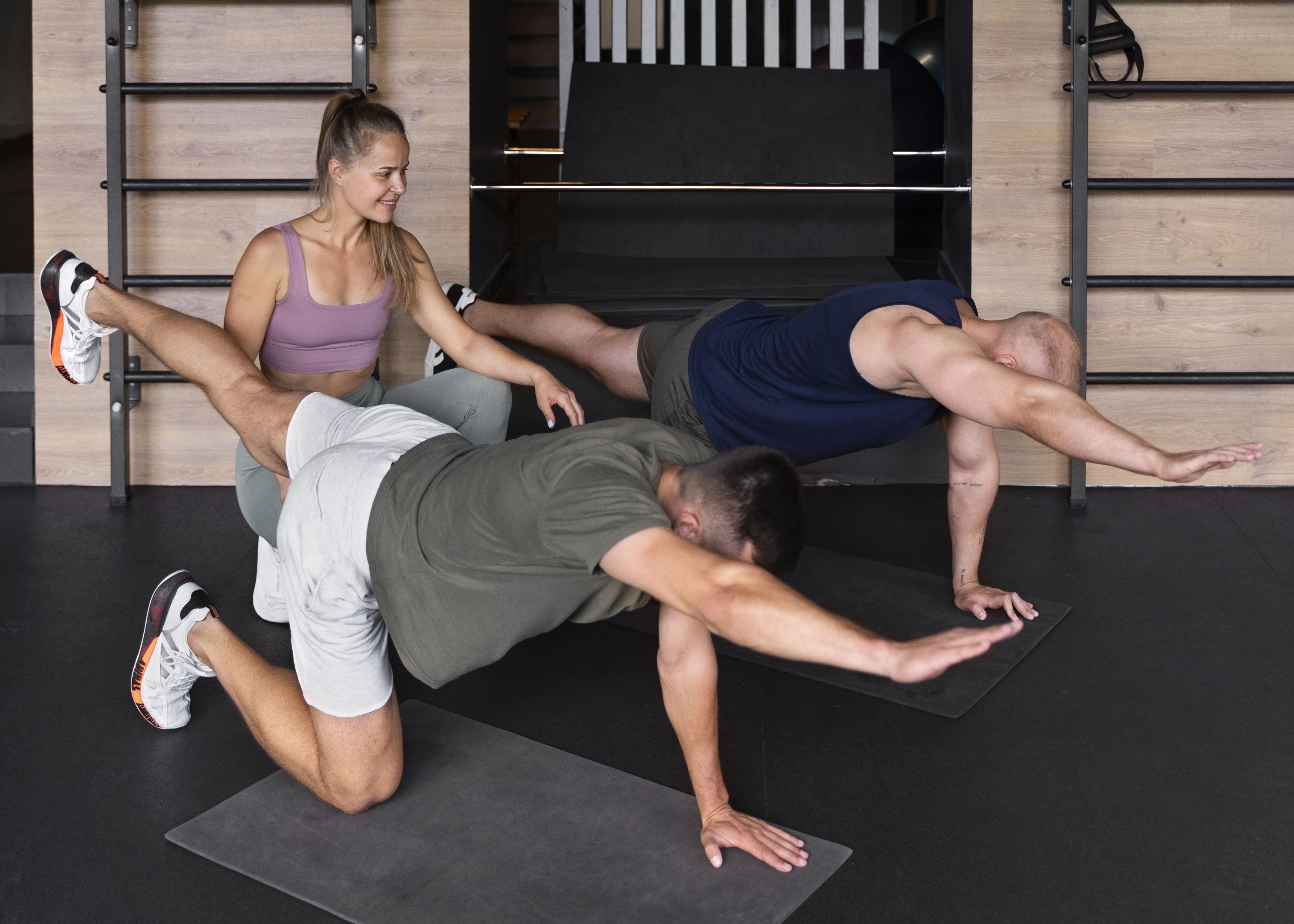 Upper body day in the Upper/Lower split workout program
On upper day you train all muscles above the waist: chest, back, shoulders, and arms.
Upper body day in the Upper/Lower split workout program
On upper day you train all muscles above the waist: chest, back, shoulders, and arms.
Lower Body Day: Exercises and Program
On lower day you train all leg muscles plus core.
Lower Day Priority Order
- Major knee-dominant movement (squat or leg press)
- Major hip-dominant movement (deadlift or RDL)
- Unilateral movement (lunges or Bulgarian split squat)
- Hamstring isolation (leg curl)
- Calves
- Core (if time allows)
Best Lower Body Exercises
| Exercise | Primary Muscle | Type | Priority |
|---|---|---|---|
| Barbell Squat | Quads, glutes | Compound | ⭐⭐⭐ |
| Romanian Deadlift | Hamstrings, glutes | Compound | ⭐⭐⭐ |
| Conventional Deadlift | Entire posterior chain | Compound | ⭐⭐⭐ |
| Leg Press | Quads | Compound | ⭐⭐ |
| Bulgarian Split Squat | Quads, glutes | Compound | ⭐⭐ |
| Hip Thrust | Glutes | Compound | ⭐⭐ |
| Leg Curl | Hamstrings | Isolation | ⭐⭐ |
| Leg Extension | Quads | Isolation | ⭐ |
| Standing Calf Raise | Calves | Isolation | ⭐⭐ |
Sample Lower Body Workout
| Exercise | Sets | Reps | Rest |
|---|---|---|---|
| Barbell Squat | 4 | 6–8 | 3 min |
| Romanian Deadlift | 4 | 8–10 | 2–3 min |
| Leg Press | 3 | 10–12 | 2 min |
| Leg Curl | 3 | 10–12 | 90 sec |
| Bulgarian Split Squat | 3 | 10/leg | 90 sec |
| Standing Calf Raise | 4 | 12–15 | 60 sec |
Duration: ~55–65 minutes
 Lower body day in the Upper/Lower split workout program
On lower day you focus on legs: quads, hamstrings, glutes and calves.
Lower body day in the Upper/Lower split workout program
On lower day you focus on legs: quads, hamstrings, glutes and calves.
Complete Upper/Lower Program for Beginners
This program is designed for lifters with 0–12 months of training experience.
Weekly Schedule: 4 Days
| Day | Workout |
|---|---|
| Monday | Upper A |
| Tuesday | Lower A |
| Wednesday | Rest |
| Thursday | Upper B |
| Friday | Lower B |
| Saturday | Rest |
| Sunday | Rest |
Upper A
| Exercise | Sets | Reps | Rest |
|---|---|---|---|
| Barbell Bench Press | 3 | 8–10 | 2–3 min |
| Barbell Row | 3 | 8–10 | 2–3 min |
| Dumbbell Overhead Press | 3 | 10–12 | 2 min |
| Lat Pulldown | 3 | 10–12 | 2 min |
| Face Pull | 2 | 15–20 | 60 sec |
| Bicep Curl | 2 | 12–15 | 60 sec |
Upper B
| Exercise | Sets | Reps | Rest |
|---|---|---|---|
| Barbell Overhead Press | 3 | 8–10 | 2–3 min |
| Wide-Grip Lat Pulldown | 3 | 8–10 | 2–3 min |
| Incline Dumbbell Press | 3 | 10–12 | 2 min |
| Cable Row | 3 | 10–12 | 2 min |
| Lateral Raise | 2 | 12–15 | 60 sec |
| Tricep Pushdown | 2 | 12–15 | 60 sec |
Lower A
| Exercise | Sets | Reps | Rest |
|---|---|---|---|
| Barbell Squat | 3 | 8–10 | 3 min |
| Romanian Deadlift | 3 | 10–12 | 2–3 min |
| Leg Press | 3 | 10–12 | 2 min |
| Leg Curl | 3 | 12–15 | 90 sec |
| Standing Calf Raise | 3 | 15–20 | 60 sec |
| Plank | 3 | 30–45 sec | 45 sec |
Lower B
| Exercise | Sets | Reps | Rest |
|---|---|---|---|
| Romanian Deadlift | 3 | 8–10 | 3 min |
| Goblet Squat | 3 | 10–12 | 2 min |
| Hip Thrust | 3 | 10–12 | 2 min |
| Lunge | 3 | 10/leg | 90 sec |
| Seated Calf Raise | 3 | 15–20 | 60 sec |
| Crunch | 3 | 15–20 | 45 sec |
Progression for Beginners
Use double progression:
- Start at the bottom of the rep range (e.g. 8 reps)
- Add 1 rep per week until you reach the top (e.g. 10)
- Increase weight by 2.5–5 kg and start over
Read more about progressive overload.
Complete Upper/Lower Program for Intermediate Lifters
This program is for lifters with 1–3 years of experience who want more volume.
Weekly Schedule: 4 Days (Higher Volume)
Upper A (Strength-Focused)
| Exercise | Sets | Reps | RPE |
|---|---|---|---|
| Barbell Bench Press | 4 | 4–6 | 8–9 |
| Barbell Row | 4 | 5–7 | 8–9 |
| Barbell Overhead Press | 3 | 6–8 | 8 |
| Pull-Up / Lat Pulldown | 3 | 6–8 | 8 |
| Face Pull | 3 | 15–20 | 7–8 |
| Barbell Curl | 3 | 8–10 | 8 |
| Dip / Tricep Pushdown | 3 | 8–10 | 8 |
Upper B (Hypertrophy-Focused)
| Exercise | Sets | Reps | RPE |
|---|---|---|---|
| Incline Dumbbell Press | 4 | 8–10 | 8 |
| Cable Row | 4 | 10–12 | 8 |
| Dumbbell Overhead Press | 3 | 10–12 | 8 |
| Close-Grip Lat Pulldown | 3 | 10–12 | 8 |
| Cable Lateral Raise | 4 | 12–15 | 8 |
| Cable Crossover | 3 | 12–15 | 8 |
| Incline Curl | 3 | 10–12 | 8 |
| Overhead Tricep Extension | 3 | 10–12 | 8 |
Lower A (Strength-Focused)
| Exercise | Sets | Reps | RPE |
|---|---|---|---|
| Barbell Squat | 4 | 4–6 | 8–9 |
| Romanian Deadlift | 4 | 6–8 | 8–9 |
| Leg Press | 3 | 8–10 | 8 |
| Leg Curl | 4 | 8–10 | 8 |
| Standing Calf Raise | 4 | 10–12 | 8 |
| Ab Wheel Rollout | 3 | 10–15 | 8 |
Lower B (Hypertrophy-Focused)
| Exercise | Sets | Reps | RPE |
|---|---|---|---|
| Hip Thrust | 4 | 8–10 | 8 |
| Bulgarian Split Squat | 4 | 10–12/leg | 8 |
| Leg Extension | 3 | 12–15 | 8 |
| Lying Leg Curl | 4 | 12–15 | 8 |
| Lunge | 3 | 12/leg | 8 |
| Seated Calf Raise | 4 | 15–20 | 8 |
| Hanging Leg Raise | 3 | 12–15 | 8 |
Upper/Lower vs. Other Splits
Upper/Lower vs. Full Body
| Feature | Full Body | Upper/Lower |
|---|---|---|
| Sessions per week | 2–3 | 3–5 |
| Volume per muscle per session | Low | Moderate |
| Volume per muscle per week | Moderate | High |
| Complexity | Simple | Simple |
| Best for | Beginners, very busy schedules | Beginners–intermediate |
When to switch from full body to Upper/Lower:
- After 3–6 months of consistent training
- When you want more volume per muscle group
- When you can train 4+ days per week
Upper/Lower vs. Push Pull Legs (PPL)
| Feature | Upper/Lower | Push Pull Legs |
|---|---|---|
| Sessions per week | 4 | 6 |
| Volume per muscle per session | Moderate | High |
| Session duration | 60–75 min | 45–60 min |
| Isolation exercises | Fewer | More |
| Best for | Busy schedules, beginners–intermediate | Intermediate–advanced |
Read more about the Push Pull Legs program.
When to switch from Upper/Lower to PPL:
- When you can commit to 5–6 sessions per week
- When you want to maximize hypertrophy
- When you want more isolation work per session
Which Split is Right for You?
| Situation | Recommended Split |
|---|---|
| 2 days per week | Full body |
| 3 days per week | Full body or rotating Upper/Lower |
| 4 days per week | Upper/Lower ⭐ |
| 5 days per week | Upper/Lower or PPL |
| 6 days per week | Push Pull Legs |
Progressive Overload in the Upper/Lower Split
Weekly Progression Targets
Compound lifts (bench, squat, deadlift, row):
- Target: +2.5 kg per week (beginners)
- Target: +1.25–2.5 kg every 2 weeks (intermediate)
Accessory movements (isolation exercises):
- Use double progression
- Add reps first → then increase weight
Example 8-Week Progression
| Week | Bench Press | Squat |
|---|---|---|
| 1 | 60 kg × 8 | 80 kg × 8 |
| 2 | 60 kg × 9 | 80 kg × 9 |
| 3 | 60 kg × 10 | 80 kg × 10 |
| 4 | 62.5 kg × 8 | 82.5 kg × 8 |
| 5 | 62.5 kg × 9 | 82.5 kg × 9 |
| 6 | 62.5 kg × 10 | 82.5 kg × 10 |
| 7 | 65 kg × 8 | 85 kg × 8 |
| 8 | DELOAD | DELOAD |
Deload Week
Take a deload week every 6–8 weeks:
- Reduce weights to ~50%
- Reduce sets by ~50%
- Keep the same movements and structure
Read more about recovery and deloading.
Most Common Mistakes and How to Avoid Them
1. Too Many Isolation Exercises
Mistake: Upper day includes 4 bicep exercises and 3 tricep exercises.
Fix: Prioritize compound movements. Your arms already get significant work from presses and rows. 1–2 isolation exercises per arm is plenty.
2. Imbalanced Push/Pull Ratio
Mistake: Upper day has 4 pushing movements and 2 pulling movements.
Fix: Keep the ratio at least 1:1, ideally 1:1.5 in favor of pulling (improves posture, prevents shoulder injuries).
3. Neglecting Legs
Mistake: Upper sessions are long and intense, lower sessions are short and light.
Fix: Legs are the largest muscle group in your body. Give them the same attention as your upper body.
4. Identical A and B Sessions
Mistake: Every upper day is exactly the same workout.
Fix: Vary exercises and rep ranges between A and B days. This creates a more complete stimulus for muscle growth.
5. Sessions Running Too Long
Mistake: Upper day takes 2 hours because you want to "do everything."
Fix: Cap sessions at 60–75 minutes. Focus on quality over quantity. If time runs short, cut isolation exercises — never the compounds.
6. Wrong Exercise Order
Mistake: Starting upper day with lateral raises and finishing with bench press.
Fix: Always start with big compound movements while you're freshest. Isolation exercises go at the end.
FAQ
Can you build muscle with an Upper/Lower split?
Absolutely. The Upper/Lower split is one of the most effective programs for hypertrophy because every muscle group gets trained twice per week — which research shows is the optimal frequency for muscle growth (Schoenfeld et al., 2016).
Should I start with Upper or Lower day?
It doesn't matter. Start with whichever you prefer. Some people prefer upper days early in the week because upper body is more visually motivating. Others like to "get legs out of the way" first. Pick what works for you and stay consistent.
How do I add core training?
Two options:
- Add to the end of lower days (2–3 core exercises)
- Add to the end of both days (1–2 exercises each)
Your core already gets indirect work from heavy compound lifts like squats, deadlifts, and overhead presses.
Can you build strength with an Upper/Lower split?
Yes. The Upper/Lower split is excellent for strength development. Use your A days for strength focus (4–6 reps) and B days for hypertrophy focus (8–12 reps).
How long should each session take?
Target 60–75 minutes. If sessions consistently exceed 90 minutes, you either have too many exercises or rest periods that are too long. Identify what you can cut.
Do I need cardio separately?
Not required for muscle growth, but recommended for health. 2–3 sessions of 20–30 minutes of low-intensity cardio on rest days will not impair muscle growth.
When should I switch to PPL?
Consider Push Pull Legs when:
- You have trained Upper/Lower consistently for at least 6–12 months
- Progress has slowed significantly despite consistent effort
- You can commit to 5–6 training sessions per week
- You want more volume per muscle group per session
Summary
The Upper/Lower split is the best choice for the majority of lifters. It delivers:
- Optimal frequency — every muscle trained twice per week
- Sufficient volume — enough work for each muscle group
- Practicality — 4 sessions per week is all you need
- Simplicity — only 2 different workouts to remember
Key takeaways:
- Upper/Lower is the most effective 2-day split — clear, logical, and proven
- 4 days per week is optimal — Upper-Lower-Rest-Upper-Lower-Rest-Rest
- Prioritize compound movements — bench, row, squat, deadlift, overhead press
- Maintain push/pull balance — at least 1:1, ideally more pulling than pushing
- Vary A and B sessions — different exercises and rep ranges
- Track your progression — log your lifts and advance systematically
How to start:
- Beginner: Run the beginner program for 3–6 months
- Intermediate: Move to the intermediate program
- Track progression and deload every 6–8 weeks
References
-
Schoenfeld, B.J., et al. (2016). Effects of Resistance Training Frequency on Measures of Muscle Hypertrophy: A Systematic Review and Meta-Analysis. Sports Medicine, 46(11), 1689–1697. PubMed
-
Schoenfeld, B.J., et al. (2017). Dose-response relationship between weekly resistance training volume and increases in muscle mass. Journal of Sports Sciences, 35(11), 1073–1082. PubMed
-
Grgic, J., et al. (2018). Effect of Resistance Training Frequency on Gains in Muscular Strength: A Systematic Review and Meta-Analysis. Sports Medicine, 48(5), 1207–1220. PubMed
-
Ralston, G.W., et al. (2017). The Effect of Weekly Set Volume on Strength Gain: A Meta-Analysis. Sports Medicine, 47(12), 2585–2601. PubMed
-
Krieger, J.W. (2010). Single vs. multiple sets of resistance exercise for muscle hypertrophy: a meta-analysis. Journal of Strength and Conditioning Research, 24(4), 1150–1159. PubMed
Want a personalized Upper/Lower program? Join Tsemppi — our AI builds you a custom Upper/Lower split based on your goals and automatically tracks your progress.


