

Why do some athletes keep developing while others stagnate for years? The answer often comes down to one principle: progressive overload. A meta-analysis found that progressive overload is the single most important factor in long-term muscle growth and strength development (Schoenfeld et al., 2017).
Why Progression Is the Most Important Thing I Ever Learned
For the first two years in the gym, I made the same mistake as most people: I trained hard but without a plan. I showed up, trained "by feel," and went home satisfied with my sweaty shirt.
The problem? The weights didn't go up. The muscles didn't grow. I was doing the same workout with the same weights month after month.
The turning point came when I started logging every set, every rep, every weight. Suddenly I could see it in black and white: last week I did 60 kg × 8 — this week the goal is 60 kg × 9 or 62.5 kg × 8.
That simple change — systematic tracking and intentional progression — changed everything. In one year, my bench press improved more than it had in the two previous years combined.
"Progression isn't complicated. It's simply the decision to do slightly more today than yesterday — and to write it down." – Pietari Risku, Founder of Tsemppi
Table of Contents
- What does progressive overload mean?
- Why does progressive overload work?
- 7 ways to apply progressive overload
- Progressive overload in practice
- When and how to increase weight
- Most common mistakes in progression
- FAQ
- Summary
What Does Progressive Overload Mean?
Progressive overload means gradually increasing the demands placed on your body over time. Simply put: you do slightly more each week or month than you did before.
The Core Idea
Your body adapts to what it's asked to do. If you always do the same workout with the same weights, your body has no reason to grow stronger. But when you systematically increase the demands, your body is forced to adapt.
| Situation | Body's response |
|---|---|
| Same workout every week | No development — body has already adapted |
| Slightly harder workout | Body adapts — muscles grow, strength increases |
| Too large a jump | Overtraining or injury |
The History of Progressive Overload
The principle isn't new. In ancient Greek legend, the wrestler Milo carried a calf on his shoulders every day. As the calf grew, so did Milo's strength — until he was carrying a full-grown bull. That's progressive overload in its simplest form.
Why Does Progressive Overload Work?
The Science Behind Adaptation
When you load a muscle beyond its current capacity, you trigger a cascade of physiological processes:
- Mechanical tension — loading muscles causes microtrauma
- Metabolic stress — accumulation of lactic acid and other metabolites
- Muscle damage — small tears in muscle fibers
Research shows that these three factors together trigger muscle protein synthesis — the muscle's repair and growth process (Schoenfeld, 2010).
Supercompensation
When you recover from training, your body doesn't just return to baseline — it builds itself slightly stronger to prepare for future demands. This is called supercompensation. Read more about recovery from training.
If you train too soon, you haven't recovered. If you wait too long, the supercompensation has already faded. Correct timing is the key.
7 Ways to Apply Progressive Overload
Progressive overload doesn't only mean adding weight. There are many ways to increase the challenge:
1. Add Weight (Load)
The most traditional method: increase the weight when you've hit your current targets.
| Exercise | Week 1 | Week 2 | Week 3 | Week 4 |
|---|---|---|---|---|
| Bench press | 60 kg | 62.5 kg | 65 kg | 67.5 kg |
| Squat | 80 kg | 82.5 kg | 85 kg | 87.5 kg |
Best for: Compound movements, strength development
2. Add Reps
Keep the weight the same but do more reps.
| Week | Weight | Reps | Total volume |
|---|---|---|---|
| 1 | 50 kg | 3×8 | 1,200 kg |
| 2 | 50 kg | 3×9 | 1,350 kg |
| 3 | 50 kg | 3×10 | 1,500 kg |
| 4 | 52.5 kg | 3×8 | 1,260 kg → restart |
Best for: When weight isn't ready to go up yet; isolation exercises
3. Add Sets (Volume)
Do more sets per muscle group per week.
| Month | Sets/week (chest) |
|---|---|
| 1 | 10 sets |
| 2 | 12 sets |
| 3 | 14 sets |
| 4 | Deload → 8 sets |
Best for: Those focused on muscle growth, advanced athletes. Read more in the muscle growth workout program.
4. Train More Frequently
Train a muscle group more times per week.
| Phase | Frequency |
|---|---|
| Starting out | Each muscle 1×/week |
| 3 months in | Each muscle 2×/week |
| 6 months in | Weak points 3×/week |
Best for: When individual sessions are already optimized
5. Improve Technique (Efficiency)
Same weight, but better range of motion, deeper ROM, stronger mind-muscle connection.
Best for: Beginners, returning from injury. Read the beginner gym workout program.
6. Shorten Rest Periods (Density)
Do the same amount of work in less time.
| Week | Rest between sets | Session duration |
|---|---|---|
| 1 | 120 seconds | 60 min |
| 2 | 105 seconds | 55 min |
| 3 | 90 seconds | 50 min |
Best for: Developing endurance, training in a calorie deficit
7. Increase Difficulty (Intensity Techniques)
Use techniques such as drop sets (reduce weight and continue), rest-pause (short break then more reps), and supersets (two exercises back-to-back).
Best for: Advanced athletes, breaking through plateaus
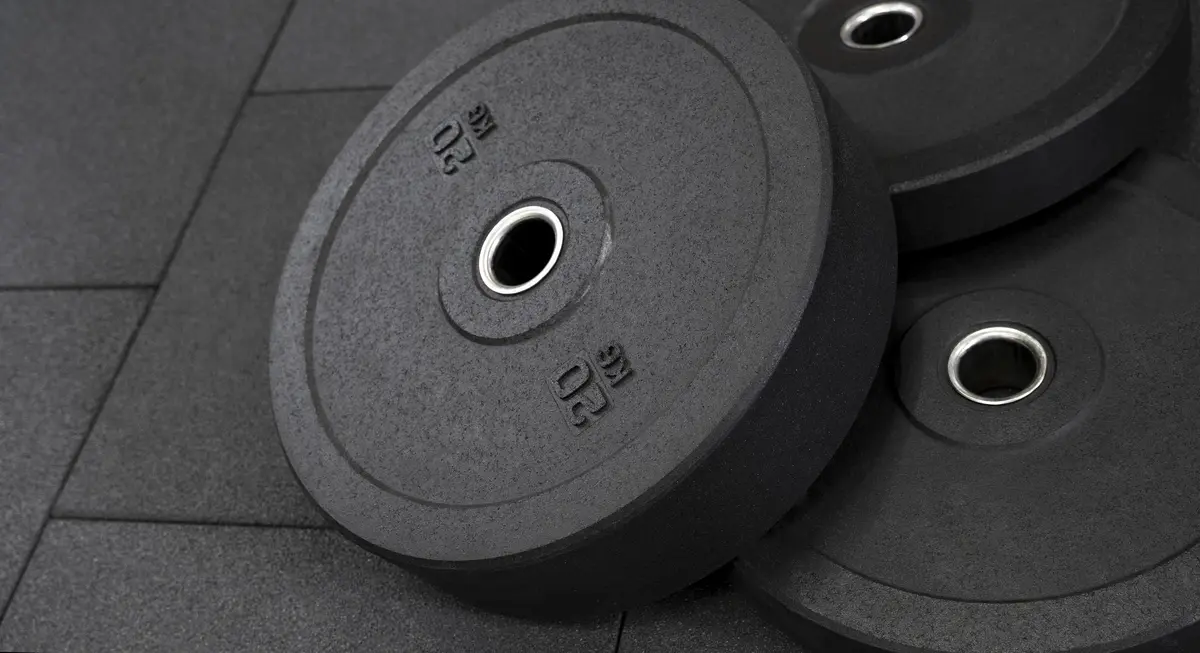
 Adding weight in progressive overload
Progressive overload can mean adding small weight plates week by week.
Adding weight in progressive overload
Progressive overload can mean adding small weight plates week by week.
Progressive Overload in Practice
Example: Beginner's 12-Week Progression
Let's see how progressive overload works in practice on the bench press:
| Week | Weight | Sets × Reps | Total volume | Change |
|---|---|---|---|---|
| 1 | 40 kg | 3×8 | 960 kg | Starting point |
| 2 | 40 kg | 3×9 | 1,080 kg | +reps |
| 3 | 40 kg | 3×10 | 1,200 kg | +reps |
| 4 | 42.5 kg | 3×8 | 1,020 kg | +weight |
| 5 | 42.5 kg | 3×9 | 1,147 kg | +reps |
| 6 | 42.5 kg | 3×10 | 1,275 kg | +reps |
| 7 | 45 kg | 3×8 | 1,080 kg | +weight |
| 8 | 45 kg | 3×9 | 1,215 kg | +reps |
| 9 | 45 kg | 3×10 | 1,350 kg | +reps |
| 10 | 47.5 kg | 3×8 | 1,140 kg | +weight |
| 11 | 47.5 kg | 3×9 | 1,282 kg | +reps |
| 12 | 47.5 kg | 3×10 | 1,425 kg | +reps |
Result: In 12 weeks, weight went from 40 kg to 47.5 kg (+18.75%)
The Double Progression Method
The most popular way to apply progressive overload is double progression:
- Choose a rep range (e.g., 8–12)
- Start at the bottom of the range (8 reps)
- Add reps each week
- When you hit the top of the range (12 reps) in all sets → increase the weight
- Restart from the bottom
Example:
- Week 1: 50 kg × 8, 8, 8
- Week 2: 50 kg × 9, 8, 8
- Week 3: 50 kg × 10, 9, 9
- Week 4: 50 kg × 11, 10, 10
- Week 5: 50 kg × 12, 12, 11
- Week 6: 50 kg × 12, 12, 12 → INCREASE WEIGHT
- Week 7: 52.5 kg × 8, 8, 8 → new cycle begins
When and How to Increase Weight
Rules for Adding Weight
Research suggests the optimal rate of weight increase depends on experience level (Ralston et al., 2017):
| Level | Weight gain/month | Example (bench) |
|---|---|---|
| Beginner (0–1 yr) | 2–5 kg/month | 60 → 80 kg/year |
| Intermediate (1–3 yr) | 1–2 kg/month | 80 → 95 kg/year |
| Advanced (3–5 yr) | 0.5–1 kg/month | 100 → 110 kg/year |
| Veteran (5+ yr) | 1–2 kg/year | 120 → 122 kg/year |
When Is the Right Time to Increase Weight?
Increase the weight when:
- You've hit your target reps in all sets
- RPE (perceived exertion) is below 8/10
- Technique remains clean throughout
- You've recovered well
Don't increase the weight if:
- The last set falls noticeably short
- Technique breaks down on the final reps
- You're fatigued or under high stress
- Recovery has been poor
How Much to Add at Once?
| Exercise | Recommended increase |
|---|---|
| Squat, deadlift | 2.5–5 kg |
| Bench press, overhead press | 1.25–2.5 kg |
| Row, pulling movements | 2.5 kg |
| Isolation exercises | 1–2.5 kg, or add reps first |
Tip: Buy 0.5 kg and 1.25 kg micro plates — they allow smaller jumps on upper body movements.
 Tracking training for progressive overload
Tracking your training is essential for making progressive overload work.
Tracking training for progressive overload
Tracking your training is essential for making progressive overload work.
Most Common Mistakes in Progression
1. Progressing Too Fast
You want to add weight every session, but your body can't adapt quickly enough. Result: injury or overtraining.
Fix: Follow the plan. Even a beginner should only progress 2–5 kg per month on big lifts.
2. No Progression at All
You're lifting the same weights for months because "they feel comfortable." No adaptation, no development.
Fix: Log every session. If the numbers haven't moved in 4–6 weeks, something needs to change.
3. Lack of Tracking
You don't remember what you did last week. How can you know whether to increase the weight?
Fix: Use a training app or a training journal. An AI workout program tracks automatically and suggests progression.
4. Sacrificing Technique for Weight
You increase the weight but range of motion shortens, momentum creeps in, your back rounds.
Fix: Weight only increases when technique stays identical. A half-rep with heavier weight is not progression.
5. Neglecting the Deload
Continuous progression without rest. The body fatigues, progression stalls, motivation disappears.
Fix: Take a deload week (50–60% of normal weights) every 4–6 weeks, or whenever you feel the need.
6. Tracking Only One Variable
You focus only on the weight and forget reps, sets, technique, and how it felt.
Fix: Track total volume (sets × reps × weight) — it's the best single measure of progression.
FAQ
What does progressive overload mean?
Progressive overload means gradually increasing the demands on your body over time. It can mean adding weight, adding reps, adding sets, or other methods of making training more challenging.
How often should I increase the weight?
A beginner can increase weight every 1–2 weeks. At the intermediate level, progression slows to every 2–4 weeks. For advanced athletes, even a small increase per month is a solid result. Use the double progression method.
Can I progress without adding weight?
Yes. You can add reps, sets, training frequency, shorten rest periods, or improve technique. All of these count as progressive overload.
What do I do when the weights stop going up?
Change the progression method: add reps instead of weight. Take a deload week. Review your recovery (sleep, nutrition, stress). Switch up your program. Plateaus are normal — don't give up.
How much weight should I add at once?
For big lifts (squat, deadlift) add 2.5–5 kg. For upper body movements, 1.25–2.5 kg. For isolation exercises, it's often better to add reps first.
Is a training journal necessary?
Absolutely. Without tracking, you have no way of knowing whether you're developing. Use an app, a spreadsheet, or a plain notebook — the important thing is that you write it down.
Summary
Progressive overload is the most important principle of muscle growth. Without it, your body has no reason to change. Here are the key takeaways:
- The principle: Systematically increase the demands — the body adapts
- The methods: Weight, reps, sets, frequency, technique, rest periods
- Double progression: Reps up → weight up → restart
- Tracking: Log every session — otherwise you won't know if you're progressing
- Patience: Even a beginner only advances 2–5 kg/month on big lifts
- Deload: Take a lighter week every 4–6 weeks
Progressive overload combined with adequate protein intake and smart programming reliably produces results.
References
-
Schoenfeld, B.J., et al. (2017). Dose-response relationship between weekly resistance training volume and increases in muscle mass: A systematic review and meta-analysis. Journal of Sports Sciences, 35(11), 1073-1082. PubMed
-
Schoenfeld, B.J. (2010). The mechanisms of muscle hypertrophy and their application to resistance training. Journal of Strength and Conditioning Research, 24(10), 2857-2872. PubMed
-
Ralston, G.W., et al. (2017). The Effect of Weekly Set Volume on Strength Gain: A Meta-Analysis. Sports Medicine, 47(12), 2585-2601. PubMed
-
Peterson, M.D., et al. (2004). Maximizing strength development in athletes: a meta-analysis to determine the dose-response relationship. Journal of Strength and Conditioning Research, 18(2), 377-382. PubMed
-
Krieger, J.W. (2010). Single vs. multiple sets of resistance exercise for muscle hypertrophy: a meta-analysis. Journal of Strength and Conditioning Research, 24(4), 1150-1159. PubMed
Want a personalized training program? Join Tsemppi — the AI tracks your progression automatically and tells you exactly when to increase the weight. Start your 7-day free trial today, no credit card required.


