

"How much do you bench?" — the eternal question of gym culture. The bench press is often the first lift every new gym-goer learns, and chest day is many people's most anticipated session of the week. But how many actually train their chest optimally? This guide gives you everything you need: anatomy knowledge, the best exercises, ready-made programs for every level, and a progression model to make your bench press go up in 2026.
Why Chest Training Requires More Than Just the Bench
My first three years in the gym I made the same mistake as most lifters: chest training meant bench press — and that was it. Three sets of bench, maybe a couple of sets with dumbbells, then biceps. My chest grew, but only up to a point.
The problem became clear when I looked at myself from the side: the lower chest was developed, but the upper chest was flat. There was none of that "full" look I was after. And the bench press stalled at 80 kg month after month.
The turning point came when I understood two things: the chest muscle has different portions that require different angles and movements, and bench pressing alone isn't enough. When I added incline press and cable fly work to my program, the chest started developing evenly — and ironically, the bench press started climbing too, because strengthening the upper chest improved the entire movement.
Now I'll help you avoid the same mistakes and build a chest that's both strong and evenly developed.
"The bench press is the king of chest training, but every king needs his court. Without incline work and isolation movements, the chest will never reach its full potential." – Pietari Risku, Founder of Tsemppi
Table of Contents
- Why Is Chest Training So Important?
- Chest Anatomy for Lifters
- Best Chest Workout Exercises
- Chest Workout Program for Beginners
- Chest Workout Program for Intermediate Lifters
- Chest Workout Program for Advanced Lifters
- Chest Training Within Different Programs
- Chest Training Progression Model
- Technique Tips for Key Exercises
- Most Common Mistakes in Chest Training
- Chest Training and Shoulder Health
- Chest Training Without a Gym
- FAQ
- Summary
Why Is Chest Training So Important?
Chest training isn't just about aesthetics — though that's a primary motivator for many. A strong chest is a cornerstone of functional pushing strength.
The Science
The chest muscle is one of the largest in the upper body, and training it delivers broad benefits:
- Improves pushing strength in all daily life and athletic situations (Stastny et al., 2017)
- Supports shoulder function — the pec is one of the primary movers of the shoulder joint
- Elevates anabolic hormone response alongside other large muscle groups
- Improves overall upper body aesthetics — a developed chest creates an athletic physique
Practical Benefits
| Benefit | Explanation |
|---|---|
| Pushing strength | Everything involving pushing: doors, carts, sports performance |
| Upper body balance | Chest + back together create a balanced upper body |
| Shoulder protection | A strong chest stabilizes the shoulder joint alongside the back |
| Bench press | The sport's benchmark — strong chest = strong bench |
| Body composition | A large muscle burns energy and creates shape in the upper body |
| Confidence | A developed chest is one of the most visible results of training |
Chest Anatomy for Lifters
The chest muscle is not one uniform muscle. Understanding anatomy is the key to balanced development.
Pectoralis Major
The main chest muscle, divided into three functional portions:
Upper Portion (Clavicular Head)
- Origin: Clavicle
- Function: Shoulder flexion (raising forward-upward) and adduction
- Key exercises: Incline press, incline dumbbell press, high cable fly
- Why it matters: Gives the chest a "full" appearance at the top and creates the connection to the shoulder. The most underdeveloped portion in most lifters.
Middle Portion (Sternocostal Head)
- Origin: Sternum
- Function: Horizontal shoulder adduction
- Key exercises: Flat bench press, mid-cable crossover
- Why it matters: The largest portion of the chest and the greatest force producer
Lower Portion (Abdominal Head)
- Origin: Abdominal fascia, lower ribs
- Function: Shoulder extension and downward adduction
- Key exercises: Decline press, dips, low cable fly
- Why it matters: Creates the definition of the chest's lower edge
Pectoralis Minor
- Location: Beneath the pec major
- Function: Pulls the shoulder blade forward and downward
- Why it matters: Often tight in desk workers — can cause shoulder problems. Stretching is important.
Serratus Anterior
- Location: On the ribs, along the side of the torso
- Function: Scapular protraction and stabilization
- Key exercises: Push-up plus, landmine press
- Why it matters: Stabilizes the shoulder blade in all pressing movements
Practical Implications of Anatomy
| Chest Portion | Activating Angle | Key Exercises |
|---|---|---|
| Upper | 30–45° incline | Incline press, incline dumbbell press, high cable fly |
| Middle | Flat (0°) | Flat bench press, cable fly, dumbbell fly |
| Lower | −15–30° decline or dip | Decline press, dips, low cable fly |
Key insight: You need different angles to develop the entire chest. Flat bench alone leaves the upper chest underdeveloped.
Best Chest Workout Exercises
Compound Movements (Prioritize These)
1. Bench Press
The undisputed king of chest training. Loads the entire chest, front delts, and triceps.
| Feature | Details |
|---|---|
| Target muscles | Mid-chest (primary), front delt, triceps |
| Type | Compound |
| Equipment | Barbell + bench press rack |
| Difficulty | Beginner–advanced |
Read the complete bench press guide.
2. Incline Bench Press
Irreplaceable for developing the upper chest. 30–45 degree angle.
| Feature | Details |
|---|---|
| Target muscles | Upper chest (primary), front delt, triceps |
| Type | Compound |
| Equipment | Barbell or dumbbells + adjustable bench |
| Difficulty | Beginner–advanced |
3. Dumbbell Press
Allows greater range of motion than the barbell and reveals side-to-side imbalances.
| Feature | Details |
|---|---|
| Target muscles | Chest (flat or incline angle), front delt, triceps |
| Type | Compound |
| Equipment | Dumbbells + bench |
| Difficulty | Beginner–advanced |
4. Dips (Chest-Focused)
Excellent for building the lower chest and overall chest mass. Bodyweight or weighted.
| Feature | Details |
|---|---|
| Target muscles | Lower chest, triceps, front delt |
| Type | Compound, bodyweight |
| Equipment | Dip station |
| Difficulty | Intermediate–advanced |
Chest dip vs. tricep dip: Lean your torso forward (about 30°) and allow elbows to flare slightly out to target the chest. An upright torso shifts focus to the triceps.
5. Machine Chest Press
A safe option that's particularly good for beginners and finishing a session.
| Feature | Details |
|---|---|
| Target muscles | Chest, front delt, triceps |
| Type | Compound, machine |
| Equipment | Chest press machine |
| Difficulty | Beginner–advanced |
Isolation Movements (Finish With These)
6. Cable Fly / Cable Crossover
The best isolation movement for the chest. Continuous tension throughout the entire range of motion — unlike dumbbells.
| Feature | Details |
|---|---|
| Target muscles | Chest (different portions by angle) |
| Type | Isolation |
| Equipment | Cable machine |
| Variations | High cable fly (lower chest), mid-cable fly, low cable fly (upper chest) |
| Difficulty | Beginner–advanced |
7. Dumbbell Fly
Classic isolation movement that stretches the chest at the bottom position.
| Feature | Details |
|---|---|
| Target muscles | Chest |
| Type | Isolation |
| Equipment | Dumbbells + bench (flat or incline) |
| Difficulty | Beginner–intermediate |
Note: The cable fly is biomechanically superior to dumbbell flyes because tension is maintained throughout the range of motion. Use dumbbell flyes only if a cable machine isn't available.
8. Pec Deck (Butterfly)
Machine version of the fly movement. Safe and easy to target precisely.
| Feature | Details |
|---|---|
| Target muscles | Chest |
| Type | Isolation, machine |
| Equipment | Pec deck machine |
| Difficulty | Beginner–advanced |
Exercise Summary
| Exercise | Primary Target | Chest Portion | Priority |
|---|---|---|---|
| Bench Press | Mid/lower chest | Full chest | ⭐⭐⭐ Highest |
| Incline Bench Press | Upper chest | Upper chest | ⭐⭐⭐ Highest |
| Dumbbell Press | Angle-dependent | Varies | ⭐⭐ High |
| Dips | Lower chest | Lower chest | ⭐⭐ High |
| Cable Fly | Angle-dependent | Varies | ⭐⭐ High |
| Dumbbell Fly | Angle-dependent | Varies | ⭐ Moderate |
| Machine Press | Full chest | Varies | ⭐ Moderate |
| Pec Deck | Full chest | Mid-chest | ⭐ Moderate |
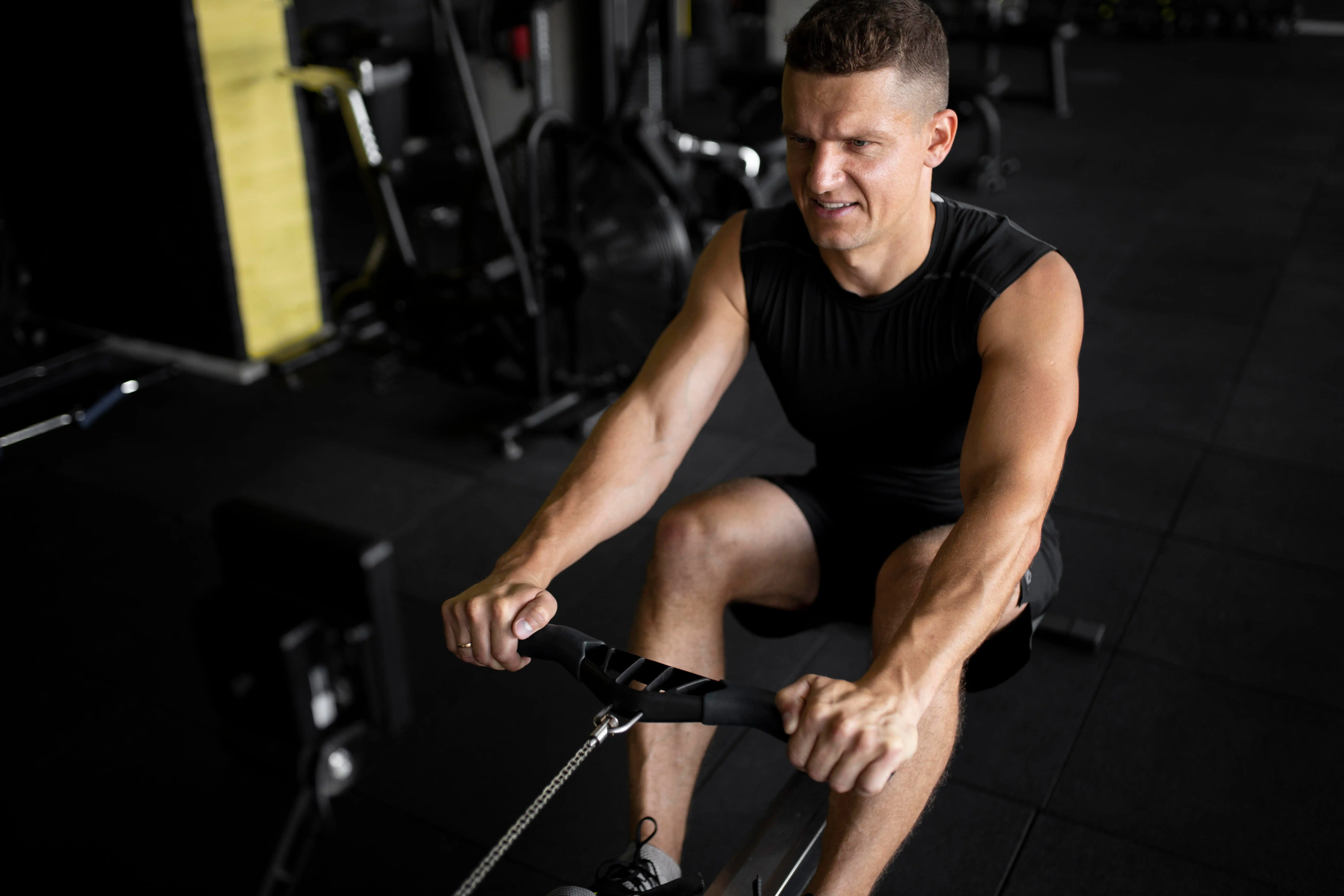 Chest workout exercises 2026
Effective chest training combines different angles and movement types into a balanced complete stimulus.
Chest workout exercises 2026
Effective chest training combines different angles and movement types into a balanced complete stimulus.
Chest Workout Program for Beginners
With less than one year of training, focus on learning bench press technique and building base strength.
Beginner Chest Workout (1× per week, dedicated chest day)
| Exercise | Sets × Reps | Rest | Notes |
|---|---|---|---|
| Barbell Bench Press | 3 × 8–10 | 2 min | Focus on technique, start light |
| Incline Dumbbell Press | 3 × 10–12 | 90 sec | 30 degrees is sufficient |
| Machine Chest Press | 3 × 10–12 | 90 sec | Great for finishing the session |
| Cable Fly (mid position) | 2 × 12–15 | 60 sec | Light weight, feel the muscle connection |
Total volume: 11 sets Duration: Approximately 35–45 minutes
Beginner Chest Work (as part of a full body program)
If you train with a full body program 3 times per week:
| Exercise | Sets × Reps | Rest |
|---|---|---|
| Bench Press | 3 × 8–10 | 2 min |
| Incline Dumbbell Press | 3 × 10–12 | 90 sec |
This gives the chest work 3 times per week, which is optimal for beginners (Schoenfeld et al., 2016).
Tips for Beginners
Learn bench press technique first. An empty bar is the best teacher. Don't add weight until the movement is under control. Read the bench press guide.
Incline press is as important as flat bench. Many beginners skip incline entirely. Add it from the start — upper chest development from the first months pays dividends.
Don't bounce the bar off your chest. A controlled descent and a light touch without bouncing is both safe and effective.
Use a spotter. Bench pressing is always safest with a spotter or safety pins in place. Never bench alone without a safety mechanism.
Chest Workout Program for Intermediate Lifters
With 1–3 years of experience, it's time to add volume, angle variation, and intensity.
Intermediate Chest Workout A (Strength Focus)
| Exercise | Sets × Reps | Rest | RPE |
|---|---|---|---|
| Barbell Bench Press | 4 × 5–7 | 2–3 min | 8 |
| Incline Dumbbell Press | 3 × 8–10 | 90 sec | 7–8 |
| Chest-Focused Dips | 3 × 8–12 | 90 sec | 8 |
| High Cable Fly (targets lower chest) | 3 × 12–15 | 60 sec | 8–9 |
Intermediate Chest Workout B (Hypertrophy Focus)
| Exercise | Sets × Reps | Rest | RPE |
|---|---|---|---|
| Incline Barbell Press | 4 × 6–8 | 2–3 min | 8 |
| Flat Dumbbell Press | 3 × 8–10 | 90 sec | 8 |
| Pec Deck or Cable Fly | 3 × 10–12 | 60 sec | 8–9 |
| Low Cable Fly (targets upper chest) | 3 × 12–15 | 60 sec | 8 |
Weekly Structure
As part of an Upper/Lower program:
| Day | Workout | Chest Component |
|---|---|---|
| Monday | Upper A | Chest Workout A (strength) + back + shoulders |
| Tuesday | Lower A | — |
| Wednesday | Rest | — |
| Thursday | Upper B | Chest Workout B (hypertrophy) + back + shoulders |
| Friday | Lower B | — |
As part of a PPL program:
Push day = chest + shoulders + triceps.
Total volume: 13–14 sets per chest session, 26–28 sets per week
Chest Workout Program for Advanced Lifters
With over 3 years of training, you need more volume, angle variation, and intensity techniques.
Advanced Chest Workout A (Strength + Mass)
| Exercise | Sets × Reps | Rest | RPE |
|---|---|---|---|
| Barbell Bench Press | 5 × 3–5 | 3–4 min | 8–9 |
| Incline Dumbbell Press | 4 × 7–9 | 2 min | 8 |
| Weighted Dips | 3 × 6–8 | 2 min | 8–9 |
| High Cable Fly (drop set) | 3 × 10–12 + drop | 60 sec | 9–10 |
Advanced Chest Workout B (Hypertrophy + Upper Chest Focus)
| Exercise | Sets × Reps | Rest | RPE |
|---|---|---|---|
| Incline Barbell Press (pause reps) | 4 × 5–7 | 2–3 min | 8–9 |
| Flat Dumbbell Press (1.5-rep method) | 3 × 6–8 | 2 min | 9 |
| Unilateral Machine Press | 3 × 10–12/side | 60 sec | 8–9 |
| Pec Deck (myo-reps) | 2 × 12–15 + 3–4 mini-sets | 60 sec | 9 |
| Low Cable Fly (upper chest) | 3 × 12–15 | 60 sec | 8 |
Advanced Techniques
Pause bench: Hold the bar against your chest for 2–3 seconds. Removes the stretch reflex, develops explosive strength, and improves bottom-position strength. Especially effective for breaking through bench press plateaus.
1.5-rep method: Press up, lower halfway, press back up, lower all the way down. Doubles chest work per rep. Excellent with dumbbell press.
Drop sets: Complete a set, reduce weight 20–30%, and continue immediately. Works especially well for cable fly and pec deck where weight changes are quick.
Pre-exhaustion: Start with an isolation movement (cable fly) before a compound movement (bench press). Pre-fatigues the chest so it becomes the weakest link in the press rather than the triceps.
Close-grip to wide-grip bench superset: Start narrow grip (tricep emphasis), immediately switch to wider grip (chest emphasis) when triceps fatigue. Effective way to maximize volume in one set.
Chest Training Within Different Programs
Full Body (3× per week)
1–2 chest exercises in every session. Suitable for beginners.
| Session | Chest Exercises |
|---|---|
| Session 1 | Bench Press 3×8 |
| Session 2 | Incline Dumbbell Press 3×10 |
| Session 3 | Machine Press 3×10, Cable Fly 2×12 |
Weekly chest volume: 11–14 sets
Upper/Lower (4× per week)
Two different chest emphases per week. Read the Upper/Lower guide.
Weekly chest volume: 22–28 sets
Push/Pull/Legs (3–6× per week)
Push day = chest + shoulders + triceps. Read the PPL guide.
| PPL Rotation | Push Day |
|---|---|
| 1× through (3 days/week) | 1 chest session per week (12–15 sets) |
| 2× through (6 days/week) | 2 chest sessions per week (24–30 sets) |
Optimal Weekly Chest Volume
| Experience Level | Sets Per Week | Recommended Distribution |
|---|---|---|
| Beginner | 10–12 | 2–3 pressing + 1–2 isolation |
| Intermediate | 14–18 | 3–4 pressing (different angles) + 2–3 isolation |
| Advanced | 18–24+ | 4–5 pressing + 3–4 isolation, angle variation |
(Schoenfeld et al., 2017)
Chest Training Progression Model
Double Progression for Chest Training
For bench press:
| Week | Bench | Reps |
|---|---|---|
| 1 | 70 kg | 6, 6, 5, 5 |
| 2 | 70 kg | 6, 6, 6, 5 |
| 3 | 70 kg | 7, 6, 6, 6 |
| 4 | 70 kg | 7, 7, 7, 6 |
| 5 | 70 kg | 7, 7, 7, 7 → INCREASE WEIGHT |
| 6 | 72.5 kg | 5, 5, 5, 5 |
For isolation movements (cable fly, pec deck):
Higher rep range (10–15) and smaller weight increments. Cable fly: add one weight stack increment when you reach the top of the range.
Linear Progression for Beginners
During the first months:
- Bench press: +2.5 kg per week (micro plates of 1.25 kg are invaluable)
- Incline press: +2.5 kg per week
- Dumbbells: +2 kg per side every 2 weeks (dumbbell jumps are larger)
Breaking Through Bench Press Plateaus
The bench press is notorious for plateaus. When progress stalls, try these:
- Add incline volume — a weak upper chest is often the limiting factor
- Pause bench — builds bottom-position strength
- Pin press / Spoto press — train the sticking point directly
- Add tricep work — triceps are often the weak link near lockout
- Take a deload — you may simply need recovery
Read more about progressive overload.
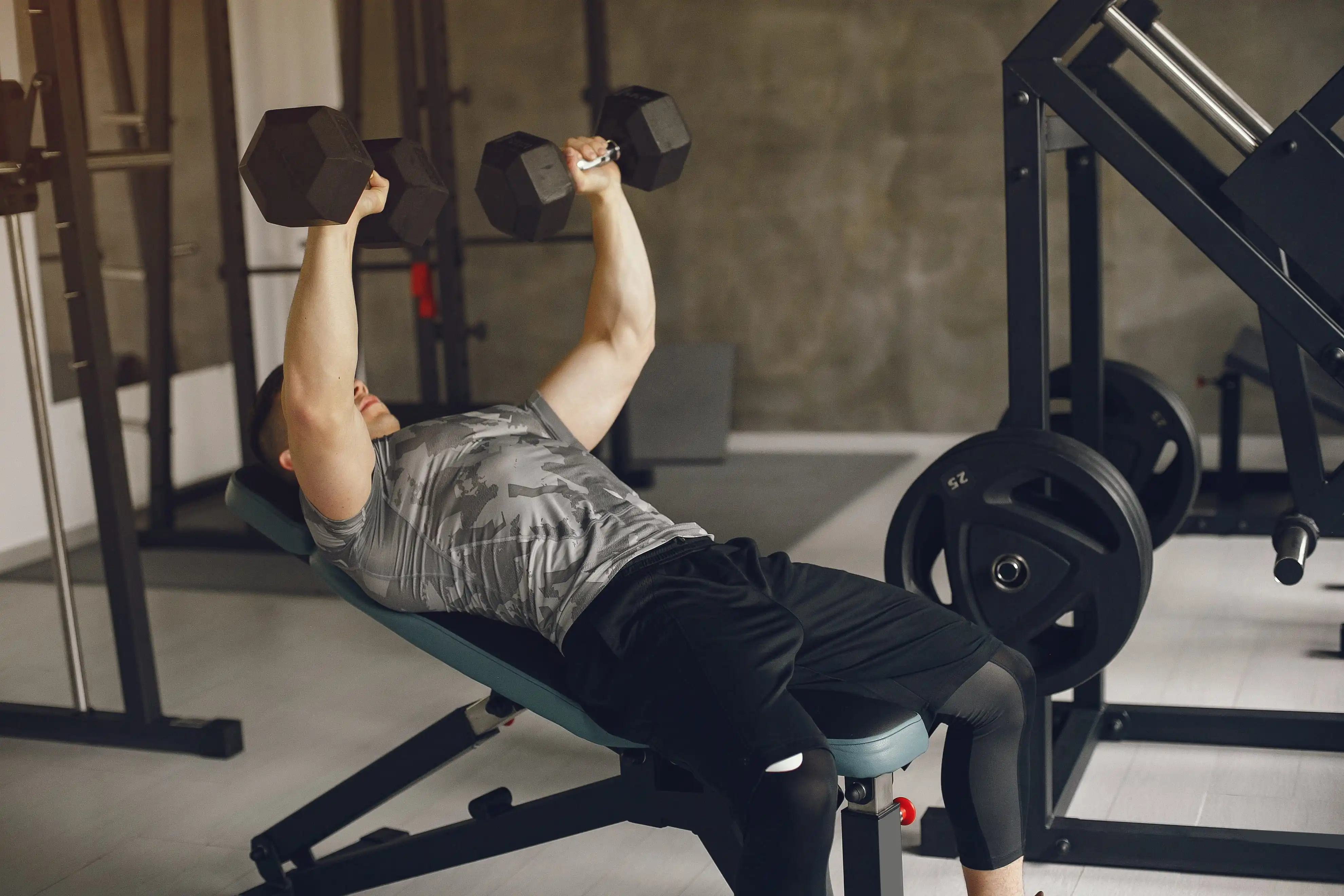 Chest workout progression 2026
Bench press progression requires patience and varied chest training — flat bench alone isn't enough.
Chest workout progression 2026
Bench press progression requires patience and varied chest training — flat bench alone isn't enough.
Technique Tips for Key Exercises
Bench Press Technique in a Nutshell
- Setup: Lie on the bench, pull shoulder blades together and down (retraction + depression). Slight arch in the lower back. Feet firmly on the floor.
- Grip: Slightly wider than shoulders. Pinky finger at the knurling ring works for most people.
- Unracking: Extend arms to lockout, move bar directly over the chest.
- Descent: Controlled lowering to the lower chest line. Elbows at about 45–75 degrees from the torso.
- Bottom position: Bar touches the chest lightly — no bouncing.
- Press: Drive explosively upward, slight arc back toward the rack. Exhale.
- Breathing: Inhale and brace the core before descent, exhale at the top of the press.
Full technique guide: Bench Press Program.
Incline Press Technique
- Angle: 30 degrees is optimal for upper chest activation. 45 degrees already shifts too much work to the shoulder (Trebs et al., 2010).
- Barbell variation: Lower bar to the upper chest (below the collarbone), not at nipple level
- Dumbbell variation: Lower dumbbells beside the upper chest, elbows slightly to the sides. Dumbbells allow greater range of motion = more stretch.
- Shoulder blades: Retract and depress — same setup as flat bench
- Avoid: Too steep an angle (over 45°), hips lifting off the bench
Cable Fly Technique
- Setup: Cable machines on both sides, set cables to desired height
- High cable fly (targets lower chest): Cables high, pull handles down-forward crossing
- Mid cable fly: Cables at mid-height, pull straight forward together
- Low cable fly (targets upper chest): Cables low, pull up-forward crossing
- Position: Step forward from between the cables, slight forward lean, slight elbow bend
- End position: Hands crossed or nearly touching — squeeze the chest in maximum contraction for 1–2 seconds
- Return: Controlled opening, feel the chest stretch
Most common mistake: Too much weight → elbows bend too much → movement becomes a press. Fix: reduce weight and keep elbow angle constant.
Dip Technique (Chest Focus)
- Grip: Shoulder-width or slightly wider
- Starting position: Arms straight, legs crossed or slightly in front
- Descent: Lean torso forward (about 30°), elbows flare slightly outward
- Depth: Lower until upper arm is parallel or slightly below
- Press: Push up and squeeze the chest at the top
- Difference from tricep dip: Chest dip = forward lean and wider elbows. Tricep dip = upright position and elbows close to the sides.
Most Common Mistakes in Chest Training
1. Only Flat Bench
Mistake: Every week, 4 sets of flat bench press, no other angles.
Fix: Add incline press (30°) to every chest session. Research shows 30-degree angle significantly increases upper chest activation compared to flat bench (Trebs et al., 2010). Start with both flat and incline from day one.
2. Shoulders Do All the Work
Mistake: In the bench press you only feel it in your shoulders, not your chest.
Fix: Pull your shoulder blades firmly together during setup and keep them there throughout the set. This "locks" the shoulders and shifts the work to the chest. Also try a slightly wider grip — it increases chest activation.
3. Bouncing the Bar Off the Chest
Mistake: The bar bounces off the chest — no control at the bottom position.
Fix: Perform controlled reps: 2–3 second descent, light touch on the chest, explosive press. Pause bench press is the best way to learn this.
4. No Leg Drive in Bench Press
Mistake: Feet just resting on the floor or dangling in the air.
Fix: Actively drive your feet into the floor. Leg drive creates stability and transfers force from the floor through the bench to the bar. It can add 5–10% to your bench press.
5. Too Narrow Exercise Selection
Mistake: Only pressing movements, no isolation exercises.
Fix: Add at least one isolation movement (cable fly or dumbbell fly) to every chest session. Isolation movements load the chest without the limitation of triceps and shoulders, enabling better muscle connection.
6. No Warm-Up
Mistake: Jumping straight to working weights on bench press.
Fix: Progressive warm-up sets. Example before 80 kg working sets: empty bar × 10, 40 kg × 8, 60 kg × 5, 70 kg × 3. This warms up the muscles, joints, and neural connections.
7. Chest-to-Back Imbalance
Mistake: Three chest exercises and one back exercise per session.
Fix: Remember push-pull balance. For every chest set, do at least one back set. Read the back workout program.
Chest Training and Shoulder Health
Chest training places significant load on the shoulder joint. Long-term health requires attention.
Why Chest-Dominant Training Can Hurt Shoulders
- The chest muscle pulls the upper arm into internal rotation and forward
- Without sufficient back work, the shoulder locks into a forward-rotated position
- Rotator cuff tendons get compressed (impingement)
- Result: pain in pressing movements, especially incline variations
Preventive Routine
Do these before every chest session (5 minutes):
| Exercise | Sets × Reps | Notes |
|---|---|---|
| Band Pull-Apart | 2 × 15 | Warms up upper back and rotator cuff |
| External rotation with band | 2 × 12/side | Activates the infraspinatus |
| Shoulder circles | 1 × 10/direction | Distributes synovial fluid |
Do these after every chest session:
| Exercise | Sets × Reps | Notes |
|---|---|---|
| Face Pull | 3 × 15–20 | Balances the pushing work of chest training |
| Doorframe chest stretch | 2 × 30 sec/side | Prevents tightening |
The Golden Rule of Posture
For every chest set, do at least one back set. This maintains push-pull balance and protects the shoulders over the long term. Read more in the shoulder workout guide.
Chest Training Without a Gym
The chest is one of the easiest muscle groups to train at home — push-ups are an effective exercise requiring no equipment.
Bodyweight Chest Workout (no equipment)
| Exercise | Sets × Reps | Rest |
|---|---|---|
| Push-up | 4 × max (or 10–20) | 60 sec |
| Decline push-up (feet elevated) | 3 × 10–15 | 60 sec |
| Wide-grip push-up | 3 × 10–15 | 60 sec |
| Diamond push-up (narrow grip) | 3 × 8–12 | 60 sec |
| Archer push-up (advanced) | 2 × 6–8/side | 90 sec |
Progression with bodyweight:
- Add reps weekly
- Slow the tempo (3-1-2: 3 sec down, 1 sec pause, 2 sec up)
- Progress to harder variations
- Add weight (backpack with weight plates)
Minimal Equipment (dumbbells + resistance band)
| Exercise | Sets × Reps | Rest |
|---|---|---|
| Dumbbell Press (on floor) | 4 × 8–12 | 90 sec |
| Incline Dumbbell Press (bench/chair) | 3 × 10–12 | 90 sec |
| Dumbbell Fly (on floor) | 3 × 12–15 | 60 sec |
| Band Fly | 3 × 15–20 | 45 sec |
| Push-up with band | 3 × 10–15 | 60 sec |
Read more about home workout programs.
FAQ
How often should I train my chest per week?
The optimal frequency is twice per week. Meta-analysis shows 2× per week produces significantly better muscle growth results than 1× per week (Schoenfeld et al., 2016). In practice this means two Push days in a PPL program or two Upper days in an Upper/Lower split.
How many chest sets per week?
Beginners 10–12 sets, intermediate 14–18 sets, advanced 18–24+ sets per week (Schoenfeld et al., 2017). Distribute volume across different angles: at least 1/3 should be incline pressing movements.
Why isn't my bench press going up?
The most common reasons: too little incline work (weak upper chest limits the lift), weak triceps (lockout fails), poor technique (shoulder blades don't stay in place), too little volume, or too much training without recovery. Try pause bench and add more tricep work.
Incline vs. flat bench — which is more important?
Both are important. If you had to choose only one: incline is more comprehensive because it activates the upper chest effectively while the mid-chest also works. Ideally both belong in your program. Start with whichever is the more important development focus for you.
Do I need decline bench press?
Not necessarily. Flat bench and especially dips already activate the lower chest effectively. Decline press is a useful addition for advanced lifters, but it's not essential. Priority order: flat bench → incline bench → dips → decline.
Is machine chest press as good as free weight bench?
Not quite. Free weights activate more stabilizing muscles and require better coordination. But machine press is an excellent addition — especially at the end of a session when stabilizers are fatigued and you want to safely load the chest.
How do I get my upper chest to grow?
Upper chest development requires targeted work: incline press at 30° (barbell or dumbbell), low cable fly (cables set low, pulling upward), and incline dumbbell fly. Start every chest session with an incline movement until the upper chest catches up with the rest.
How long should rest periods be for chest training?
For heavy compound movements (bench press, incline press): 2–3 minutes for strength recovery. For isolation movements (cable fly, pec deck): 60–90 seconds for metabolic loading. Rest periods that are too short on heavy sets reduce performance; too long on isolation moves reduce metabolic stress.
What is a good bench press target?
Common benchmarks for men: bodyweight = beginner, 1.25× bodyweight = intermediate, 1.5× bodyweight = advanced, 2× bodyweight = elite. For women: 0.5× bodyweight = beginner, 0.75× bodyweight = intermediate, 1× bodyweight = advanced.
Summary
Chest training is more than just bench pressing — it's a comprehensive upper body building project that requires different angles, movement types, and progressive loading. Remember these key points:
Chest training fundamentals:
- Train chest 2× per week — the proven optimal frequency
- Use different angles — flat bench + incline press (30°) in every session
- Combine compound and isolation — bench press + cable fly = complete development
- Don't neglect the upper chest — start every session with an incline movement
- Maintain push-pull balance — for every chest set, at least one back set
- Protect your shoulders — face pulls and warm-up before every session
Realistic goals for 2026:
| Experience Level | Bench Press Progress/Year | Chest Development |
|---|---|---|
| Beginner | +20–30 kg | Significant growth |
| Intermediate | +10–15 kg | Moderate growth |
| Advanced | +5–10 kg | Slow but steady |
Chest day is many people's favorite session of the week — make it also the most effective session of the week with the right program and technique.
Also read these guides to support your chest training:
- Bench Press Program: Technique and Programming
- Back Workout Program 2026
- Shoulder Workout Exercises
- Workout Program 2026: The Complete Guide
- Push Pull Legs Program Guide
- Progressive Overload Training
References
-
Schoenfeld, B.J., et al. (2016). Effects of Resistance Training Frequency on Measures of Muscle Hypertrophy. Sports Medicine, 46(11), 1689–1697. PubMed
-
Schoenfeld, B.J., et al. (2017). Dose-response relationship between weekly resistance training volume and increases in muscle mass. Journal of Sports Sciences, 35(11), 1073–1082. PubMed
-
Trebs, A.A., et al. (2010). An electromyography analysis of 3 muscles surrounding the shoulder joint during the performance of a chest press exercise at several angles. Journal of Strength and Conditioning Research, 24(7), 1925–1930. PubMed
-
Stastny, P., et al. (2017). Does Long-Term Clinical Electrical Stimulation Affect EMG Activation Patterns? Journal of Strength and Conditioning Research, 31(7), 1985–1993. PubMed
-
Lauver, J.D., et al. (2016). Influence of bench angle on upper extremity muscular activation during bench press exercise. European Journal of Sport Science, 16(3), 309–316. PubMed
-
Ratamess, N.A., et al. (2009). Progression Models in Resistance Training for Healthy Adults. Medicine & Science in Sports & Exercise, 41(3), 687–708. PubMed
-
Saeterbakken, A.H., et al. (2017). The Effects of Bench Press Variations in Competitive Athletes on Muscle Activity and Performance. Journal of Human Kinetics, 57(1), 61–71. PubMed
Want a personalized chest workout program? Join Tsemppi — our AI builds you a complete chest training plan based on your goals, tracks your progression, and tells you when it's time to increase the weight.


