

Wide, rounded shoulders are a goal for many — and for good reason. Well-developed shoulders improve posture, make the waist look narrower, and add upper body strength. Research shows that varied shoulder training activates all three heads of the deltoid more effectively than one-dimensional training (Campos et al., 2002).
My Experience with Shoulder Training
Shoulders were my weak point for a long time. For years I mainly did bench press and overhead press — and wondered why my shoulders looked flat from the side. It took a while to understand that the deltoid has three heads, each requiring its own attention.
The turning point came when I started systematically training the rear and lateral delts. Face pulls and lateral raises changed everything. My shoulders started looking round from every angle — not just from the front.
"The secret to shoulder training is simple: leave the ego at the door, use lighter weights, and focus on feel. The deltoid is a small muscle — it doesn't need 30 kg lateral raises to respond." – Pietari Risku, Founder of Tsemppi
Table of Contents
- Shoulder anatomy — why it matters
- Best shoulder workout exercises
- Shoulder workout programs by level
- Technique tips — how to avoid injuries
- Most common mistakes in shoulder training
- FAQ
- Summary
Shoulder Anatomy — Why It Matters
The deltoid consists of three heads, each requiring different exercises for complete development.
The Three Heads of the Deltoid
| Head | Location | Function | Best exercises |
|---|---|---|---|
| Front (anterior) | Front | Arm raises forward, pressing | Overhead press, front raises |
| Side (lateral) | Side | Arm raises to the side | Lateral raises, upright row |
| Rear (posterior) | Back | Arm moves backward | Rear delt fly, face pull |
Why All Three Heads Matter
Most athletes overemphasize the front head (bench press and overhead press) and neglect the rear and lateral. This leads to an unbalanced appearance (shoulders look flat from the side), postural problems (shoulders round forward), and injury risk (rotator cuff strain).
Best Shoulder Workout Exercises
Overhead Press
The overhead press is the king of shoulder exercises — a compound movement that activates all three heads with an emphasis on the front.
Technique:
- Stand with feet hip-width apart
- Hold the bar at shoulder width at chest height
- Press the bar straight overhead
- Lower under control
Sets and reps: 3–4 × 6–10
| Variation | Key feature |
|---|---|
| Standing barbell | Most core activation |
| Seated barbell | Easier to isolate shoulders |
| Dumbbell | Greater range of motion |
| Arnold press | Rotation activates all three heads |
Lateral Raise
The lateral raise is the best movement for developing the lateral (side) head — the one that makes shoulders look wide.
Technique:
- Stand with dumbbells at your sides
- Raise arms out to the side to shoulder height
- Keep a slight bend in the elbows
- Lower under control
Sets and reps: 3–4 × 12–15
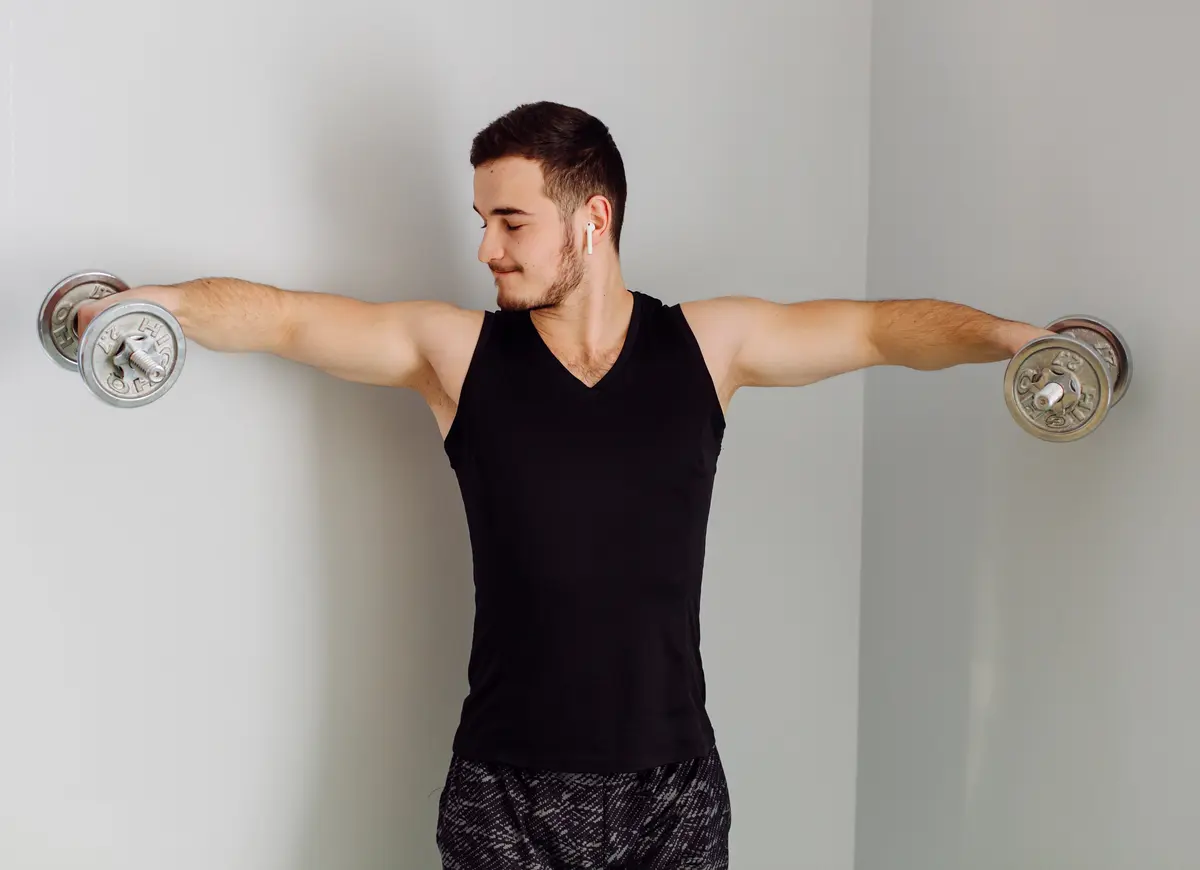 Lateral raise with correct technique
The lateral raise is the most effective exercise for developing the lateral deltoid — keep a slight bend in the elbows.
Lateral raise with correct technique
The lateral raise is the most effective exercise for developing the lateral deltoid — keep a slight bend in the elbows.
Most common mistakes:
- Weight too heavy → body English kicks in
- Arms raised too high → trapezius takes over
- Lowering too fast → eccentric phase is lost
Front Raise
Front raises target the anterior deltoid. Note: the front head already gets significant work from pressing movements, so front raises aren't strictly necessary.
Technique:
- Stand with dumbbells in front of your thighs
- Raise arms straight forward to shoulder height
- Keep arms straight or with a slight bend
- Lower under control
Sets and reps: 2–3 × 12–15
Rear Delt Fly
The rear delt is the most commonly neglected head — training it improves posture and balances the look of the shoulders.
Technique:
- Hinge the torso forward (45–90 degrees)
- Let the dumbbells hang straight down
- Raise arms out to the sides, squeezing shoulder blades together
- Lower under control
Sets and reps: 3–4 × 12–15
Face Pull
The face pull is an excellent movement for the rear deltoid and rotator cuff health.
Technique:
- Set a rope attachment at eye height on a cable
- Pull the rope toward your face with elbows high
- At the end position, rotate hands outward
- Squeeze rear delts and shoulder blades
Sets and reps: 3–4 × 15–20
Upright Row
The upright row activates both the lateral deltoid and the trapezius. Note: can stress the shoulder — use a wide grip.
Technique:
- Take a wide grip on the bar or dumbbells
- Pull the weight up along the body
- Raise elbows out to the sides, no higher than shoulder height
- Lower under control
Sets and reps: 3 × 10–12
 Overhead press with dumbbells
The overhead press is the most effective compound movement for shoulder development.
Overhead press with dumbbells
The overhead press is the most effective compound movement for shoulder development.
Shoulder Workout Programs by Level
Beginner (0–1 year of training)
Focus on the basic movements and learning technique. Read more in the beginner gym workout program.
| Exercise | Sets | Reps | Rest |
|---|---|---|---|
| Overhead press (seated, dumbbells) | 3 | 10–12 | 90 sec |
| Lateral raise | 3 | 12–15 | 60 sec |
| Face pull | 3 | 15–20 | 60 sec |
Frequency: 1–2 times per week
Intermediate (1–3 years of training)
Add volume and variation.
| Exercise | Sets | Reps | Rest |
|---|---|---|---|
| Overhead press (standing, barbell) | 4 | 6–8 | 2 min |
| Arnold press | 3 | 10–12 | 90 sec |
| Lateral raise | 4 | 12–15 | 60 sec |
| Rear delt fly | 3 | 12–15 | 60 sec |
| Face pull | 3 | 15–20 | 60 sec |
Frequency: 2 times per week
Advanced (3+ years of training)
Maximum volume and intensity.
| Exercise | Sets | Reps | Rest |
|---|---|---|---|
| Overhead press (standing) | 4 | 5–6 | 2–3 min |
| Dumbbell press (seated) | 3 | 8–10 | 90 sec |
| Lateral raise (drop sets) | 4 | 12–15 + drop | 60 sec |
| Upright row (wide grip) | 3 | 10–12 | 90 sec |
| Rear delt fly | 4 | 12–15 | 60 sec |
| Face pull | 3 | 15–20 | 60 sec |
Frequency: 2–3 times per week (distributed across different days)
Read more about progressive overload.
Technique Tips — How to Avoid Injuries
The shoulder is the most mobile joint in the body — and therefore also the most vulnerable to injury. Research shows that up to 36% of gym-goers experience shoulder pain (Kolber et al., 2010).
5 Key Technique Tips
1. Warm up properly
Before shoulder training: 5 minutes of easy rowing or arm circles, internal and external rotations with a band (15 reps each), and light lateral raises (2×15).
2. Don't raise too high
In lateral raises and upright rows, keep arms at or below shoulder height. Going higher shifts the load to the trapezius and stresses the shoulder joint.
3. Control the eccentric phase
Don't drop the weights — lower under control in 2–3 seconds. The eccentric phase is just as important for muscle growth as the concentric.
4. Avoid going too heavy on isolation movements
Technique breaks down quickly on lateral raises — use lighter weight and focus on feeling the lateral deltoid work.
5. Balance your push/pull ratio
Make sure you're doing as many pulling movements (face pulls, rear delt work) as pressing movements. This protects the shoulders and keeps posture in check.
Most Common Mistakes in Shoulder Training
1. Neglecting the Rear Delts
Most people focus only on the front head and lateral raises. Result: imbalanced shoulders and postural problems.
Fix: Include at least 2 rear delt movements in every shoulder session.
2. Ego-Lifting on Isolation Exercises
Heavy weights on lateral raises and fly movements wreck technique. The trapezius and other muscles take over.
Fix: Use a weight where you can complete 12–15 clean reps without swinging.
3. Trapezius Dominance
If you feel more in your traps than your lateral delt during lateral raises, your technique needs work.
Fix: Keep your shoulders down and focus on raising your elbows, not your hands.
4. Too Little Volume
Shoulders respond well to high training volume — they're small muscles that recover quickly.
Fix: Aim for 15–20 sets per week for advanced athletes, 10–15 for intermediate.
5. Inadequate Warm-Up
The shoulder is a sensitive joint. Training cold significantly increases injury risk.
Fix: Spend 5–10 minutes warming up before shoulder training.
FAQ
How often should I train shoulders?
Most people benefit from 2 shoulder sessions per week. Once per week is fine for beginners. Advanced athletes can split shoulder work across 3 days (e.g., front delt on push day, rear delt on pull day).
What are the best shoulder exercises for beginners?
Focus on three fundamentals: seated dumbbell overhead press, lateral raises, and face pulls. These cover all three deltoid heads safely.
Should I use heavy weights for shoulder training?
On compound movements (overhead press) you can go heavier (6–10 reps). On isolation movements (lateral raises, fly variations) lighter weights and higher reps (12–15) produce better results.
Why does shoulder training cause pain?
Common causes: inadequate warm-up, too much weight, poor technique, or neglected rear delts. If pain persists, see a physiotherapist.
Does shoulder training help with posture issues?
Yes — especially rear delt and rotator cuff training (face pulls, rear delt fly) improves posture by pulling the shoulders back.
Can I train shoulders at home?
Yes. With dumbbells or resistance bands you can do all the basic movements at home: lateral raises, front raises, rear delt fly, and Arnold press. Read more in the home workout program.
Summary
Effective shoulder training requires addressing all three deltoid heads. Here are the key takeaways:
- Variety: Train the front, lateral, and rear heads equally
- Compound movements first: Overhead press builds mass; isolation exercises finish the job
- Technique: Control the movement — don't go too heavy on isolation work
- Rear delts: Don't skip them — face pulls and rear delt fly belong in every session
- Warm up: The shoulder is a sensitive joint — always warm up thoroughly
Combine effective shoulder training with a smart AI workout program and optimal protein intake — results will follow.
References
-
Campos, G.E., et al. (2002). Muscular adaptations in response to three different resistance-training regimens: specificity of repetition maximum training zones. European Journal of Applied Physiology, 88(1-2), 50-60. PubMed
-
Kolber, M.J., et al. (2010). Shoulder injuries attributed to resistance training: a brief review. Journal of Strength and Conditioning Research, 24(6), 1696-1704. PubMed
-
Schoenfeld, B.J., et al. (2014). Effects of different volume-equated resistance training loading strategies on muscular adaptations in well-trained men. Journal of Strength and Conditioning Research, 28(10), 2909-2918.
-
Reinold, M.M., et al. (2009). Electromyographic analysis of the rotator cuff and deltoid musculature during common shoulder external rotation exercises. Journal of Orthopaedic & Sports Physical Therapy, 39(2), 75-84.
-
Wattanaprakornkul, D., et al. (2011). Direction-specific recruitment of rotator cuff muscles during shoulder flexion and extension. Clinical Biomechanics, 26(2), 126-132.
Want a personalized workout program? Join Tsemppi — the AI creates a program that adapts to your progress. Start your 7-day free trial today, no credit card required.


