

The bench press is one of the three big compound lifts — and simultaneously the most commonly performed movement with poor technique at the gym. Research suggests that up to 67% of gym-goers bench press with technique that limits results or increases injury risk (Gomo & Van Den Tillaar, 2015).
In this comprehensive guide we cover everything you need to know about the perfect bench press — technique details, programming principles, the most common mistakes, and how to safely add more weight to the bar.
My Relationship with the Bench Press
The bench press was the first "real" gym lift I learned — and the first one I got injured on. For my first few years I did everything wrong: elbows flared to 90 degrees, shoulder blades spread apart, bar bouncing off my chest. Shoulder pain was constant.
The turning point came when I started actually studying technique. I learned scapular retraction, elbow angle, and the importance of leg drive. The shoulder pain disappeared and the weights started moving up.
Now the bench press is one of my strongest lifts — and I understand why technique is so critical. This guide distills everything I've learned over the years.
"The bench press isn't just pushing upward — it's a coordinated full-body movement. When I learned that, my weights went up and the pain went away." – Pietari Risku, Founder of Tsemppi
Table of Contents
- Why Is the Bench Press So Important?
- Bench Press Fundamentals
- Perfect Technique Step by Step
- Most Common Mistakes and How to Fix Them
- Breathing and Core Tension
- Training Programs for All Levels
- Bench Press Variations
- Tips for Advanced Lifters
- Shoulder Health and Injury Prevention
- FAQ
Why Is the Bench Press So Important?
The bench press isn't just a chest exercise — it's a full upper body strength movement that develops multiple muscle groups simultaneously. The National Strength and Conditioning Association (NSCA) classifies it as one of the most effective upper body movements.
Muscles Activated
| Muscle Group | Role | Activation Level |
|---|---|---|
| Pectoralis major | Prime mover, horizontal adduction | 100% |
| Anterior deltoid | Assisting, shoulder flexion | 70–85% |
| Triceps brachii | Elbow extension | 60–75% |
| Serratus anterior | Scapular stabilization | 40–50% |
| Latissimus dorsi | Eccentric control, stabilization | 30–40% |
EMG research shows that the bench press significantly activates not only the pecs but also the shoulders and triceps, making it a true compound movement (Saeterbakken et al., 2017).
Scientifically Proven Benefits
| Benefit | Research Finding | Source |
|---|---|---|
| Upper body strength | 8 weeks of training increased 1RM by an average of 14% | Ogasawara et al. 2012 |
| Muscle mass | Pec cross-sectional area grew 11% | Schoenfeld et al. 2016 |
| Bone density | Upper body resistance training improves chest bone density | Mosti et al. 2013 |
| Functional strength | Transfers to pushing movements in sports and daily life | Cronin et al. 2003 |
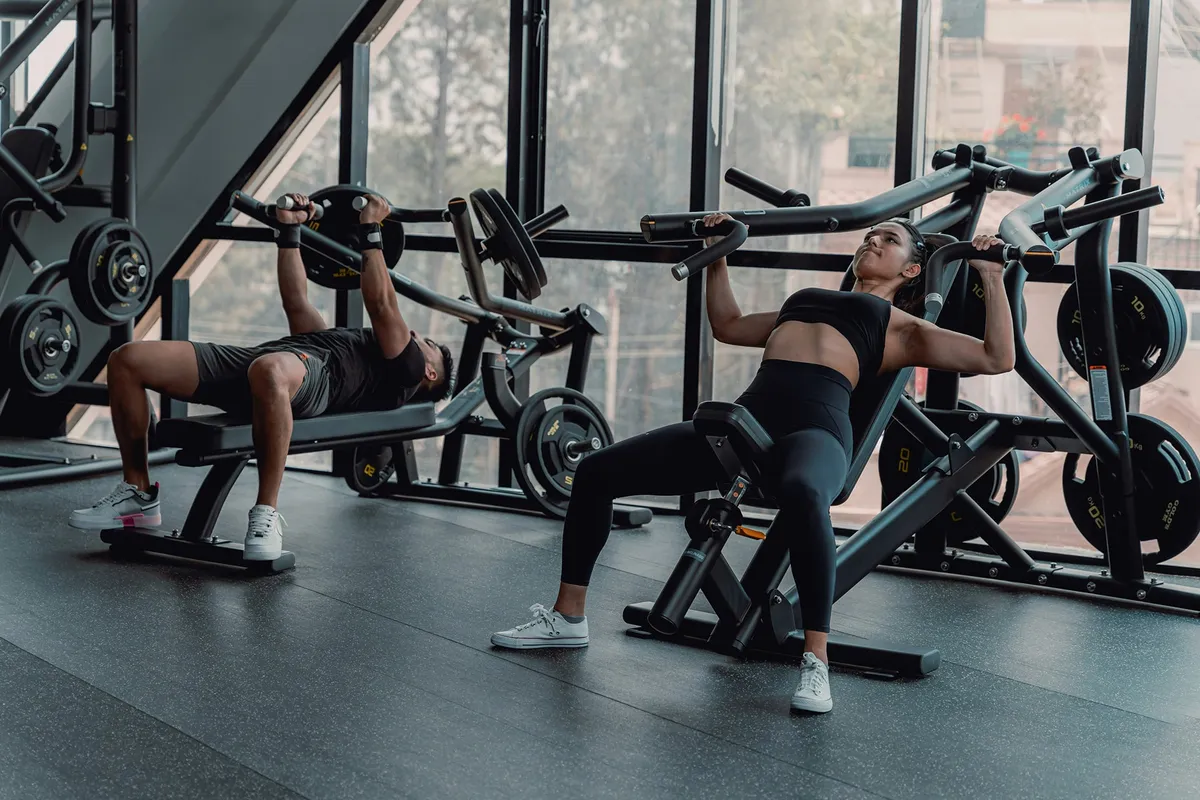 Correct bench press technique
Correct bench press setup: shoulder blades tight together, slight arch in the lower back, feet firmly on the floor.
Correct bench press technique
Correct bench press setup: shoulder blades tight together, slight arch in the lower back, feet firmly on the floor.
Bench Press Fundamentals
Before You Touch the Bar
Consider these factors before bench pressing:
Shoulder mobility:
- Can you raise your arms straight overhead?
- Is there pain or stiffness in the shoulders?
- Required mobility: 180° flexion, 90° external rotation
Thoracic spine mobility:
- Can you properly extend your upper back?
- Poor thoracic mobility → compensation at the shoulder → injury risk
Scapular control:
- Can you retract and depress your shoulder blades?
- This is the single most important technique point in the bench press
💡 Tip: Do a 5-minute shoulder warm-up before every chest session. It improves mobility and prevents injuries.
Equipment
Essential:
- Bench press rack with safety pins or a spotter
- Olympic barbell (20 kg) — appropriate thickness for grip
Recommended:
- Flat-soled shoes or bare feet (better foot drive)
- Chalk for hands (better grip)
- Wrist wraps if needed (especially with heavy loads)
Optional:
- Belt (only for maximum attempts)
- Slingshot (for overload training)
Perfect Technique Step by Step
1. Setting Up on the Bench
- Lie on your back so your eyes are directly under the bar
- Place feet firmly on the floor, knees at roughly 90 degrees
- Squeeze shoulder blades tightly together and down — this creates a stable platform
- Create a slight arch in the lower back — hips and upper back must remain in contact with the bench
- Tighten glutes and legs — "push the floor away"
2. Grip Width
- Standard grip: Ring finger on the knurling rings (81cm marks)
- Narrow grip: Pinky inside the rings (more triceps)
- Wide grip: Index finger outside the rings (more chest, but higher shoulder risk)
Research shows 1.5× shoulder width is the optimal grip for most people (Saeterbakken et al., 2017). Too wide increases shoulder stress; too narrow shifts load to the triceps.
Hand position:
- Thumbs wrapped around the bar — no thumbless grip (suicide grip)
- Bar rests in the heel of the palm, not the fingers
- Wrists straight in line with the forearms
3. Unracking the Bar
- Take a deep breath and brace your entire body
- Extend arms straight — bar directly over the shoulders
- Don't push the bar up and out — ask a spotter if needed
- Lock out the elbows and wait a moment
4. The Descent (Eccentric)
- Begin by bending the elbows — bar lowers under control
- Elbows at approximately 45–75 degrees relative to the torso (never 90°)
- Lower the bar to the lower sternum (at or just below nipple line)
- Touch the chest lightly — do not bounce
- Descent duration: 2–3 seconds
5. The Press (Concentric)
- Drive the bar up and slightly back (toward your face)
- Push your feet into the floor and squeeze your glutes — "leg drive"
- Keep shoulder blades tight — don't let them open up
- Fully extend the arms — don't aggressively lock out the elbows
- Exhale after passing the sticking point
⚠️ Note: Biomechanics research shows the bar path is curved (J-curve), not straight. The bar should travel up AND back toward the face.
Most Common Mistakes and How to Fix Them
| Mistake | Why It's Harmful | Fix |
|---|---|---|
| Elbows at 90 degrees | Shoulder impingement risk | Lower elbows to 45–75 degree angle |
| No scapular retraction | Shoulders compensate, injury risk | Squeeze shoulder blades together BEFORE unracking |
| Bar bouncing off chest | No muscle tension, injury risk | Touch chest lightly, 1-second pause |
| Hips rising off bench | Back injury risk, red-lighted in competition | Squeeze glutes, maintain bench contact |
| Wrists bent back | Wrist injury, power loss | Keep wrists straight, bar in heel of palm |
| Feet moving/floating | No leg drive, unstable base | Feet firmly planted, tension in glutes |
| Grip too wide | Shoulder overload, injury risk | Maximum 1.5–2× shoulder width |
Breathing and Core Tension
Research shows that correct breathing technique can improve bench press performance by up to 10% (Hackett et al., 2013).
Valsalva Technique for Bench Press
- Before descent: Take a deep breath into your belly (diaphragmatic breathing)
- During descent: Hold your breath, maintain tension
- At chest contact: Maximum full-body tension
- During press: Hold breath past the sticking point
- After lockout: Exhale, take a new breath
💡 Tip: Think of "filling your belly with air and pushing it outward" — this creates intra-abdominal pressure that supports the spine and increases force output.
The Tension Chain
Effective bench pressing requires whole-body tension:
- Feet driving into the floor
- Glutes contracted
- Upper back pressed into the bench
- Shoulder blades retracted and depressed
- Core braced (breath held)
- Hands squeezing the bar tightly
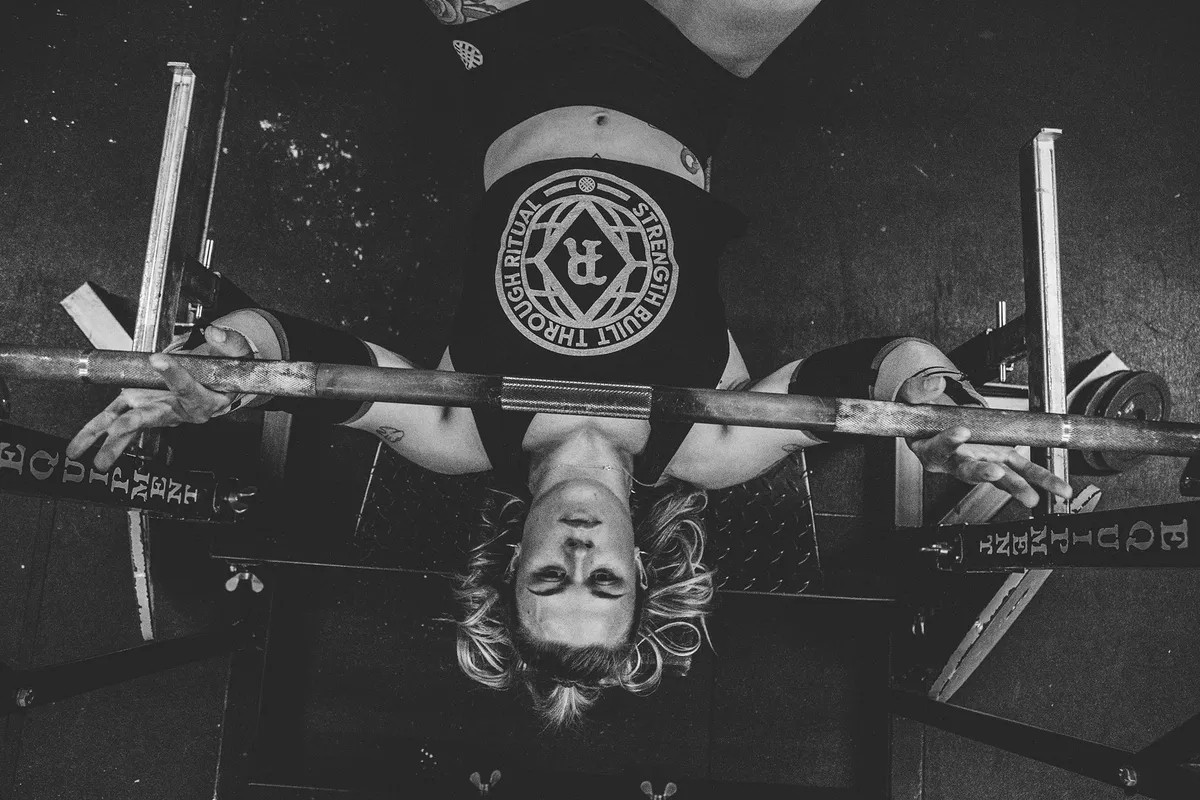 Bench press workout program
The bench press is a full-body movement — legs, glutes, back and arms all work together.
Bench press workout program
The bench press is a full-body movement — legs, glutes, back and arms all work together.
Training Programs for All Levels
Beginner (0–6 months)
Goal: Learn technique, build motor patterns and base strength
| Week | Bench Press | Accessory Work |
|---|---|---|
| 1–2 | 3×10 @ empty bar | Push-ups 3×10 |
| 3–4 | 3×10 @ 30–40 kg | Assisted dips 3×8 |
| 5–6 | 3×8 @ 40–50 kg | Machine chest press 3×12 |
| 7–8 | 4×6–8 @ progressive load | Tricep pushdown 3×12 |
Frequency: 2× per week, 72h recovery between sessions
Read more in the beginner gym workout program.
Intermediate (6–18 months)
Goal: Build strength and muscle mass systematically
Weekly structure:
| Day | Session | Sets × Reps | Intensity |
|---|---|---|---|
| Monday | Heavy bench | 5×5 | 80–85% 1RM |
| Thursday | Light/volume | 4×8–10 | 65–70% 1RM |
Accessory work (both days):
- Incline dumbbell press 3×10
- Dips (weighted) 3×8
- Tricep isolation (French press or pushdown) 3×12
Research shows that benching 2× per week produces better results than 1× per week (Grgic et al., 2018).
Advanced (18+ months)
Goal: Break personal records and address weaknesses
Periodized 4-week program:
| Week | Day 1 (Heavy) | Day 2 (Volume) | Day 3 (Variations) |
|---|---|---|---|
| 1 | 5×5 @ 78% | 4×8 @ 65% | Incline press 4×8 |
| 2 | 5×4 @ 82% | 4×8 @ 67% | Close-grip bench 4×6 |
| 3 | 5×3 @ 86% | 4×6 @ 70% | Pause bench 4×4 |
| 4 (Deload) | 3×5 @ 60% | 3×8 @ 55% | Light variations |
Read more about progressive overload.
Advanced techniques:
- Pause bench: 2–3 sec pause on the chest
- Spoto press: Bar stopped 2–3 cm above the chest
- Floor press: Bench press performed on the floor (limited ROM)
- Board press: Boards on chest (overload training)
Bench Press Variations
Incline Press
- Bench at 15–45 degree angle
- Emphasizes the upper chest and front delts
- EMG research shows 30° is optimal for upper chest activation (Trebs et al., 2010)
- Use: As an accessory lift or when upper chest is a weak point
Decline Press
- Bench at 15–30 degree decline
- Emphasizes the lower chest
- Reduces shoulder stress
- Use: When shoulders are irritated or lower chest is lagging
Close-Grip Bench Press
- Grip at shoulder width or narrower
- Significantly emphasizes the triceps
- Research shows tricep activation increases 20–30%
- Use: For tricep development and improving lockout strength
Dumbbell Press
- Greater range of motion than barbell
- Better muscle activation and stretch
- Corrects side-to-side imbalances
- Research shows 4% greater pec activation compared to barbell
- Use: For hypertrophy, as a variation, to correct asymmetries
Floor Press
- Performed on the floor instead of a bench
- Range of motion ends when elbows touch the floor
- Eliminates leg drive and bounce effect
- Use: For lockout strength development, shoulder-friendly alternative
Tips for Advanced Lifters
1. Leg Drive — Using Your Legs to Press More
Biomechanics research shows that properly applied leg drive can add 5–10% to your bench press.
Technique:
- Place feet back with heels on the floor (or toes, competition style)
- As you press, drive your feet into the floor
- Force travels from legs → hips → upper back → bar
- Hips stay on the bench — only the tension increases
2. Touch-and-Go vs. Paused
| Technique | Benefits | When to Use |
|---|---|---|
| Touch-and-Go | More volume, more reps | Hypertrophy training, volume days |
| Pause (1–2 sec) | Removes bounce effect, builds strength | Strength training, competition prep |
| Spoto Press | Builds control, shoulder-friendly | Technique work, post-injury |
3. Identifying and Fixing Weaknesses
| Weakness | How It Shows | Corrective Exercise |
|---|---|---|
| Weak off the chest | Bar won't move from chest | Pause bench, Spoto press, dumbbells |
| Weak sticking point | Bar stalls mid-rep | Pin press, board press, tempo bench |
| Weak lockout | Can't finish the rep | Floor press, close-grip bench, tricep work |
| Unstable position | Bar wobbles, feet move | Tempo bench (4-0-2-0), leg drive drills |
Shoulder Health and Injury Prevention
Research shows shoulder injuries are the most common bench press-related injury (Fees et al., 1998). The vast majority are preventable with correct technique and programming.
Shoulder Warm-Up (do this EVERY time)
- Band pull-aparts: 2×15–20
- Face pulls: 2×15–20
- External rotations: 2×12 per arm
- Shoulder circles: 10 forward, 10 backward
Read more about shoulder exercises.
Preventive Programming
- Ratio: For every pushing movement, do 1.5–2 pulling movements
- In practice: If you do 10 sets of chest work, do 15–20 sets of back work per week
- External rotators: Include every week
Warning Signs — When to Rest
- Pain at the front of the shoulder (especially when raising arm to the side)
- Clicking or grinding sensation in the shoulder
- Numbness or tingling in the arm
- Pain that radiates from the shoulder down the arm
⚠️ Note: If pain occurs, stop bench pressing and allow the shoulder to recover. See a physiotherapist if pain persists beyond 2 weeks.
FAQ
How wide should my grip be?
The optimal grip is 1.5–2× shoulder width. Research shows this maximizes pec force output while minimizing shoulder risk (Saeterbakken et al., 2017). A grip that's too wide significantly increases shoulder injury risk.
Should the bar touch my chest?
Yes, full range of motion is optimal. A meta-analysis shows that full ROM produces better hypertrophy outcomes than partial reps (Schoenfeld et al., 2017). Exception: if you have a shoulder injury, the Spoto press (stopping 2–3 cm above the chest) is a safer alternative.
How often should I bench press?
Beginners: 2× per week is sufficient as recovery capacity is still developing. Intermediate: 2–3× per week at different intensities. Advanced: 2–4× per week based on periodization.
Research shows higher frequency (2× vs. 1× per week) produces better strength outcomes (Grgic et al., 2018). Read more about recovery from training.
What's the fastest way to improve my bench press?
The fastest ways to improve:
- Fix your technique — scapular retraction, elbow angle, leg drive
- Train more frequently — 2–3× per week at varying intensities
- Strengthen your weak points — identify if the weakness is off the chest, at the sticking point, or at lockout
- Eat enough — the bench press improves when body weight increases. Read more about protein intake
Is the bench press dangerous?
The bench press is safe when technique is correct and safety equipment is used. Injuries are typically linked to excessive weight, poor technique, or missing safety pins/spotter. Always use a rack with safety pins or have a spotter.
Should my elbows be at 90 degrees?
No. Elbows at 90 degrees is the most common cause of shoulder injuries in the bench press. Biomechanics research recommends 45–75 degrees relative to the torso. This significantly reduces shoulder impingement risk.
Summary
The bench press is one of the most effective upper body movements — when done correctly. Remember these key points:
- Shoulder blades retracted — this is the single most important technique cue
- Elbows at 45–75 degrees — never 90 degrees (shoulder injury risk)
- Full-body tension — leg drive, glutes, core
- Progressive overload — add weight gradually, log every session
- Take care of your shoulders — warm up, balance with pulling work, rest when needed
The bench press isn't just pushing upward — it's a coordinated full-body movement where legs, glutes, back, shoulders, and arms all work together.
References
-
Gomo, O. & Van Den Tillaar, R. (2015). The effects of grip width on sticking region in bench press. Journal of Sports Sciences, 34(3), 232–238. PubMed
-
Schoenfeld, B.J., et al. (2016). Differential effects of attentional focus strategies during long-term resistance training. European Journal of Sport Science, 16(4), 408–414. PubMed
-
Ogasawara, R., et al. (2012). Time course for arm and chest muscle thickness changes following bench press training. Interventional Medicine & Applied Science, 4(4), 217–220. PubMed
-
Saeterbakken, A.H., et al. (2017). The effects of bench press variations in competitive athletes on muscle activity and performance. International Journal of Sports Physical Therapy, 12(6), 820–830. PubMed
-
Schoenfeld, B.J., et al. (2017). Hypertrophic effects of concentric vs. eccentric muscle actions: a systematic review and meta-analysis. Journal of Strength and Conditioning Research, 31(9), 2599–2608. PubMed
-
Grgic, J., et al. (2018). Effects of resistance training frequency on measures of muscle hypertrophy: a systematic review and meta-analysis. Sports Medicine, 48(5), 1207–1220. PubMed
-
Fees, M., et al. (1998). Upper extremity weight-training modifications for the injured athlete. American Journal of Sports Medicine, 26(5), 732–742. PubMed
-
Hackett, D.A., et al. (2013). The effect of breathing strategies on mean force during the bench press. Journal of Strength and Conditioning Research, 27(6), 1651–1657. PubMed
-
Trebs, A.A., et al. (2010). An electromyography analysis of 3 muscles surrounding the shoulder joint during the performance of a chest press exercise at several angles. Journal of Strength and Conditioning Research, 24(7), 1925–1930.
Want a personalized training program that adapts to your progress? Join Tsemppi and get an AI-powered program that tracks every lift and tells you exactly what to do next.


