

Gym training isn't just for men — and women don't need to train differently than men. Yet many women hesitate to pick up free weights or worry about "getting too bulky." The truth? Research shows that women benefit from strength training at least as much as men — and the fear of excessive muscle growth is physiologically unfounded (Roberts et al., 2020). This guide gives you everything you need for effective, results-driven gym training.
Why I Wrote a Guide for Women
"Don't lift heavy weights — you don't want to look like a man."
I heard this advice years ago from someone who wanted to start going to the gym. She ended up doing only cardio and light weights — and wondered why results never came.
This myth is one of the most persistent in the fitness world. And it's complete nonsense.
I've coached dozens of women and seen the same pattern every time: initial fear of weights, then cautious experimentation, and finally — when results start showing — a complete reversal. "Why did nobody tell me this sooner?" is a phrase I hear often.
The truth is that the same training principles work for everyone. But I also understand that women may have different goals, concerns, and questions. That's why I wrote this guide — not because women need "different training," but because I want to clear away unnecessary fears and myths.
"Strong isn't masculine. Strong is just strong. And every woman deserves to know what strength feels like." – Pietari Risku, Founder of Tsemppi
Table of Contents
- Myths about women's strength training
- Women's physiology and training
- Best exercises for women
- Workout programs by goal
- Beginner workout program for women
- Intermediate workout program for women
- Menstrual cycle and training
- Nutrition for women's muscle growth
- Most common mistakes and how to avoid them
- FAQ
- Summary
Myths About Women's Strength Training
Before we get to training programs, let's debunk the most common myths:
Myth 1: "Weights will make women too muscular"
Truth: Women have 15–20 times less testosterone than men (Vingren et al., 2010). This hormone is central to muscle growth. It is physiologically impossible for a woman to accidentally build "too much" muscle.
Those extremely muscular women you see on competition stages? They train full-time for years, eat precisely calculated amounts of food, and many use hormones. You won't end up there by accident.
Myth 2: "Women should train with light weights and high reps"
Truth: Research shows that women respond to different rep ranges the same way men do (Schoenfeld et al., 2017). If your goal is strength, train heavy. If the goal is muscle growth, use 6–12 reps. The same applies to everyone.
Myth 3: "Cardio alone is enough to get toned"
Truth: Cardio burns calories but doesn't build muscle. "Getting toned" in practice means building muscle mass while reducing fat — and strength training is the most effective way to achieve that.
Myth 4: "Women can't do pull-ups / bench press / deadlifts"
Truth: Women can do all the same movements as men. The starting point may differ, but progression works exactly the same way.
Myth 5: "Women should only focus on legs and glutes"
Truth: A balanced program develops the whole body. Upper body training improves posture, prevents injuries, and creates a proportional physique.
Women's Physiology and Training
While the same principles apply to everyone, there are some physiological differences worth understanding:
Hormonal Differences
| Factor | Women | Men | Effect on training |
|---|---|---|---|
| Testosterone | 15–70 ng/dL | 300–1,000 ng/dL | Slower muscle growth |
| Estrogen | Higher | Lower | Better recovery, less muscle damage |
| Body composition | More fat | More muscle | Different starting point |
Women's Advantages in Training
Research shows women have several advantages: better endurance within sets (women fatigue less relative to their strength — Hunter, 2014), faster recovery (women can often train at higher frequency), and better fat oxidation at rest (women use more fat as an energy source — Tarnopolsky, 2008).
Practical Implications
In practice, women may benefit from slightly higher rep ranges, can potentially train a muscle group more frequently (3× vs. 2× per week), and may find shorter rest periods between sets work well. But the fundamental principles remain the same.
Best Exercises for Women
The same fundamental movements work for everyone — but here are particularly effective exercises for women's most common goals:
Glutes and Hamstrings
| Exercise | Why it's effective | Difficulty |
|---|---|---|
| Hip thrust | Best glute activation of any exercise | Easy |
| Romanian deadlift | Hamstrings + glutes, excellent ROM | Intermediate |
| Bulgarian split squat | Excellent glute activation, corrects imbalances | Intermediate |
| Cable kickback | Good glute isolation | Easy |
| Deep squat | Comprehensive, functional | Intermediate |
Read more about the squat program.
Upper Body
| Exercise | Why it's effective | Difficulty |
|---|---|---|
| Bent-over row | Back foundation, improves posture | Intermediate |
| Lat pulldown | Wide back, V-shape | Easy |
| Bench press | Chest, shoulders, triceps | Intermediate |
| Overhead press | Shoulders, core stability | Intermediate |
| Face pull | Rear delts, posture | Easy |
Core
| Exercise | Why it's effective | Difficulty |
|---|---|---|
| Plank | Comprehensive core activation | Easy |
| Pallof press | Rotational stability | Easy |
| Hanging leg raise | Abs + hip flexors | Intermediate |
| Ab wheel rollout | Very effective but demanding | Hard |
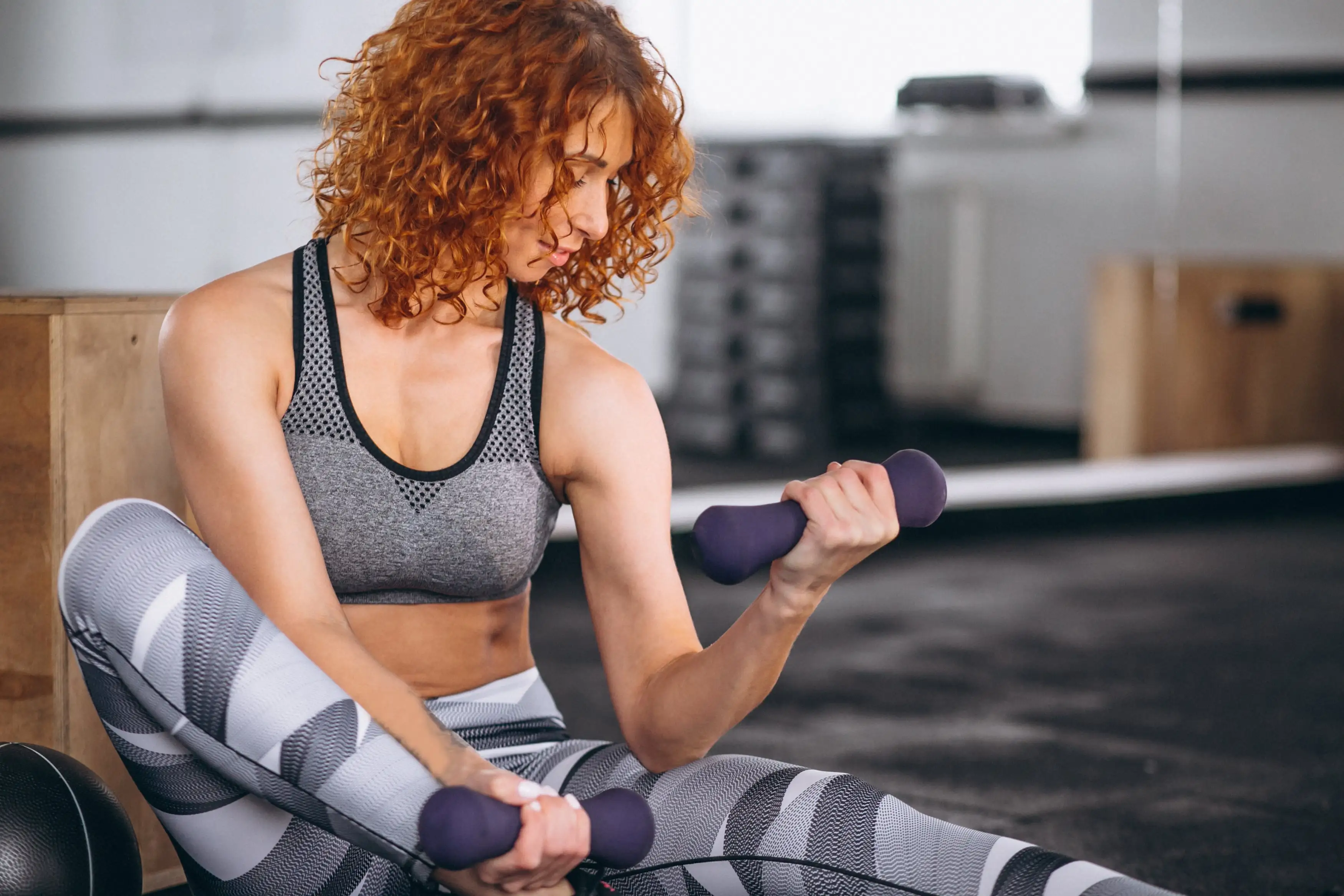 Workout program for women - best exercises
Fundamental movements like squat, deadlift, and hip thrust are the most effective exercises for women.
Workout program for women - best exercises
Fundamental movements like squat, deadlift, and hip thrust are the most effective exercises for women.
Workout Programs by Goal
Goal: Toning and fat loss
What it actually means: Maintaining/building muscle mass + reducing fat.
Training strategy: Strength training 3–4× per week, moderate volume (10–15 sets/muscle group/week), light cardio 2–3× per week, calorie deficit through diet (not excessive exercise).
Remember: You can't "spot reduce" fat from specific areas. Overall body fat decreases uniformly.
Goal: Glutes and shape
Training strategy: Glutes 3–4× per week (with different exercises), emphasis on hip thrust, Bulgarian split squat, Romanian deadlift, high volume for glutes (15–20 sets/week), rest of body at maintenance volume.
Goal: General strength and health
Training strategy: Full-body program 3× per week, fundamental movements (squat, bench, deadlift, row), progressive overload prioritized, moderate volume (10–12 sets/muscle group/week).
Goal: Maximum muscle growth
Training strategy: 4–5 training sessions per week, high volume (15–20+ sets/muscle group/week), 6–12 reps for most exercises, calorie surplus (eating more than you burn). Read more in the workout program for muscle growth.
Beginner Workout Program for Women
This program is for you if you've been training for less than 6 months or are starting now.
Program: 3× per week Full Body
Weekly structure:
- Monday: Workout A
- Wednesday: Workout B
- Friday: Workout A
- (Next week: B-A-B alternation)
Workout A — Lower body emphasis
| Exercise | Sets | Reps | Rest |
|---|---|---|---|
| Goblet squat | 3 | 10–12 | 90 sec |
| Romanian deadlift (dumbbells) | 3 | 10–12 | 90 sec |
| Hip thrust | 3 | 12–15 | 60 sec |
| Dumbbell bench press | 3 | 10–12 | 90 sec |
| Lat pulldown | 3 | 10–12 | 60 sec |
| Plank | 3 | 30–45 sec | 45 sec |
Workout B — Upper body emphasis
| Exercise | Sets | Reps | Rest |
|---|---|---|---|
| Bodyweight squat (or with bar) | 3 | 10–12 | 90 sec |
| Walking lunge | 3 | 10/leg | 60 sec |
| Dumbbell bent-over row | 3 | 10–12 | 90 sec |
| Dumbbell overhead press | 3 | 10–12 | 90 sec |
| Face pull | 3 | 15 | 45 sec |
| Crunch | 3 | 15 | 45 sec |
Progression for Beginners
Use double progression: start with a weight where you can do 10 reps cleanly, add reps each week (10 → 11 → 12), when you hit 12 reps in all sets → increase weight, restart at 10 reps with the new weight.
Expected progress in year one: Squat: +20–40 kg, Hip thrust: +30–50 kg, Bench press: +10–20 kg.
Read more in the beginner gym workout program.
Intermediate Workout Program for Women
This program suits you if you've been training 6–24 months and have solid technique on the basic movements.
Program: 4× per week Upper/Lower split
Weekly structure: Monday: Lower (strength), Tuesday: Upper (strength), Thursday: Lower (volume), Friday: Upper (volume).
Lower Body — Strength (Monday)
| Exercise | Sets | Reps | Rest |
|---|---|---|---|
| Back squat | 4 | 5–6 | 3 min |
| Romanian deadlift | 4 | 6–8 | 2–3 min |
| Hip thrust | 3 | 8–10 | 2 min |
| Bulgarian split squat | 3 | 8–10/leg | 90 sec |
| Calf raises | 4 | 12–15 | 60 sec |
Upper Body — Strength (Tuesday)
| Exercise | Sets | Reps | Rest |
|---|---|---|---|
| Barbell bench press | 4 | 5–6 | 3 min |
| Barbell bent-over row | 4 | 6–8 | 2–3 min |
| Overhead press | 3 | 8–10 | 2 min |
| Wide-grip lat pulldown | 3 | 8–10 | 90 sec |
| Face pull | 3 | 15 | 60 sec |
Lower Body — Volume (Thursday)
| Exercise | Sets | Reps | Rest |
|---|---|---|---|
| Leg press | 4 | 10–12 | 90 sec |
| Hip thrust | 4 | 10–12 | 90 sec |
| Walking lunge | 3 | 12/leg | 60 sec |
| Lying leg curl | 3 | 12–15 | 60 sec |
| Cable kickback | 3 | 15/leg | 45 sec |
| Glute bridge | 3 | 15 | 45 sec |
Upper Body — Volume (Friday)
| Exercise | Sets | Reps | Rest |
|---|---|---|---|
| Incline dumbbell press | 4 | 10–12 | 90 sec |
| Cable row | 4 | 10–12 | 90 sec |
| Lateral raise | 3 | 12–15 | 60 sec |
| Cable fly | 3 | 12–15 | 60 sec |
| Bicep curl | 2 | 12–15 | 45 sec |
| Tricep pushdown | 2 | 12–15 | 45 sec |
Progression at Intermediate Level
On strength days: add 1–2.5 kg when you complete all reps. On volume days: use double progression (10 → 12 → weight increases). Deload every 5–6 weeks (50–60% of normal weights).
Menstrual Cycle and Training
The menstrual cycle affects performance — this is a fact, not a weakness. Used wisely, you can optimize your training around the cycle.
Phases and Training
| Phase | Days | Hormones | Training recommendation |
|---|---|---|---|
| Menstruation | 1–5 | Low | Train normally if you feel ok; lighter if needed |
| Follicular phase | 6–14 | Estrogen rising | Best time for heavy training! Strength and recovery at peak |
| Ovulation | 14–16 | Peak | Excellent performance; be mindful of injury risk |
| Luteal phase | 17–28 | Progesterone rising | Reduced endurance; focus on technique and volume |
Practical Tips
Follicular phase (days 6–14): Schedule PR attempts here. You can train at higher intensity. Recovery is faster.
Luteal phase (days 17–28): Expect slightly reduced performance. Focus on technique. Don't get frustrated if weights feel heavier.
During menstruation: Listen to your body. Lighter training is fine, but many women train normally. Exercise can even help relieve cramps.
Important: These are generalizations. Learn to know your own body and respond accordingly.
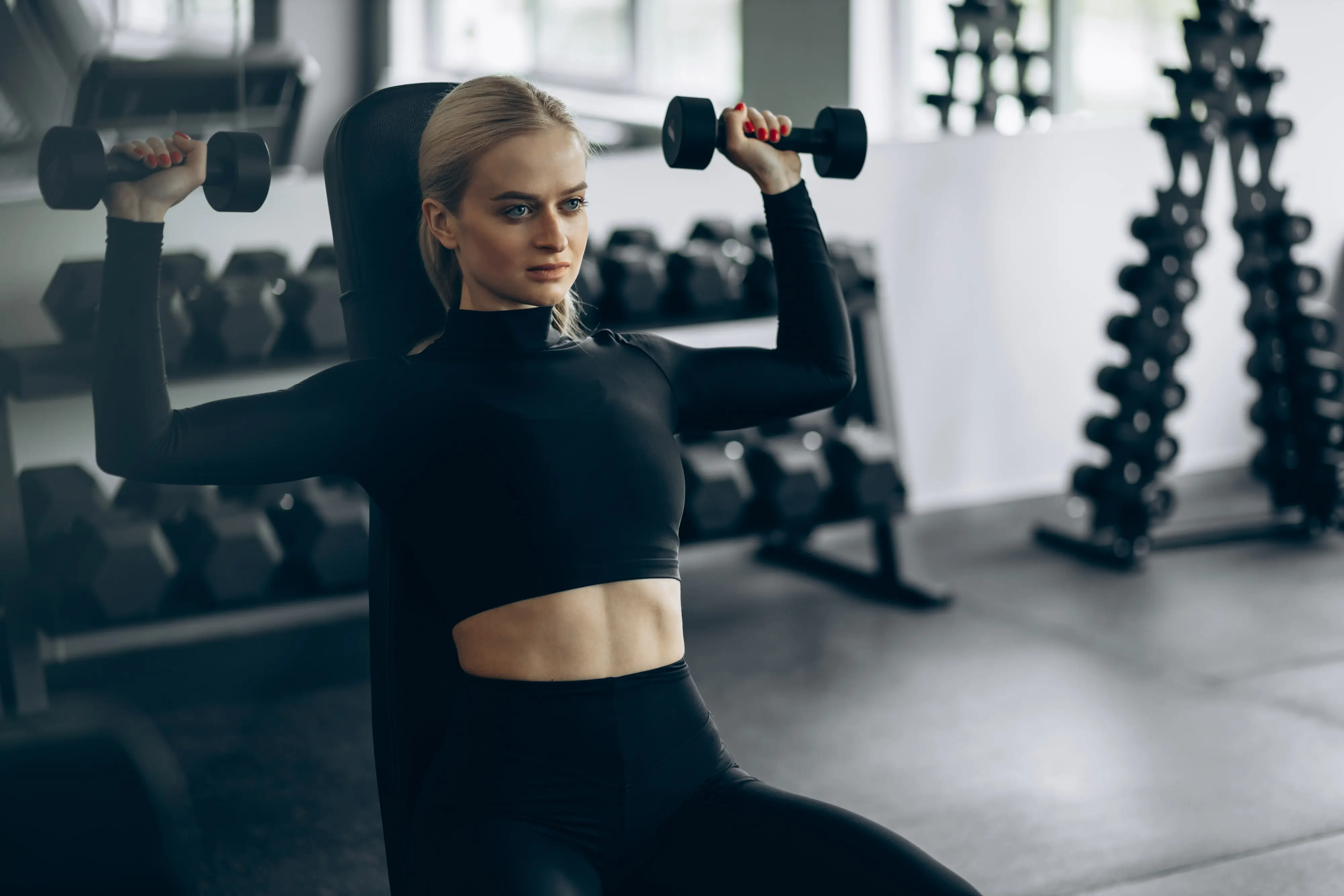 Workout program for women - results
Consistent strength training produces results — for women just as it does for men.
Workout program for women - results
Consistent strength training produces results — for women just as it does for men.
Nutrition for Women's Muscle Growth
Protein Requirements
Research suggests optimal protein intake for muscle growth is 1.6–2.2 g/kg/day (Morton et al., 2018). This applies equally to women and men.
| Weight | Protein/day | Examples |
|---|---|---|
| 55 kg | 88–121 g | 4 eggs + 200g chicken + quark |
| 65 kg | 104–143 g | 4 eggs + 250g chicken + quark + protein shake |
| 75 kg | 120–165 g | Same + extra protein shake |
Read more in the protein intake for muscle growth guide.
Calories by Goal
For muscle growth: Calorie surplus of +200–300 kcal/day. Weight gain: 0.25–0.5 kg/week (slower than men).
For toning: Calorie deficit of -300–500 kcal/day. Weight loss: 0.5–0.75 kg/week. Keep protein high (2 g/kg) to preserve muscle.
For maintenance: Eat at maintenance level. Body composition can still improve (recomp).
Special Considerations for Women
Menstruation increases iron requirements. Calcium is important for bone health. Vitamin D affects hormones and recovery.
Most Common Mistakes and How to Avoid Them
1. Weights Too Light
Fear of "getting bulky" leads to ineffective training. Fix: the last 2–3 reps should feel genuinely challenging. If you could easily do 10 more, the weight is too light.
2. Cardio Only
Hours on the treadmill but no weights. Fix: replace 50% of cardio with strength training. Results improve dramatically.
3. Only Legs and Glutes
Upper body completely neglected. Fix: a balanced program. Upper body training improves posture and the overall physique.
4. Eating Too Little
"Eating healthy" translates in practice to under-fueling. Fix: calculate your calorie needs. Ensure adequate protein. Building muscle requires energy.
5. No Progression
Same weights month after month. Fix: log your sessions. Increase weights systematically. Use a training app.
6. Comparing Yourself to Social Media
Comparing yourself to fitness influencers. Fix: remember you're seeing only the best moments, perfect lighting, and often years of work. Compare yourself only to who you were yesterday.
FAQ
How quickly can a woman build muscle?
A beginner can build 3–6 kg of muscle in the first year. After that, the rate slows to 1–3 kg/year. Men build roughly 50% more due to testosterone.
Can a woman get a six-pack?
Yes, but it requires a low body fat percentage (16–19%). This can affect the menstrual cycle and hormones. A visible six-pack isn't necessarily the healthiest goal for every woman.
Do women need to do different exercises than men?
No. The same movements work for everyone. You can emphasize certain muscle groups based on your goals, but the fundamentals (squat, bench press, deadlift, row) are the foundation for everyone.
Can you train during your period?
Yes. Most women can train normally. Exercise can even help relieve cramps. Listen to your body — a lighter session is perfectly fine if you feel unwell.
How do I prevent "bulging" thighs?
"Bulging" is generally the result of muscle growth with a fat layer on top. The solution isn't to stop training legs — it's to focus on overall body composition. As your body fat percentage drops, thighs look lean and defined.
How many times per week should a woman train?
3–4 times produces excellent results. For beginners: 3×/week. For more experienced athletes: 4–5×. Quality beats quantity.
Do you need supplements?
The essentials: protein powder (if getting enough protein from food is difficult), creatine (proven effective and safe for women too), and vitamin D (especially in northern countries). Everything else is secondary.
Summary
Women's strength training holds no mysteries — the same principles apply to everyone. But by understanding the specific aspects of women's physiology, you can optimize your training even further.
Key takeaways:
- Forget the myths — weights won't make you "too bulky"
- Train with challenging weights — light pink dumbbells won't cut it
- Focus on fundamental movements — squat, bench, deadlift, row, hip thrust
- Progression is the key — increase weights systematically
- Eat enough — especially protein (1.6–2.2 g/kg)
- Understand your cycle — schedule hard training in the follicular phase
- Be consistent — results come from weeks and months of work
Start today — if you're a beginner, begin with a 3×/week full-body program. If you're intermediate, try the upper/lower split. Most importantly: start and stay consistent.
References
-
Roberts, B.M., et al. (2020). Sex Differences in Resistance Training: A Systematic Review and Meta-Analysis. Journal of Strength and Conditioning Research, 34(5), 1448-1460. PubMed
-
Vingren, J.L., et al. (2010). Testosterone Physiology in Resistance Exercise and Training. Sports Medicine, 40(12), 1037-1053. PubMed
-
Schoenfeld, B.J., et al. (2017). Strength and Hypertrophy Adaptations Between Low- vs. High-Load Resistance Training. Journal of Strength and Conditioning Research, 31(12), 3508-3523. PubMed
-
Hunter, S.K. (2014). Sex Differences in Human Fatigability: Mechanisms and Insight to Physiological Responses. Acta Physiologica, 210(4), 768-789. PubMed
-
Tarnopolsky, M.A. (2008). Sex Differences in Exercise Metabolism and the Role of 17-Beta Estradiol. Medicine & Science in Sports & Exercise, 40(7), 1289-1296. PubMed
-
Morton, R.W., et al. (2018). A systematic review, meta-analysis and meta-regression of the effect of protein supplementation on resistance training-induced gains. British Journal of Sports Medicine, 52(6), 376-384. PubMed
-
McNulty, K.L., et al. (2020). The Effects of Menstrual Cycle Phase on Exercise Performance in Eumenorrheic Women: A Systematic Review and Meta-Analysis. Sports Medicine, 50(10), 1813-1827. PubMed
Want a personalized training program designed just for you? Join Tsemppi — the AI creates a customized program based on your goals and tracks your progression automatically. Start your 7-day free trial today, no credit card required.


