

Not all effective training requires jumping, impact, and pushing joints to their limits. Low impact training offers a way to build fitness, burn calories, and develop muscle — while protecting your joints. Research shows that low impact training can be just as effective as high-intensity exercise for improving body composition and overall health (Maillard et al., 2018). This guide gives you everything you need for effective low impact training.
Why I Chose Low Impact Training
For years I trained "hard and heavy." Jump squats, burpees, running on asphalt, heavy deadlifts — if it didn't feel brutal, it didn't feel like training.
Then my knees started complaining. First a small tightness. Then a sharp pain at the bottom of a squat. Eventually, climbing stairs felt uncomfortable.
The doctor's verdict: no serious injury, but years of cumulative loading. "You might want to consider less demanding forms of training," he said.
My first reaction was resistance. Low impact? That sounds like senior aerobics, not real training.
But when I started researching, I was surprised to find that many elite athletes use low impact training as a core part of their programs. Swimmers, cyclists, CrossFit athletes — all of them use low-load sessions for recovery and building aerobic capacity.
I tried it. I replaced some jump training with swimming and rowing. I swapped running for the exercise bike. I learned to squat without knee pain.
The results? My knees thanked me. My fitness held — and in some ways even improved. Recovery sped up. And best of all: I could train more consistently because my body wasn't constantly broken down.
"The best workout isn't the one that hurts the most. It's the one you can do year after year without your body falling apart." – Pietari Risku, Founder of Tsemppi
Table of Contents
- What does low impact training mean?
- Who is low impact training for?
- Low impact vs. high impact — differences and benefits
- The science behind low impact training
- Best low impact training modalities
- Low impact exercises: 30 effective options
- Low impact workout program for beginners
- Low impact workout program for advanced athletes
- Low impact HIIT — intensity without impact
- Low impact training for weight loss
- Most common mistakes and how to avoid them
- FAQ
- Summary
What Does Low Impact Training Mean?
Definition
Low impact training refers to exercise where:
- At least one foot stays on the ground at all times
- No jumping or impact forces on the joints
- Smoother movement patterns and controlled motions
- Less stress on joints, tendons, and connective tissue
What Low Impact Does NOT Mean
❌ It doesn't mean easy — low impact training can be extremely intense
❌ It doesn't mean ineffective — done right, it burns calories and builds muscle
❌ It doesn't mean it's only for older people — it suits everyone, including athletes
❌ It doesn't mean lazy — it requires just as much commitment as any other training
Low Impact vs. Low Intensity
These are different things:
| Low impact | Low intensity |
|---|---|
| Minimal joint impact | Low heart rate and load |
| Can be high intensity | Always low intensity |
| Example: hard sprint on a bike | Example: a gentle walk |
| Sweating hard | Not even breathing hard |
Important distinction: Low impact training can be high intensity! Sprints on a stationary bike are extremely intense but low-impact.
Who Is Low Impact Training For?
Especially recommended for:
1. Those with joint problems
- Knee, hip, or ankle issues
- Arthritis or osteoarthritis
- Joint degeneration
2. Those who are overweight
- Extra body weight stresses the joints
- Low impact reduces injury risk
- Enables consistent training
3. Beginners
- A gentler way to start exercising
- Lower injury rates
- Easier to learn proper technique
4. Those recovering from injury
- During rehabilitation
- Returning to training after injury
- Managing chronic injuries
5. Pregnant individuals
- Safer option during pregnancy
- Less strain on the pelvic floor
- Hormonal changes loosen ligaments
6. Older adults
- Protecting bones and joints
- Reducing fall risk
- Sustainable long-term training
7. Athletes in active recovery
- "Active rest" on rest days
- Building aerobic base
- Avoiding overtraining
But It Also Suits Everyone Else!
Low impact training isn't just for "special groups." It's a smart choice for anyone who wants to:
- Train consistently over the long term without injuries
- Increase training volume without overloading
- Add variety to their program
- Improve recovery
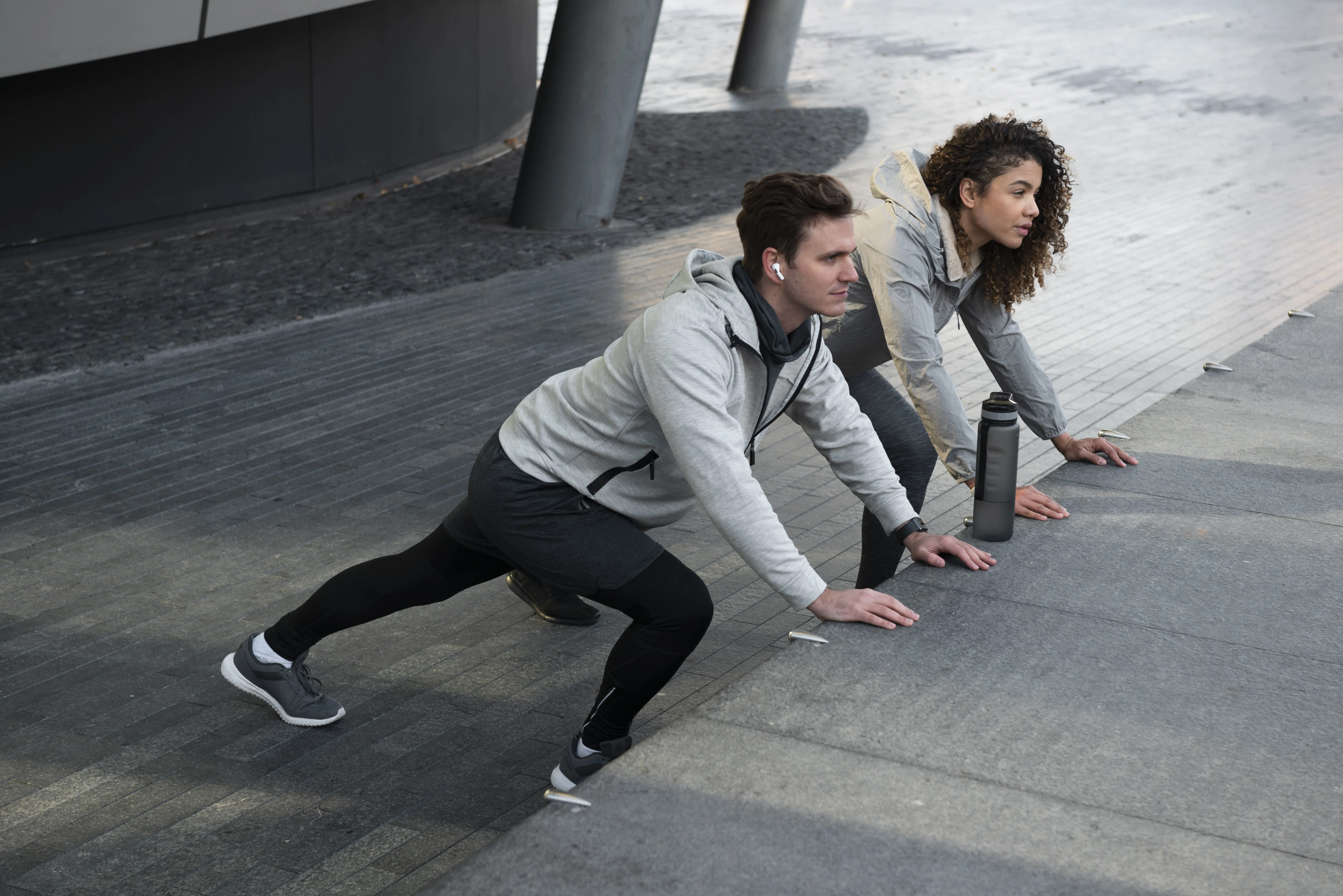 Low impact exercises
Low impact movements are highly effective while protecting the joints — a squat without a jump is a perfect example.
Low impact exercises
Low impact movements are highly effective while protecting the joints — a squat without a jump is a perfect example.
Low Impact vs. High Impact — Differences and Benefits
High Impact Training
Examples:
- Running
- Jump squats
- Burpees
- Jump rope
- Plyometrics
Benefits:
- Effectively builds bone density
- Higher calorie burn in less time
- Develops explosive power
- Functional power output
Drawbacks:
- Stresses joints, tendons, and connective tissue
- Higher injury risk
- Requires more recovery time
- Doesn't suit everyone
Low Impact Training
Examples:
- Swimming
- Cycling
- Rowing
- Walking
- Pilates/yoga
- Strength training (most movements)
Benefits:
- Joint-friendly
- Lower injury risk
- Faster recovery
- Suitable for more people
- Allows higher training frequency
Drawbacks:
- Doesn't build bone density as efficiently
- Doesn't develop explosive power
- Can feel "too easy" (even though it isn't)
Comparison Table
| Attribute | High impact | Low impact |
|---|---|---|
| Joint load | High | Low |
| Injury risk | Higher | Lower |
| Calorie burn | High | Can be equally high |
| Bone density | Builds effectively | Builds less |
| Recovery time | Longer | Shorter |
| Accessibility | More limited | Broader |
The Optimal Approach
For most people, the best approach is a combination:
- Majority of training: Low impact (70–80%)
- A portion of training: High impact (20–30%)
This captures the benefits of high impact (bone density, explosiveness) while reducing the risks.
The Science Behind Low Impact Training
Research Evidence
1. Effectiveness for fat loss
Maillard et al. (2018) compared high impact and low impact interval training in overweight women. Results showed both groups lost the same amount of fat, the low impact group had fewer injuries, and adherence was better in the low impact group.
2. Cardiovascular health
Tanaka et al. (2009) demonstrated that swimming (low impact) improves vascular function as effectively as running (high impact).
3. Muscle strength
Low impact strength training is equally effective for developing muscular strength as high impact alternatives (Schoenfeld et al., 2016). A squat without a jump builds the legs just as well as a jump squat — but places far less stress on the knees.
Why Low Impact Works
1. Progressive overload doesn't require impact
Muscles don't know whether you've jumped or not. They respond to load — and load can be increased without impact: add weight, add reps, slow the tempo, add sets.
2. Consistency beats intensity
Would you rather complete 100 lighter sessions per year or 50 hard ones (because you got injured in between)? Which produces better results?
3. Recovery is part of development
Low impact enables faster recovery → more training sessions → more results.
Best Low Impact Training Modalities
1. Swimming ⭐
Why it's excellent:
- Zero impact — water supports the body
- Full-body development
- Outstanding cardio
- Cooling — you don't feel yourself sweating
Calorie burn: 400–700 kcal/h
Best for: Joint problems, overweight individuals, back pain
2. Cycling / Stationary Bike ⭐
Why it's excellent:
- No impact — legs move in a closed chain
- Easy to adjust intensity
- Can be done indoors or outdoors
- Significantly less knee stress than running
Calorie burn: 400–800 kcal/h
Best for: Knee problems, running restrictions, endurance training
3. Rowing Machine ⭐
Why it's excellent:
- Full-body movement
- Low impact when performed correctly
- Extremely efficient calorie burner
- Develops back and legs simultaneously
Calorie burn: 500–800 kcal/h
Best for: Full-body training, those who want intense sessions
4. Walking / Nordic Walking
Why it's excellent:
- The most natural form of movement
- No equipment needed
- Can be done anywhere
- Surprisingly effective over longer distances
Calorie burn: 200–400 kcal/h
Best for: Beginners, older adults, active recovery
5. Cross-trainer / Elliptical
Why it's excellent:
- Combines the benefits of running and cycling
- Zero impact
- Arms involved = full body
- Easy to use
Calorie burn: 400–700 kcal/h
Best for: Those with running restrictions, versatile cardio
6. Pilates
Why it's excellent:
- Strengthens the core
- Improves posture
- Increases mobility
- Controlled and safe
Calorie burn: 200–400 kcal/h
Best for: Back problems, posture issues, mobility work
7. Yoga
Why it's excellent:
- Combines strength and flexibility
- Reduces stress
- Improves balance
- Breathing practice
Calorie burn: 150–350 kcal/h (depending on style)
Best for: Stressed individuals, mobility issues, holistic wellbeing
8. Strength Training
Why it's excellent:
- Most strength exercises are low impact
- Builds muscle and bone density
- Raises resting metabolic rate
- Highly adaptable
Calorie burn: 300–500 kcal/h
Best for: Everyone — strength training is the foundation of all fitness
Low Impact Exercises: 30 Effective Options
Lower Body (10 exercises)
| # | Exercise | Replaces (high impact) | Targets |
|---|---|---|---|
| 1 | Squat | Jump squat | Quads, glutes |
| 2 | Walking lunge | Jump lunge | Quads, glutes |
| 3 | Romanian deadlift | — | Hamstrings, glutes |
| 4 | Hip thrust | — | Glutes |
| 5 | Step-up | Box jump | Quads, glutes |
| 6 | Bulgarian split squat | — | Quads, glutes |
| 7 | Leg press | — | Quads |
| 8 | Leg curl | — | Hamstrings |
| 9 | Calf raises | Jump calf raises | Calves |
| 10 | Lateral lunge | Side hop | Thighs, glutes |
Upper Body (10 exercises)
| # | Exercise | Targets |
|---|---|---|
| 11 | Bench press | Chest, triceps |
| 12 | Bent-over row | Back, biceps |
| 13 | Overhead press | Shoulders |
| 14 | Lat pulldown | Back |
| 15 | Push-up | Chest, triceps |
| 16 | Cable row | Back |
| 17 | Face pull | Rear delts |
| 18 | Bicep curl | Biceps |
| 19 | Tricep pushdown | Triceps |
| 20 | Dip (machine or assisted) | Chest, triceps |
Core (5 exercises)
| # | Exercise | Replaces (high impact) | Targets |
|---|---|---|---|
| 21 | Plank | — | Full core |
| 22 | Dead bug | — | Deep abdominals |
| 23 | Bird dog | — | Back, core |
| 24 | Pallof press | — | Obliques |
| 25 | Crunch | V-up | Rectus abdominis |
Cardio (5 exercises)
| # | Exercise | Replaces (high impact) | Effectiveness |
|---|---|---|---|
| 26 | March in place | Run in place | ⭐⭐ |
| 27 | Step touch (side step) | Lateral hop | ⭐⭐ |
| 28 | High knee march | High knee run | ⭐⭐⭐ |
| 29 | Power walk | Running | ⭐⭐ |
| 30 | Slow mountain climber | Fast mountain climber | ⭐⭐⭐ |
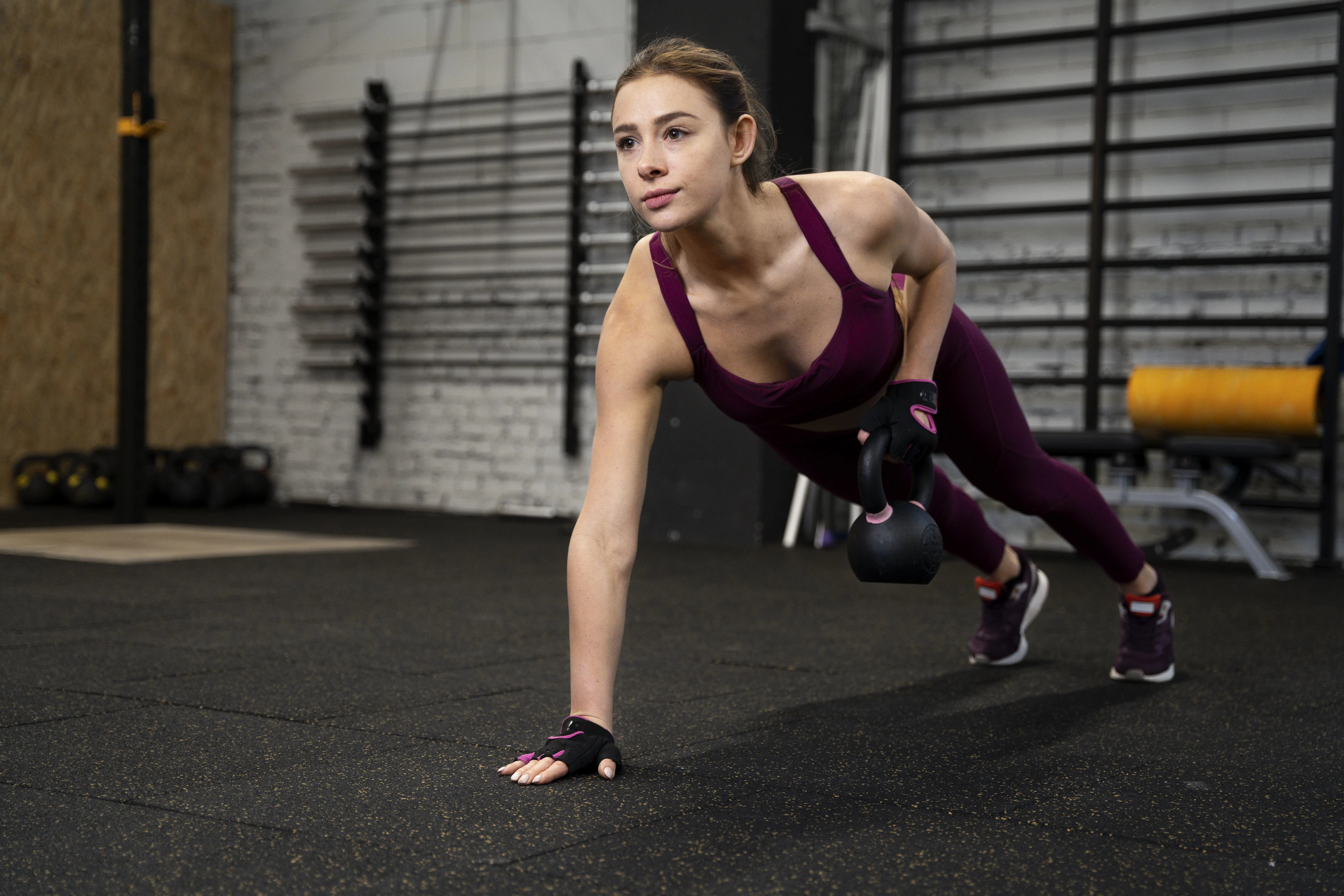 Low impact training for joints
Low impact training is joint-friendly and enables sustainable long-term exercise.
Low impact training for joints
Low impact training is joint-friendly and enables sustainable long-term exercise.
Low Impact Workout Program for Beginners
Weekly Schedule: 3 days
| Day | Session | Duration |
|---|---|---|
| Mon | Strength A + cardio | 45 min |
| Wed | Strength B + mobility | 45 min |
| Fri | Cardio + core | 40 min |
Workout A: Lower Body + Upper Body Push
| Exercise | Sets | Reps | Rest |
|---|---|---|---|
| Squat (bodyweight or weighted) | 3 | 12–15 | 60 sec |
| Push-up (or wall push-up) | 3 | 10–12 | 60 sec |
| Walking lunge | 3 | 10/leg | 60 sec |
| Overhead press (light) | 3 | 12 | 60 sec |
| Calf raises | 2 | 15 | 45 sec |
| Plank | 3 | 30 sec | 45 sec |
| Cardio: Walking or cycling | — | 15 min | — |
Workout B: Posterior Chain + Upper Body Pull
| Exercise | Sets | Reps | Rest |
|---|---|---|---|
| Romanian deadlift (light) | 3 | 12 | 60 sec |
| Bent-over row (dumbbells) | 3 | 12 | 60 sec |
| Hip thrust (bodyweight) | 3 | 15 | 60 sec |
| Lat pulldown (or resistance band) | 3 | 12 | 60 sec |
| Step-up | 2 | 10/leg | 60 sec |
| Dead bug | 3 | 10/side | 45 sec |
| Mobility: Stretching | — | 10 min | — |
Workout C: Cardio + Core
| Exercise | Duration/Reps |
|---|---|
| Warm-up: Walking/marching | 5 min |
| Cycling or elliptical (steady) | 20 min |
| Plank | 3×30 sec |
| Bird dog | 3×10/side |
| Crunch | 3×15 |
| Back extension | 3×12 |
| Cool-down: Stretching | 10 min |
Low Impact Workout Program for Advanced Athletes
Weekly Schedule: 5 days
| Day | Session | Duration |
|---|---|---|
| Mon | Strength: Lower body | 50 min |
| Tue | Cardio: Intervals (low impact) | 35 min |
| Wed | Strength: Upper body | 50 min |
| Thu | Active recovery: Swimming/yoga | 30–45 min |
| Fri | Strength: Full body + core | 55 min |
| Sat | Cardio: Long steady-state | 45–60 min |
| Sun | Rest | — |
Strength: Lower Body (Mon)
| Exercise | Sets | Reps | Rest |
|---|---|---|---|
| Back squat | 4 | 8–10 | 2 min |
| Romanian deadlift | 4 | 10–12 | 90 sec |
| Bulgarian split squat | 3 | 10/leg | 90 sec |
| Hip thrust (barbell) | 3 | 12 | 90 sec |
| Leg curl | 3 | 12–15 | 60 sec |
| Calf raises (weighted) | 4 | 15 | 60 sec |
Cardio: Low Impact HIIT (Tue)
On bike or elliptical:
| Phase | Duration | Intensity |
|---|---|---|
| Warm-up | 5 min | Easy |
| Interval | 30 sec | All-out (95%) |
| Recovery | 60 sec | Easy |
| Repeat | 10 rounds | |
| Cool-down | 5 min | Easy |
Total time: 35 min
Strength: Upper Body (Wed)
| Exercise | Sets | Reps | Rest |
|---|---|---|---|
| Bench press | 4 | 8–10 | 2 min |
| Bent-over row | 4 | 8–10 | 2 min |
| Overhead press | 3 | 10–12 | 90 sec |
| Lat pulldown | 3 | 10–12 | 90 sec |
| Face pull | 3 | 15 | 60 sec |
| Bicep curl | 2 | 12 | 60 sec |
| Tricep pushdown | 2 | 12 | 60 sec |
Strength: Full Body + Core (Fri)
| Exercise | Sets | Reps | Rest |
|---|---|---|---|
| Deadlift (trap bar or conventional) | 4 | 6–8 | 2 min |
| Dip (machine or assisted) | 3 | 10–12 | 90 sec |
| Cable row | 3 | 12 | 90 sec |
| Leg press | 3 | 12–15 | 90 sec |
| Step-up (weighted) | 3 | 10/leg | 60 sec |
| Ab wheel rollout | 3 | 10 | 60 sec |
| Pallof press | 3 | 12/side | 45 sec |
Cardio: Long Steady-State (Sat)
Choose one:
- Swimming: 45–60 min steady
- Cycling: 60–90 min (indoor or outdoor)
- Rowing: 30–45 min steady
- Hilly walk: 60–90 min
Low Impact HIIT — Intensity Without Impact
What Is Low Impact HIIT?
High-intensity interval training without jumping or impact. You get all the benefits — elevated heart rate, efficient calorie burn, afterburn effect — but without joint stress.
Low Impact HIIT at Home (20 min)
Structure: 40 sec work, 20 sec rest × 4 rounds
| Exercise | Description |
|---|---|
| 1. High knee march | Fast, knees high |
| 2. Squat | Brisk pace, no jump |
| 3. Slow mountain climber | Controlled, no jumping |
| 4. Push-up | On knees or toes |
| 5. Step touch | Quick, arms moving |
Execution:
- Rounds 1–2: Moderate pace
- Rounds 3–4: As fast as you can go
Low Impact HIIT on a Bike
| Phase | Duration | Resistance | Intensity |
|---|---|---|---|
| Warm-up | 3 min | Light | 50% |
| Interval | 20 sec | Heavy | 100% |
| Recovery | 40 sec | Light | 40% |
| Repeat | 15 times | ||
| Cool-down | 3 min | Light | 40% |
Total time: 21 min
Low Impact HIIT on a Rowing Machine
| Phase | Duration | Intensity |
|---|---|---|
| Warm-up | 3 min | Easy |
| Interval | 250m | All-out |
| Recovery | 250m | Easy |
| Repeat | 6 times | |
| Cool-down | 3 min | Easy |
Low Impact Training for Weight Loss
Why Low Impact Works for Weight Loss
1. Consistency
- Fewer injuries = more training sessions
- Better adherence over the long term
2. Recovery
- Faster recovery = ability to train more frequently
- Higher training frequency = more calories burned
3. Sustainability
- Longer sessions are possible
- Extended steady-state cardio burns fat effectively
Weight Loss Program: 5 days/week
| Day | Session | Estimated calorie burn |
|---|---|---|
| Mon | Strength + cardio | 400–500 kcal |
| Tue | Low impact HIIT (bike) | 350–450 kcal |
| Wed | Strength + cardio | 400–500 kcal |
| Thu | Long walk/cycling | 300–500 kcal |
| Fri | Strength + HIIT | 450–550 kcal |
| Sat | Active (free choice) | 200–400 kcal |
| Sun | Rest | — |
Weekly total burn: ~2,100–2,900 kcal
Sample Session (Mon/Wed/Fri)
Strength portion (30 min):
| Exercise | Sets | Reps |
|---|---|---|
| Squat | 3 | 12 |
| Bent-over row | 3 | 12 |
| Walking lunge | 3 | 10/leg |
| Push-up | 3 | 12 |
| Romanian deadlift | 3 | 12 |
| Plank | 3 | 45 sec |
Cardio portion (20 min):
- Cycling or elliptical at a steady pace
- Target heart rate: 60–70% of maximum
Don't Forget Nutrition!
Training is only part of the equation. Weight loss also requires a calorie deficit (consuming less than you burn) and sufficient protein (1.6–2.2 g/kg) to preserve muscle mass. Read more about protein intake for muscle growth.
Most Common Mistakes and How to Avoid Them
1. "Low Impact = Easy"
Mistake: Training too lightly because "it's just low impact."
Fix: Low impact doesn't mean low intensity. Raise the challenge — add weight, speed up the tempo, shorten rest periods.
2. Cardio Only
Mistake: Only swimming/cycling and forgetting about strength training.
Fix: Include strength training 2–3× per week. It's low impact and builds muscle.
3. Completely Avoiding Uncomfortable Movements
Mistake: Avoiding any movement that feels "uncomfortable."
Fix: Learn to distinguish good discomfort (exertion) from bad (pain). Modify movements when needed.
4. No Progression
Mistake: Same workout at the same load month after month.
Fix: Progressive overload works just as well in low impact training. Add weight, reps, or difficulty over time.
5. Completely Eliminating High Impact
Mistake: Never doing any high impact exercise at all.
Fix: If your health allows, include small amounts of high impact (e.g., some jogging within walks). It supports bone density.
6. Too Little Variety
Mistake: Only doing one form of low impact exercise (e.g., only cycling).
Fix: Mix different modalities — cycling, swimming, strength training, yoga. You'll develop more comprehensively.
FAQ
Can you build muscle with low impact training?
Yes! Strength training is predominantly low impact. Squats, deadlifts, bench press — they all build muscle without any jumping or impact.
Does low impact training burn enough calories?
Yes. For example, 45 minutes of brisk cycling burns 400–600 calories. Swimming can burn 500–700 calories per hour. The key is intensity and duration.
Can low impact training improve your running fitness?
Yes, to a degree. Cycling and swimming develop aerobic capacity. But if you want to run faster, you do need to run — start with small amounts and build gradually.
Is walking "real" exercise?
Absolutely. Long walks (45–90 min) are excellent low impact cardio. Add hills and increase pace to make it more challenging.
How often should I do low impact training?
You can do low impact training daily since recovery time is shorter. Three to six times per week is typical depending on intensity.
Can low impact training heal an existing injury?
Low impact doesn't "heal" an injury, but it allows you to keep training alongside an injury and during rehabilitation. For acute injuries, always follow medical advice.
What low impact modality do you recommend for beginners?
Walking and light strength training are the best starting points. They're safe, require no expensive equipment, and are easy to scale up progressively.
Summary
Low impact training isn't a compromise — it's a smart choice that enables effective training over the long term. It suits everyone, not just those with physical limitations.
Key takeaways:
- Low impact ≠ low intensity — you can train hard without impact
- Many training forms are low impact — swimming, cycling, rowing, strength training
- Strength training is the key — most strength movements are already low impact
- Consistency wins — fewer injuries = more sessions
- Progression works the same way — add weight, reps, and challenge over time
- Combination is best — low impact for the majority, a dose of high impact when possible
Getting started:
- Choose 2–3 low impact modalities (e.g., strength training + cycling + walking)
- Do strength training 2–3× per week
- Add cardio 2–3× per week
- Progressively increase intensity
- Track your progress and adjust as needed
References
-
Maillard, F., et al. (2018). Effect of High-Intensity Interval Training on Total, Abdominal and Visceral Fat Mass: A Meta-Analysis. Sports Medicine, 48(2), 269-288. PubMed
-
Tanaka, H., et al. (2009). Swimming exercise reduces arterial stiffness and enhances vasodilation in healthy adults. Journal of Applied Physiology, 107(6), 1715-1721. PubMed
-
Schoenfeld, B.J., et al. (2016). Effects of Resistance Training Frequency on Measures of Muscle Hypertrophy. Sports Medicine, 46(11), 1689-1697. PubMed
-
Garber, C.E., et al. (2011). American College of Sports Medicine position stand: Quantity and quality of exercise for developing and maintaining cardiorespiratory, musculoskeletal, and neuromotor fitness. Medicine & Science in Sports & Exercise, 43(7), 1334-1359. PubMed
-
Kohrt, W.M., et al. (2004). Physical Activity and Bone Health. Medicine & Science in Sports & Exercise, 36(11), 1985-1996. PubMed
-
Biddle, S.J.H., et al. (2015). Too much sitting and all-cause mortality: is there a causal link? BMC Public Health, 15, 635. PubMed
Want a personalized low impact training program? Join Tsemppi — the AI builds you a custom plan that automatically accounts for your limitations and goals. Start your 7-day free trial today, no credit card required.


